HIBAPRESS – MAP
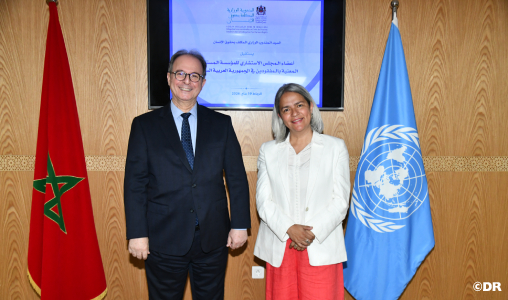
Members of the Advisory Council of the Independent Institution on Missing Persons in the Syrian Arab Republic, affiliated with the United Nations, reviewed on Tuesday in Rabat the Moroccan experience in the field of transitional justice and how to manage the reconciliation and redress phase, during a meeting with the Ministerial Delegate for Human Rights, Mohamed El Habib Belkouch.
The meeting was an opportunity to share the Moroccan experience and recall the role of the Ministerial Delegation for Human Rights as an institutional coordination mechanism with various government sectors in the field of human rights and as an interlocutor for sharing expertise with international and UN bodies. The two sides, during this meeting, stressed the importance of transitional justice as a path that takes into account the specificities of each country and its contexts, with an emphasis on benefiting from experiences and exchanging expertise in the field of revealing the fate of the missing, promoting reconciliation, and protecting human rights. In a speech on the occasion, Belkouch explained that transitional justice requires the availability of political will to enter into this experience, stressing that transitional justice does not mean democratic transition in itself, but rather contributes to pushing this transition towards advanced levels, by addressing human rights violations and seeking solutions for them, within an international accumulation that includes practices, mechanisms and agreements that have crystallized within the United Nations system in light of the experiences of a number of peoples and countries. In this regard, he reviewed a number of the specificities that distinguished the Moroccan experience in the field of transitional justice and how to manage the reconciliation and redress phase, stressing Morocco's readiness to share its experience in this field. For her part, the Assistant Secretary-General and Head of the Independent Institution on Missing Persons in the Syrian Arab Republic, Carla Quintana, reviewed the tasks of the institution and the challenges related to the missing persons file in Syria, expressing the institution's interest in benefiting from the Moroccan experience, which she described as "successful" in the field of transitional justice. She pointed out that despite the challenges facing the institution with regard to the missing persons file, there is a "window of hope" that allows today to work inside Syria and communicate with the families of the victims and the concerned parties. This meeting was an opportunity to exchange views on a number of issues related to human rights and transitional justice, in addition to reviewing experiences and expertise related to the missing persons file and mechanisms for supporting the families concerned with this file. The Advisory Council of the Independent Institution on Missing Persons in the Syrian Arab Republic is expected to hold meetings with the National Human Rights Council, and with members of the former Equity and Reconciliation Commission, in addition to human rights figures and bodies. It is noteworthy that the Independent Institution on Missing Persons in the Syrian Arab Republic was established by a decision of the United Nations General Assembly in June 2023, to determine the fate and whereabouts of all missing persons in Syria, and to support survivors and families of the missing.