This article was automatically translated from HIBAPRESS, the Arabic version:
Hibapress-Rabat
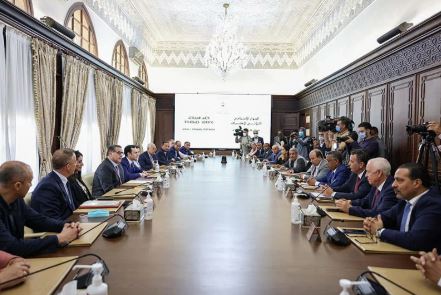
In consecration of the importance of social dialogue, which draws its reference from the high royal directives, and in application of the National Pact for the institutionalization of social dialogue, the government invited the most representative unions, the General Confederation of Morocco companies and the Moroccan Confederation of Agriculture and Rural Development to a series of meetings, chaired by the Head of Government, within the framework of the April 2025 session.
These meetings were an opportunity to take stock of the main achievements of social dialogue, to follow up on the implementation of reciprocal commitments and to sketch the contours of the next step, in particular the completion of the implementation of the two social agreements concluded with the social and economic partners, in dates of April 30, 2022 and April 29, 2024.
The holding of this session occurs in a context marked by a balance sheet rich in achievements, concretized thanks to the combination of the efforts of all the partners concerned and their positive involvement in the implementation of the results of the social agreements, which has enabled the increase in income and the improvement of the purchasing power of the workers’ class, as well as the strengthening of its social protection.
In terms of the public sector, on July 1, 2024, the first tranche of the general increase in wages set at 1000 DH monthly nets on two tranches were proceeded. This increase benefited all civil servants from public administrations, local authorities and public establishments which have not benefited from a revaluation of their wages during the general increase in wages.
In the same context, the government has ensured, thanks to sectoral dialogues, to implement a series of measures that have enabled the income of civil servants, like the National Education Sector for a global funding cost of more than 17 billion dirhams, officials from the higher education sector for a budgetary envelope of 2 billion dirhams and health officials billions of dirhams.
These measures will make it possible to bring the net monthly average of wages in the public sector to 10,100 dirhams by 2026, while it was 8,237 dirhams in 2021, and to increase the minimum net monthly salary in the public sector, which has passed in the last five years of 3000 dirhams to 4,500 dirhams, an increase of 50%. The overall cost of all of these measures will reach 45.7 billion dirhams in 2026.
In the private sector, the minimum interprofessional wage guaranteed in non -agricultural activities (SMIG) was increased by 15%, the monthly net salary thus going from 2,638.05 dirhams to 3,046.77 dirhams, a monthly increase of 408.72 dirhams.
Likewise, the agricultural minimum wage guaranteed in agricultural activities (SMAG) has been increased by 20%, the monthly net salary went from 1,859.79 dirhams to 2,255.27 dirhams, a monthly increase of 395.48 dirhams.
In the social protection component, the insured who have not accumulated 3,240 days of subscription, may benefit, for the first time, from the old -age pension, thanks to the reduction in the benefit of the benefit of this pension of 3,240 to 1320 days of contribution, and this with retroactive effect encompassing the insured persons who retired on January 1, 2023. Cumulated less than 1320 days of contributions, or their beneficiaries in the event of death, will be able to recover the share of employer contributions, in addition to their salary contributions, as was in force in the past.
In addition, the income tax regime applied to workers in the public and private sectors, was revised from January 1, 2025, relating to 6 billion dirhams, which made it possible to improve the income of the different categories of more than 400 dirhams.
In this regard, and in response to the requests made by the social and economic partners, the government has reaffirmed its determination to continue the implementation of the commitments contained in the social agreements and to open the debate on topical issues.
To this end, the Government undertakes to continue improving income in the public sector by paying the second section of the general increase in wages in the amount of 500 dirhams in July 2025. In the private sector, the increase in the guaranteed minimum wage in non -agricultural and agricultural activities of a rate of 5%will be increased, which will enter into force respectively on January 1 and April 1, 2026 By 2028, through the study of means and measures capable of implementing this commitment.
As part of the processing of categorical files, it was agreed between the Ministry of the Interior and the unions concerned, to continue the discussions about the particular status of local authorities in order to achieve adequate solutions to questions relating to this status which concerns more than 84,000 officials. A new meeting is scheduled for May 13, 2025.
The government is also committed to opening the debate around the revision of the particular statutes of certain bodies (engineers, administrators, technicians, labor inspectors, etc.) with a view to improving the working conditions of these categories.
Regarding labor laws, in particular those relating to trade union organizations and the amendment of the Labor Code, the government is committed to setting up specialized commissions including representatives of all partners, who will look at the development of consensual moldings of these texts, meeting the expectations of social and economic partners.
The session of the social dialogue of April 2025 was also an opportunity to initiate a responsible dialogue around the reform of pension plans which led to an agreement of the social and economic partners for the creation of a national commission for the reform of pension plans which will work to set up a consensual vision of the reform, taking into consideration the fundamental principles agreed within the framework of the social agreement of April 2024.
The consecration of the institutionalization of social dialogue being dependent on the regularity of the sectoral dialogue, all the government departments are invited to continue dialogue with the social and economic partners with a view to achieving efficient and achievable solutions to the questions that arise, so as to answer the aspirations of workers. In this regard, a circular from the Head of Government will be disseminated to the sectors concerned and the head of government will ensure the follow -up of the results of these sectoral dialogues.