HIBAPRESS – W.M.A.
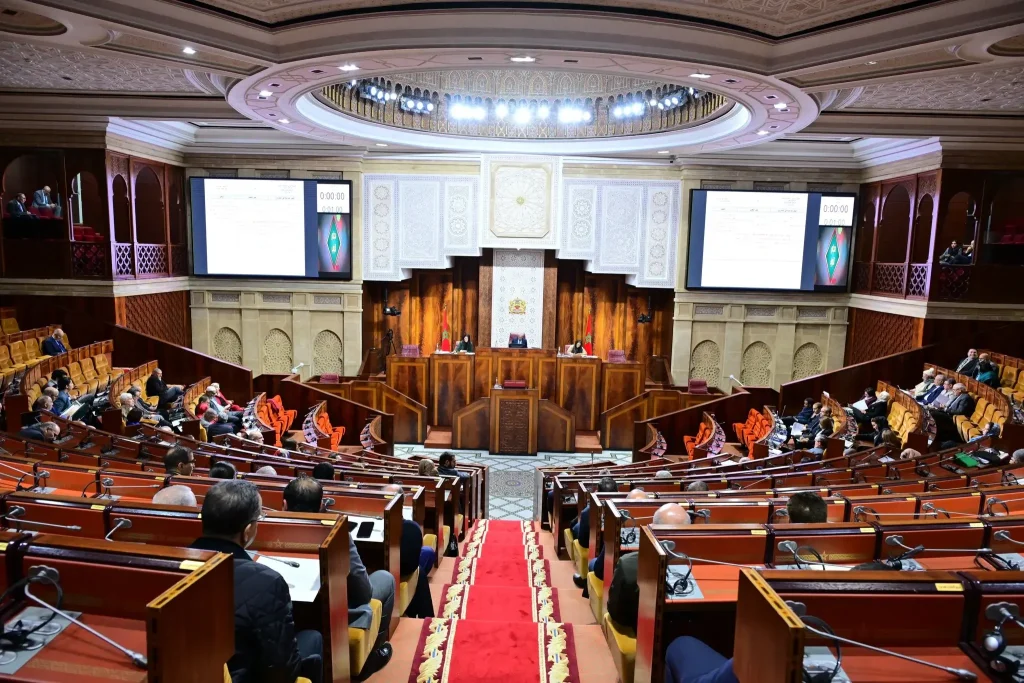
The House of Representatives, in a legislative session held today, Tuesday, approved by a majority vote, Bill No. 54.23 amending and supplementing Law No. 65.00 related to basic mandatory health insurance and establishing special provisions.
The bill received the approval of 95 parliamentarians, while 40 others opposed it. In a presentation of this legislative text, the Minister of Health and Social Protection, Amin Tahraoui, confirmed that it comes within the context of implementing Framework Law No. 09.21 related to social protection, especially articles 15 and 18, with the aim of adopting a single body to manage basic mandatory health insurance and ensure the convergence of its components. The Minister explained that the project provides for assigning the management of the basic mandatory health insurance system for the public sector, which was managed by the National Fund for Social Welfare Organizations, to the National Social Security Fund, so that the basic mandatory health insurance systems are managed by a single body. He said that the agreements concluded with mutual aid associations will continue for a period determined by a decree, with the continued benefit of the insured and their beneficiaries within the framework of the third payer, in accordance with an agreement concluded for this purpose, indicating that the concerned employees are transferred and integrated by operation of law and automatically, with the continuation of their enrollment in the basic and supplementary insurance and pension systems. On the other hand, Mr. Tahraoui confirmed that there is no need to maintain the health insurance system for students in the context of generalizing basic mandatory health insurance, as most students can benefit from health coverage as beneficiaries of the main insured, or by automatically transferring them to the “Amo solidarity” system if they do not benefit as beneficiaries. According to the Minister, the project provides for extending the age of beneficiaries of unmarried children who are studying to 30 years instead of 26, adding that it also provides for enabling foreign students to benefit from basic mandatory health insurance, under an agreement concluded between the National Social Security Fund and the governmental authorities and the concerned institutions and bodies. For its part, the majority groups noted that the legislative text "responds to objective needs created by the implementation of the generalization of basic mandatory health insurance, and aims to move from multiple and fragmented systems to a logic of effective integration and harmony", considering that it ensures in its provisions the guarantee of justice in access to services, achieving financial sustainability, and unifying management and governance mechanisms. It also considered that this text responds to an objective diagnosis of the imbalances recorded in the health system, in order to ensure efficiency and sustainability, and to overcome the overlap of jurisdictions, and to move the system "from a mere formal amendment to a substantive and fundamental amendment in the national framework for social protection". She pointed out that strengthening the governance of the mandatory health insurance system by unifying the management of insurance systems "is not limited to a technical dimension only, but carries deep strategic dimensions to raise the economic efficiency of the health system, improve management efficiency, simplify procedures, reduce disparities, and strengthen the principle of equality in access to health services". On the other hand, the majority said that "the evaluation of the overall provisions of the project does not exempt from confirming a number of key points for the success of this workshop", particularly recalling "the institutional readiness for the integration process", and highlighting that the absorption of a large number of new insured, especially from public sector employees, by the National Social Security Fund poses a set of challenges". According to the majority of deputies, these challenges relate to human resources and technical structures at the level of the smooth processing of files to avoid any confusion that may affect the rights of the insured, and to avoid what it considered "legitimate fears raised about reducing the level of services, in the counterpart of their number, which will be the responsibility of one institution", as well as the continuous evaluation of the social and economic impact of integration with the generalization of all means capable of doing so. For its part, the opposition groups stopped at a set of challenges that they considered "would complicate the process of integrating the two funds", referring to "clear differences and differences between the systems of the two funds", highlighting that "each fund has a special system in terms of the quality of services, contribution and deduction rates, coverage and compensation rates, as well as the deadlines for processing files, and special difficulties in managing long-term care files and costly diseases". They also warned that financial challenges also arise, considering that they "may constitute a real obstacle to the success of this integration, especially as the National Fund for Social Welfare Organizations recorded a financial deficit of 1.28 billion dirhams in 2023". They questioned what it could constitute of an additional burden on the finances of the National Social Security Fund and its financial sustainability. The opposition pointed to the technical and structural challenges related to the difficulty of managing the National Social Security Fund for the huge number of insured files after the integration of the two funds, warning that "it may negatively affect the quality of services, and cause delays in processing files and the insured's recovery of their compensation". She noted that the project "was not accompanied by a precise assessment study of the results of the management of the previous systems, especially the experience of the National Fund for Social Welfare Organizations, which played a pivotal role in securing wide categories of employees, students and others, as well as the current experience in managing the basic mandatory health insurance system".