HIBAPRESS – w.m.a.
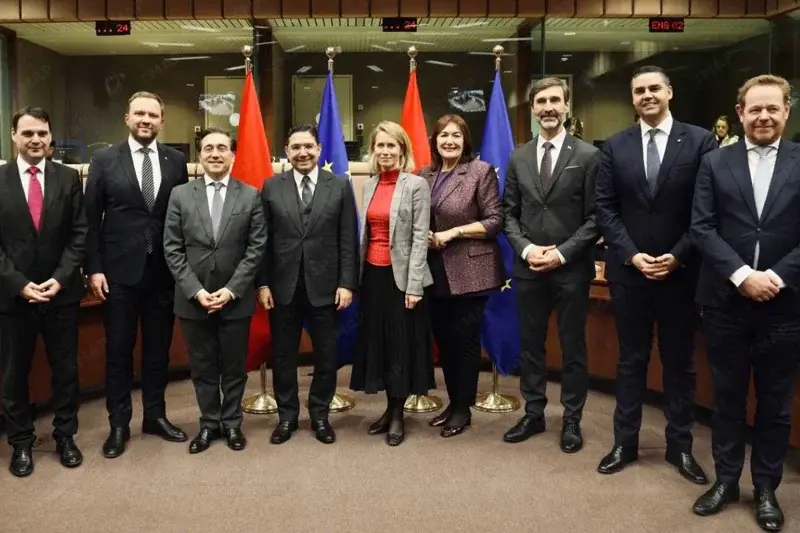
Nasser Bourita, Minister of Foreign Affairs, African Cooperation and Moroccan Expatriates, affirmed that Morocco is strongly determined to move forward alongside the European Union, with the aim of establishing a deeper, more strategic, and more resilient partnership.
Bourita explained, in a speech delivered on the occasion of the fifteenth session of the Morocco-European Union Partnership Council, held on Thursday in Brussels, that this is about "a partnership that serves our peoples, ensures our common prosperity, and consolidates stability in our common space." In this context, Bourita affirmed that "Morocco, driven by the steadfastness of its commitment and the vision of His Majesty the King, does not offer the European Union mere expectations, but a tangible strategic offer that is stability, integration, competitiveness, growth, connectivity, and a bridge to the south of the Mediterranean and Africa," pointing out that "Morocco and the European Union, thanks to more than half a century of cooperation, partnership, and joint bilateral and regional construction, and the exceptional achievements that have been realized, are today called upon to cross a new threshold in their bilateral relations." He added that this fifteenth session of the Partnership Council represents an opportunity to express this ambition, and to reaffirm the Kingdom's commitment to achieving it with the same strength and conviction that have always characterized this strategic, multifaceted, and unique partnership, in line with the vision of King Mohammed VI, which aims to "elevate our relationship to the level of a deeper, strategically rooted partnership, that goes beyond the simple logic of neighborhood to become an alliance based on a common destiny." On this occasion, the Minister reviewed the results of the past six years since the Partnership Council was held in June 2019, describing them as "generally positive," especially with the achievement of "tangible progress" in the four areas of cooperation identified together, which are: "a space for the convergence of values," "a space for economic convergence and social cohesion," "a space for common knowledge," and "a space for political consultation and strengthening cooperation in the field of security." Bourita continued, saying: "This generally positive outcome does not obscure the challenges that still exist," noting that the relationship between strategic partners must be based on predictability and prior dialogue. He added that if Morocco has always responded with commitment and willingness to European initiatives (the Barcelona Process, the European Neighborhood Policy, the Green Pact, the Pact for the Mediterranean…), it has done so out of its conviction in the common interest, and also out of loyalty to a partnership that has been, for 50 years, a central axis in its foreign policy. In this context, the Minister pointed out that "geopolitical transformations, as much as we have accumulated close convergence with Europe, have contributed to transforming Morocco into a natural and indispensable extension of the European geopolitical and economic space." Bourita stressed that "upgrading the partnership, of course, requires demands that we are aware of and are ready to fulfill, whether at the level of regulatory and organizational convergence, or mechanisms for prior and permanent and high-level consultation, or in terms of joint investments in the sectors of the future." He affirmed that any qualitative development in the partnership essentially passes through a change in the reference model, calling for a transition from the logic of "neighbor" to the logic of "ally," and from an approach based on "programs and projects" to structured strategic axes. Bourita explained that the ongoing work to prepare an in-depth strategic partnership represents "our opportunity to chart our course for the next decade," considering that building a model partnership between Morocco and the European Union cannot be conceived without mutual recognition or without shared responsibility. He added that "if we aspire to a truly balanced partnership, that takes into account the specificities of this unique relationship and the interdependent links that we have accumulated, it is necessary to fully integrate Morocco – as is the case for some countries in the pre-accession stage – into the decision-making paths in areas that directly concern it, whether it concerns the environment, trade, port networks, or technical standards." He stressed that this prior consultation is not just a formality, but forms the basis of trust and a guarantee of sustainable engagement, stressing the need to "mobilize all the vital forces in our societies" so that the partnership does not remain just a declaration of intentions between diplomats. The Minister explained that this rooting "in reality" is necessary to avoid building a purely technical partnership, and to ensure that it truly responds to the aspirations of citizens. In this dynamic perspective, Bourita considered that the 2030 FIFA World Cup, which Morocco will have the honor and pride of jointly organizing with Spain and Portugal, represents a historic and unique opportunity to accelerate the pace of the partnership at the practical level, explaining that "this unifying event can – and must – connect us concretely through the accelerated modernization of transportation and logistics, the digitization of services, the development of sustainable infrastructure, the strengthening of security systems, and the promotion of responsible and integrated tourism." The Minister concluded by saying: "We propose to make the 2030 horizon a catalyst for the partnership, highlighting its relevance and added value."