HIBAPRESS – Follow-up
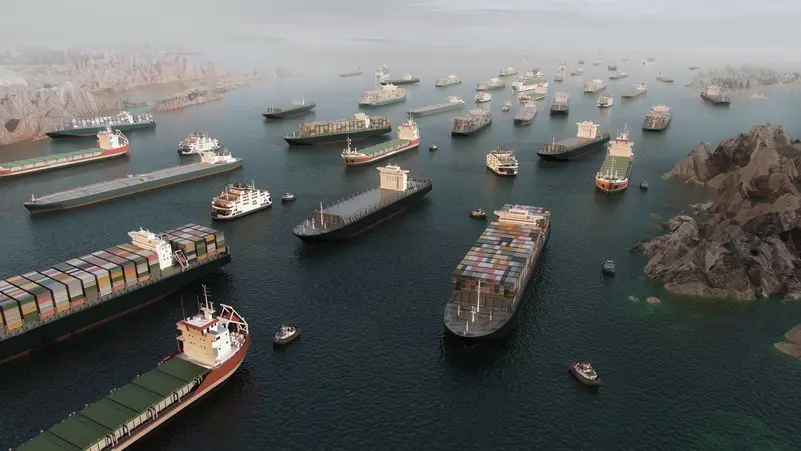
Following U.S. President Donald Trump's remarks about reopening the waterway soon, the U.S. Central Command (CENTCOM) announced the start of preparatory operations to remove mines in the Strait of Hormuz.
Two guided missile destroyers
The command clarified in a statement today, Saturday, that two U.S. guided missile destroyers, the "USS Frank E. Peterson" and the "USS Michael Murphy," conducted operations in the Strait and the Arabian Gulf as part of a broader mission aimed at securing the passage from mines that the Iranian Revolutionary Guard is believed to have planted. It added via X that the move came within the framework of efforts to ensure the safety of navigation in one of the most important global sea lanes. For his part, the commander of the U.S. Central Command, General Brad Cooper, said that the operation aims to establish a "new safe corridor" that will be announced soon to support the flow of global trade. He added that additional U.S. forces, including unmanned underwater vehicles, will join the mine removal efforts in the coming days. Trump had announced hours earlier via Truth Social that the United States had begun work on clearing the Strait of Hormuz, stressing that this step comes in the interest of several countries around the world, including China, Japan, South Korea, France, and Germany. He said: "The beneficiaries of the Strait of Hormuz lacked the courage or will to do what we are doing." He also noted that empty oil tankers from several countries are currently heading to the United States to load oil. He also considered that the only remaining threat to Iran lies in naval mines, after the war destroyed all its military capabilities, according to his expression. He pointed out that the Iranian boats used to plant mines were destroyed. These developments came just two days after the Revolutionary Guard announced last Thursday that some mines are located in the usual route in the Strait of Hormuz, announcing two alternative routes for ships, according to what the Mehr News Agency reported. He also clarified in a military statement accompanied by a marine map of the two routes, south and north of Larak Island, claiming that this change came "in order to protect against possible collisions with mines." In contrast, U.S. officials believed that Iran's insistence on controlling the Strait of Hormuz could lead to the resumption of war. It is worth mentioning that the recent U.S. announcement about "clearing the Strait of Hormuz" came while a White House official reported today, Saturday, that the trilateral talks between the United States, Iran, and Pakistan "are ongoing and face-to-face," unlike the negotiations that Washington and Tehran had previously conducted in the past months, which were conducted through intermediaries who convey messages between two delegations sitting in separate rooms. An Iranian official confirmed that it "has entered a more serious stage." The ongoing talks in Pakistan are the highest between the United States and Iran since 1979, and the subsequent severing of relations between the two countries. As for Hormuz, which is one of the most important points of negotiation between the two parties, it is considered a vital international sea lane through which a large percentage of global energy trade passes, making it a strategic point for the regional and international economies.