HIBAPRESS – Abdellatif Baraka
The repercussions of global geopolitical tensions, especially the crisis in the Strait of Hormuz, are no longer limited to fuel or traditional supply chains, but have extended significantly to parallel markets that have for years remained outside the scope of direct economic analysis. In Morocco, the repercussions of rising oil prices and transportation costs have begun to appear even in the hashish market, which is witnessing an unprecedented wave of high prices, according to field data obtained by HIBAPRESS from its sources.
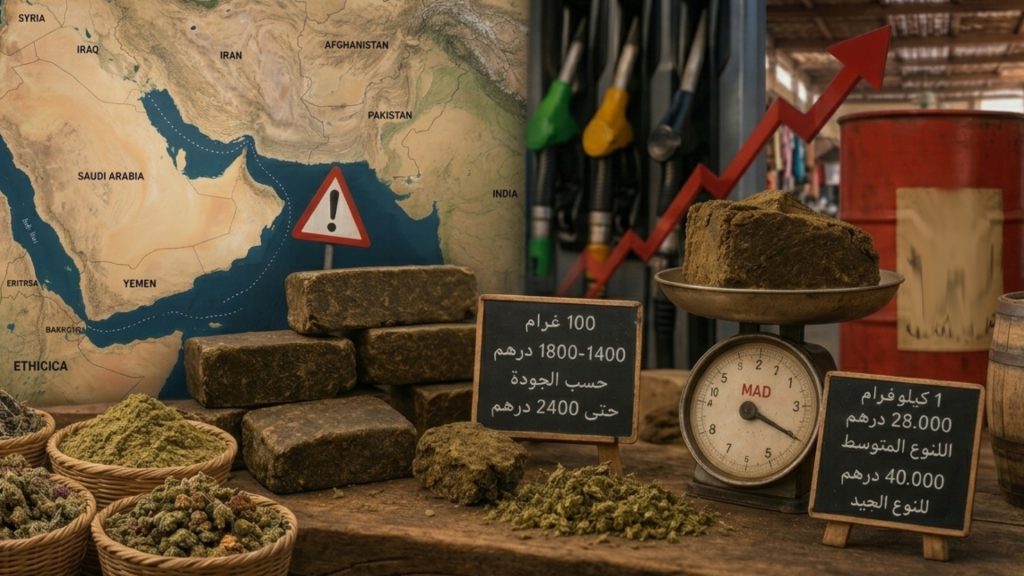
In what is locally known as the "Ketama Stock Exchange", the unofficial index for the prices of Indian cannabis, prices recorded significant jumps in recent months, with the price of 100 grams reaching between 1,400 and 1,800 dirhams, and may reach 2,400 dirhams for high-quality types. As for the kilogram, prices currently range between 28,000 dirhams for the average type and 40,000 dirhams for the good type, in a remarkable contrast to the initial selling price to the farmer, which does not exceed 700 dirhams per kilogram at best.
This large gap between the production price and the trading price reflects, according to observers, the inflation of transportation and mediation costs, which has become the decisive factor in determining prices. With the rise in global fuel prices as a result of tensions in the Gulf region, the costs of transporting goods have also risen, whether legal or within the informal economy, which was directly reflected in the prices of hashish within the national market.
To understand this transformation, it is sufficient to go back to the price development in recent years. Before the Corona pandemic, the price of 100 grams of the average type was stable at around 1,400 dirhams, rising during the pandemic to about 1,600 dirhams, driven by transportation and distribution disruptions.
After the pandemic, and especially with the return of international tensions and rising energy prices, prices entered a new phase of increase, with some types exceeding the 2,000 dirham ceiling.
This increase is not a precedent in the history of this market. In previous reports published in the media, it was pointed out that the intensive security campaigns on the cultivation of Indian cannabis and trafficking networks contributed to doubling prices, which confirms that this market remains very sensitive to security and economic variables alike.
Today, it seems that the energy factor has become a new and major player in the pricing equation, as the increases no longer only concern vegetables, fruits or consumer goods, but have also affected illegal market products. While the farmer remains the weakest link in this chain, intermediaries and distribution networks benefit from increasing profit margins, driven by the high cost of risks and transportation.
These transformations reveal another aspect of the global energy crisis, as its effects extend to invisible sectors of the economy, to confirm that international market fluctuations are capable of reshaping even the most isolated activities from official channels.