HIBAPRESS – w.m.a
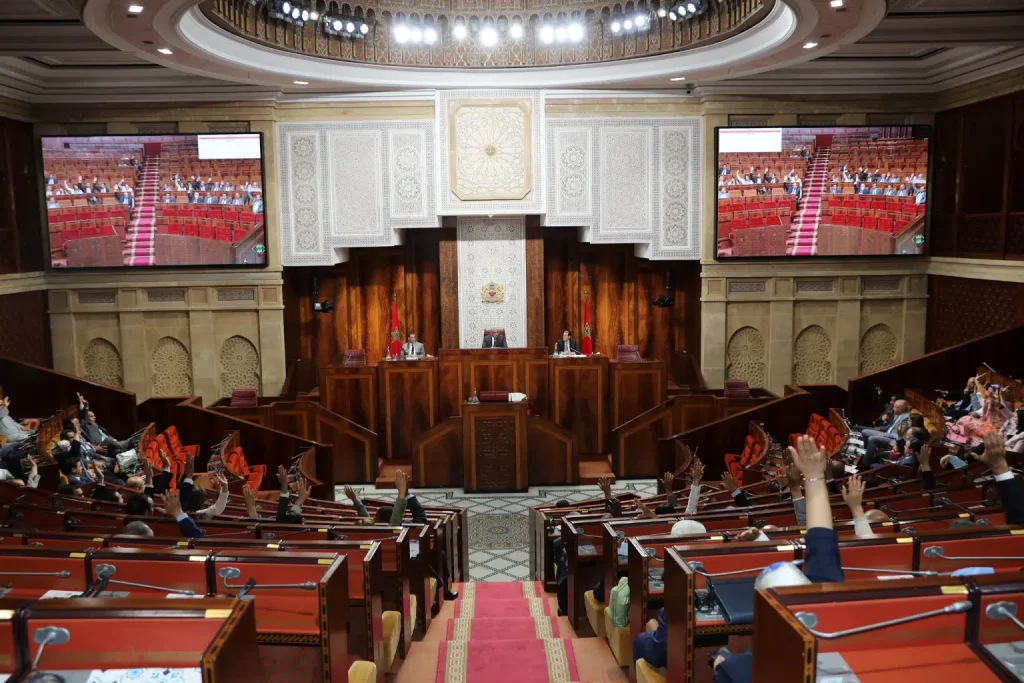
The House of Representatives, in a legislative session held this Monday evening, approved by a majority, draft law No. 09.26 regarding the reorganization of the National Press Council.
The draft law was approved by 70 deputies, while 25 deputies opposed it.
In a presentation of the draft law, the Minister of Youth, Culture and Communication, Mohamed Mehdi Bensaid, explained that this text is not included in the ordinary legislative texts, but rather constitutes a pivotal point in the process of modernizing the national media landscape, and a qualitative step towards strengthening the rule of law and consolidating the principles of good governance and strengthening the foundations of transparency and accountability.
The Minister highlighted that the text also comes in the context of "an objective assessment of a first experience in the self-regulation of the journalism profession, which is a pioneering experience that constituted an advanced step in the process of regulating the profession", noting in return that it "revealed, at the level of practice, some shortcomings and legal gaps, and also produced professional demands for the need to develop the legal framework for it."
In this context, Bensaid said that the new law aims to achieve a precise balance between promoting freedom of the press as a constitutional right guaranteed and the need to respect the rules and ethics of the profession, adding that it seeks to fill some of the legal gaps that the previous experience produced through the provision for the establishment of a committee to oversee electoral and mandate operations, ensuring their management within a framework of independence and transparency.
According to the Minister, the legislative text establishes a new stage in the process of self-regulation of the journalism profession, based on strengthening the independence of the National Press Council and consolidating its role in framing the profession in a way that keeps pace with the rapid transformations that the media field is witnessing, especially in light of the growing challenges associated with false news and the emergence of practices that are inconsistent with the ethics and rules of the profession.
For its part, the majority groups positively recorded the amendments that were made to the project, especially with regard to overcoming the provisions that raised constitutional remarks previously, and the clarification of specializations and the clarification of governance mechanisms and strengthening the institutional framework of the Council.
The parliamentary majority also appreciated the government's positive interaction with the observations of the Constitutional Court in its decision 261/26, and what it produced of "tangible improvements at the level of the project's structure and contents, which reflects a clear will to improve the text and upgrade it".
The majority raised a number of points that the Constitutional Court emphasized and that were interacted with, including ensuring the representation of the various components of the journalistic body, noting that "the self-regulation of the press is not only related to the establishment of independent bodies, but rather it assumes that it is based on real democratic foundations based on balance in representation between the various professional components."
In addition to that, the majority groups stressed that the success of this text "will not only be in its legal formulation, but also in how it is implemented on the ground, and providing the conditions that would enable the Council to carry out its tasks in the best conditions", highlighting its importance in ensuring the balance between the independence of the professional body on the one hand, and the need to sanitize the sector on the other.
For its part, the opposition groups and the group considered that this law, in its new form, "did not correct the previous fundamental imbalances that affect the foundations of self-regulation stipulated in the decision of the Constitutional Court", stressing the need not to separate the discussion of the new text from the constitutional context that it produced.
The opposition recorded "the absence of a deep review of the text that consolidates a democratic self-regulation based on balance, pluralism and representation, and the adoption of a consensus approach that restores confidence in the sector", considering that "the project was satisfied with superficial and selective amendments."
The opposition questioned the reliance on the adoption of the volume of transactions as a criterion for the representation of the representatives of the publishers, considering it "a purely financial logic that threatens pluralism, in addition to the adoption of unbalanced representation through the combination of the election and mandate mechanisms."
The opposition called on the government to open up to the proposals of professionals and the components of the media scene in all its diversity, to ensure the establishment of a strong, independent and democratic council, which is a real lever for the professionalism of the press, stressing the need today for a free and responsible professional media, subject to regulation surrounded by all legal guarantees.