

HIBAPRESS
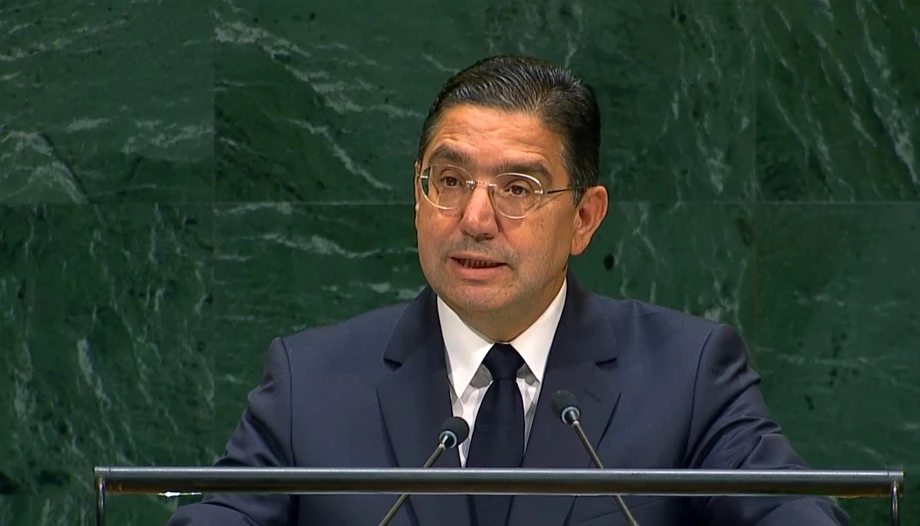
The Minister of Foreign Affairs, African Cooperation and Moroccans Abroad, Nasser Bourita, affirmed on Tuesday before the United Nations General Assembly that the Moroccan Sahara issue has witnessed a historic turning point thanks to the dynamism initiated by His Majesty King Mohammed VI.
Bourita stated that this dynamism was marked by the Security Council's adoption of Resolution 2797 in October 2025, noting that since that date, this regional dispute has taken an irreversible course of breaking with the past and looking towards the future for its final settlement.
Bourita, speaking on behalf of Morocco, noted that this path is based on principles and determinants that are not open to interpretation or "reading between the lines" as some futilely attempt to delude themselves, in blatant denial of reality and complete blindness to the established truth.
He explained that these principles are:
"First, no solution outside the framework of autonomy under Moroccan sovereignty.
Second, no other approach or mechanism outside the path of political negotiation under the auspices of the United Nations, based solely on the autonomy initiative.
Third, no discussion or debate is possible regarding the responsibilities and duties of the four parties clearly defined by Security Council Resolution 2797.
Fourth, no perpetuation of the status quo, which other parties prefer, as the train of political solution has already departed.
Fifth, no credibility for interlocutors who violate the ceasefire and refuse to respect Security Council resolutions.
Sixth, no tolerance for the continued detention of camp residents as hostages for half a century, in flagrant violation of international law and international humanitarian law."
Bourita, who is leading the Moroccan delegation to the 81st session of the UN General Assembly, highlighted that, in parallel with its firm commitment to the final settlement of this regional dispute, Morocco, under the wise leadership of His Majesty King Mohammed VI, continues to drive social and economic development in its southern provinces, particularly in the areas of infrastructure, university education, the health sector, airports, and others.
In this context, the minister pointed out that the population of the Sahara region will fulfill its national and political duty by participating, as they have done in the past, in the legislative elections scheduled for today, Wednesday, in the Kingdom, which will strengthen the edifice of genuine democratic representation and consolidate their effective engagement in the daily management of their local affairs.