Heba Press / Rabat
Yesterday, Saturday, the Moroccan Red Crescent organized a meeting in Marrakech dedicated to the presentation of the results of its interventions and contributions throughout the year following the earthquake of September 8, 2023, as well as its future strategy for mitigating the social and humanitarian effects of the tragedy.
During this meeting, which was attended by the Regional Director of the International Federation of Red Crescent and Red Cross Societies, Houssem Cherkaoui, the Ambassador of the State of Ireland to Morocco, James Minter, the representative of the Embassy of the Kingdom of Norway, Slie Samanti Vivatne and a number of executives working within the Moroccan Red Crescent, the results were reviewed by the Moroccan Red Crescent during the Al Haouz earthquake in coordination with institutional partners and all stakeholders, and also highlighted the upcoming strategy. developed to strengthen the efforts deployed in the reconstruction phase in the affected areas.
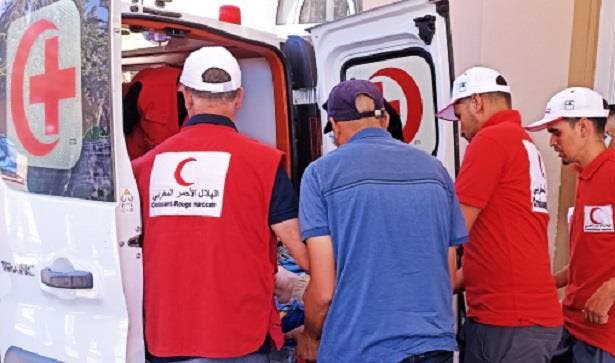
During the meeting, participants highlighted the efforts made by the Moroccan Red Crescent to meet the needs of the population by continuing relief operations, providing shelter, health facilities, drinking water and sanitation, and ensuring food security for citizens.
They added that the interventions of the Moroccan Red Crescent, with the support of partners and local authorities, reached around 26,000 beneficiaries, 35 percent of whom were women, affecting around 91 affected areas in the provinces of Al Haouz, Chichaoua, Taroudant and the prefecture of Marrakech.
Moulay Hafid Alaoui, Vice President of the Moroccan Red Crescent and Regional Coordinator of the Marrakech-Safi Region Office, said that the meeting is being held one year after the Al Haouz earthquake tragedy, in order to review the achievements presented by the Moroccan Red Crescent and anticipate the future of work.
He added in a statement to the Maghreb Arab News Agency that the Moroccan Red Crescent has played a pioneering role from the beginning in psychological support, food aid and temporary accommodation, noting the support provided by some Red Crescent Societies to the countries of Germany, Spain, France, Qatar and others.
He also stressed that the meeting was an opportunity to assess the work of the Moroccan Red Crescent, and to listen to all the actors involved, including relief teams and partners in the affected regions, to examine the strengths and weaknesses, while developing the next strategy that aims to support the reconstruction efforts and provide assistance to mitigate the effects resulting from the earthquake.
For his part, Hossam El-Sharqawi, Regional Director of the International Federation of Red Cross and Red Crescent Societies in North Africa and the Middle East, considered that the organization of this forum, which coincides with the first anniversary of the Al Haouz earthquake tragedy, was an opportunity to review what has been achieved over the course of a year, adding that urgent and advanced plans have been put in place to complete the teamwork.
He stressed that recovering from the effects of an earthquake of this magnitude takes years, based on the International Federation’s experience in many regions prone to severe earthquakes, such as China, Haiti and Nepal.
He stressed the importance of the meeting for the exchange of experiences between the participating activities and the assistance to the branches of the Moroccan Red Crescent in the affected areas, while drawing on the experience of the Moroccan Red Crescent and the public authorities in the face of such natural crises.
For his part, the Irish Ambassador to Morocco, James Millintyre, indicated that his participation in this meeting stems from the role played by Ireland in supporting the Moroccan Red Crescent during the interventions of its staff and volunteers in the areas affected by the earthquake.
He praised the efforts made by the Moroccan authorities to deal with the effects of the earthquake, stressing “the continued support for the continuation of reconstruction in these areas by developing a new strategy that allows us to keep pace with our efforts in providing all the necessary assistance with the rest of the country.” interveners, led by the Moroccan Red Crescent.
It should be noted that the Moroccan Red Crescent Society was founded in 1957 and recognized by the International Committee of the Red Cross and Red Crescent in 1958. It is a humanitarian organization that works to provide assistance on the ground to civil and military public authorities intervening in the country. humanitarian fields.