HIBAPRESS
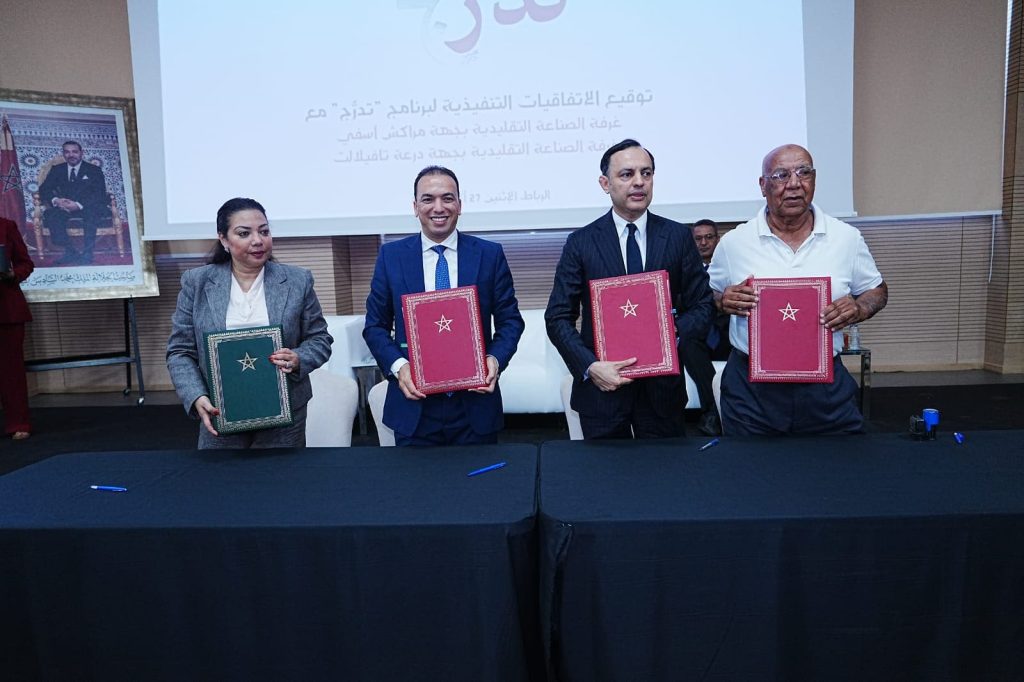
On Monday, Lahcen Al-Saadi, Secretary of State in charge of Traditional Industry, Social Economy and Solidarity, along with Younes Sgouri, Minister of Economic Inclusion, Small Enterprises, Employment and Skills, oversaw the signing ceremony of partnership agreements related to the implementation of the vocational training program in stages in the crafts of traditional industry for the period 2025-2030.
These agreements were signed with twelve chambers of traditional industry and four associations of training and qualification centers in the crafts of traditional industry, in addition to the National Agency for the Promotion of Employment and Skills. The vocational training program in stages, launched by the Secretariat of State in charge of Traditional Industry, Social Economy and Solidarity, is one of the main paths for the advancement of the traditional industry sector in Morocco, as it aims to enable young people to acquire professional and practical skills within artisanal companies, enhanced by theoretical and technical training that qualifies them to obtain nationally recognized certificates. This important path falls within the framework of the joint desire of the signatories to implement the procedure included in the roadmap for employment related to the generalization of vocational training in stages, as well as the implementation of the provisions of the vocational training development program contract 2025-2030, signed on 13-10-2025, between the Ministry of Economic Inclusion, Small Enterprises, Employment and Skills and the Ministry Delegate to the Minister of Economy and Finance in charge of the Budget and the Secretariat of State in charge of Traditional Industry, Social Economy and Solidarity, for training in the crafts of productive and service-oriented traditional industry.
Vocational training in stages is based on the principle of learning by practice, by combining training within the host company by no less than 80%, and general training within vocational training centers by 20%. This model allows young people to gain real field experience that facilitates their integration into the labor market and the development of their self-capabilities.
The training covers a wide range of artistic, productive and service crafts, including: wood crafts and engraving, leather and saddlery, metals and jewelry, textiles and traditional sewing, clay and ceramics, construction, hairdressing and beauty, service crafts related to tourism and traditional industry.
The training is conducted through a network of 67 training institutions and more than 100 annexes distributed across the various regions of the Kingdom, with a capacity of up to 30,000 pedagogical seats. The training aims to enable young people to acquire practical skills within artisanal companies, facilitate professional integration and encourage self-employment, contribute to the structuring of the economic fabric of traditional industry companies, preserve traditional crafts threatened with extinction and transfer them to the younger generations.
The conditions for accessing vocational training in stages, which is a free program open to young people from the age of 15 and above and relies on a system of paths, are: If you have a minimum of reading, writing and arithmetic, you can register for a vocational training certificate, if you have completed the sixth grade of primary education and a vocational training certificate, you can register for a professional specialization diploma, if you have completed the third year of secondary preparatory education and a professional specialization diploma, you can register for a vocational qualification diploma.
Registration is done by going to the nearest vocational qualification center or specialized institute in the arts of traditional industry or the regional or provincial directorates of the Secretariat of State in charge of Traditional Industry, Social Economy and Solidarity, or the headquarters of the professional chambers, and the media cells of these institutions provide candidates with all the information and details related to the training programs and available paths.