HIBAPRESS – Ahmed Al-Musaed
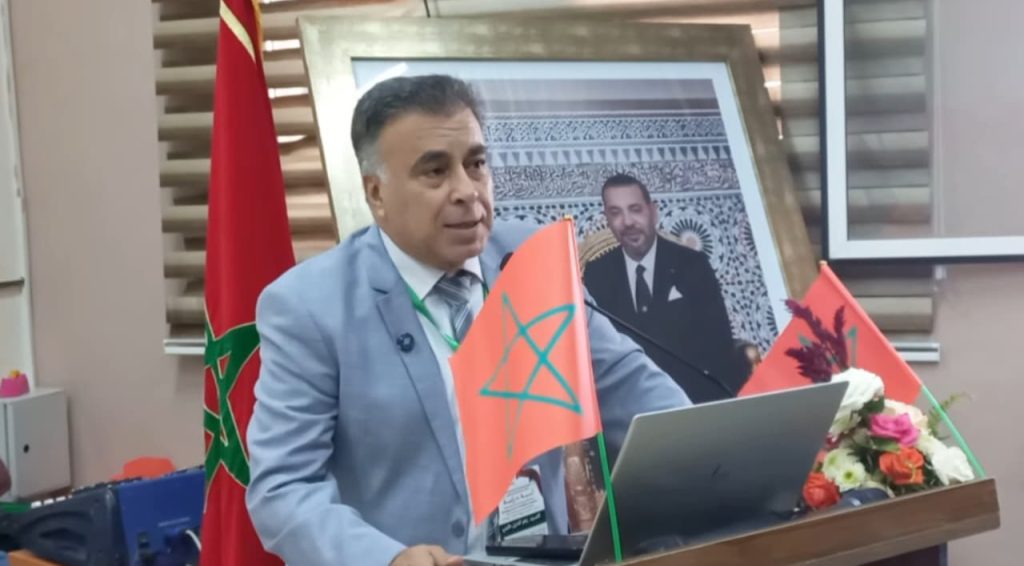
The Mohammed I University in Oujda organized a study day dedicated to examining the contents of UN Resolution No. 2797 issued on October 31 regarding the national issue, with the participation of specialized professors and researchers in political science and international relations.
In his intervention on the occasion, Zahreddine Tayyibi, professor of political science and international relations at the same university, confirmed that the new UN resolution constitutes a pivotal turning point in the course of the national issue, as it came to consolidate the national sovereignty of the Kingdom of Morocco over its southern provinces, and to emphasize that negotiation cannot be about sovereignty, but rather about the form of governance within the framework of this sovereignty. Tayyibi explained that the resolution establishes a new phase titled the implementation of self-governance, pointing out that the upcoming negotiation will be technical and will concern the form of self-management in the southern provinces, whether through a regional parliament or a small local government, but within the full Moroccan sovereignty and under its national symbols represented in the Moroccan flag, the national currency, foreign policy, national defense, and the imarat al-mu'minin. The speaker added that the recent royal speech came to renew the Moroccan approach in dealing with this file through the diplomacy of the outstretched hand towards Algeria, where His Majesty the King stressed that the outstretched hand will always remain outstretched, and that there is no victor or vanquished in order to find a consensual solution that puts an end to this fabricated conflict that has lasted for more than half a century. In this context, Tayyibi called on Algeria to engage positively in the solution process, pointing out that even if it considers itself not a party to the conflict, it must be a party to the solution, in a way that serves the stability of the region and its joint development. He also pointed out that the continuation of this conflict has cost the Algerian treasury more than $500 billion, which are huge sums that could have been directed towards the development of Algeria and the construction of a strong Maghreb Union, in addition to the fact that the closure of the borders between Morocco and Algeria has caused a loss estimated at 2% of the growth rate in both countries. He also noted that the weakness of intra-Maghreb trade represents one of the most prominent manifestations of this political stagnation, as it does not exceed 15% between African countries, which is the lowest percentage in North Africa, compared to 67% between the countries of the European Union and 58% in Asia, which reflects the urgent need to open a new page of cooperation and economic integration between the Maghreb countries. Tayyibi concluded his intervention by emphasizing that the current phase requires a review of political calculations, and a transition from the logic of competition for leadership to the logic of partnership and integration, to build a joint Maghreb future based on stability, development and regional solidarity.