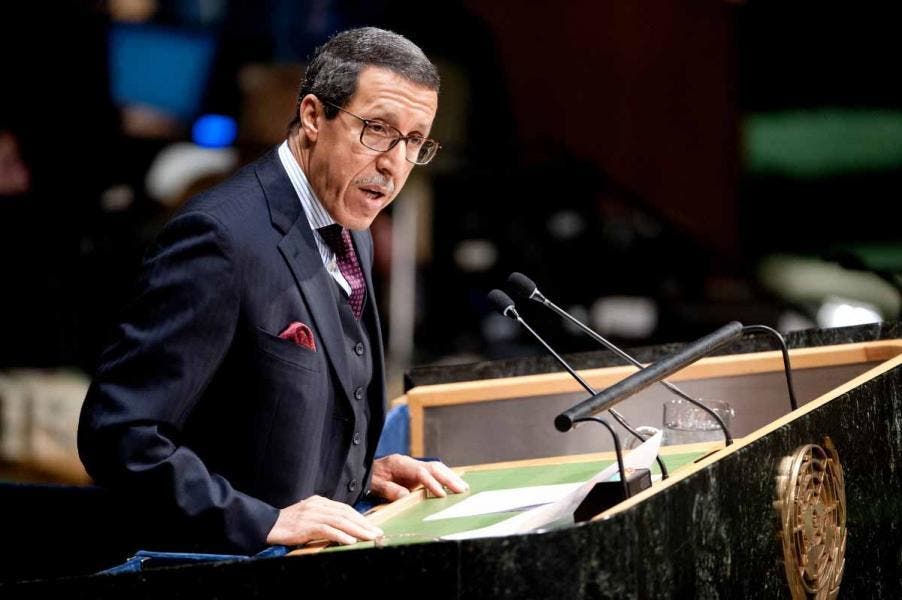
The Ambassador, Permanent Representative of Morocco to the United Nations, Omar Hلال, confirmed on Saturday in Dakhla that Moroccan diplomacy, as pursued under the leadership of His Majesty King Mohammed VI, is based on the philosophy of "action" and "concrete deeds" to embody an exceptional path.
Mr. Hلال explained, during his intervention at a meeting organized within the framework of the fifth session of the annual forum "Moroccan Diplomacy – Sahara," on the topic "Moroccan Diplomacy in the Service of Peace, Stability, and African Cooperation," that "Royal diplomacy is practiced as a distinctive embodiment of a firm conviction that the greatness of nations is measured by their ability to collectively build their future, and that solidarity is the true foundation of a more just and equitable world order."
The Moroccan diplomat added that royal diplomacy is based on "a well-articulated philosophy of action, which relies on trust instead of apprehension, on cooperation instead of isolation, on sustainability instead of opportunism, and on human dignity instead of hegemony."
Mr. Hلال mentioned that this royal vision is rooted in the country's ancient heritage "in this dialogue that dates back centuries and was woven between the Atlantic Ocean and the Sahara, between the Maghreb region, sub-Saharan Africa, and Europe," which outlined the features of a committed and open diplomacy.
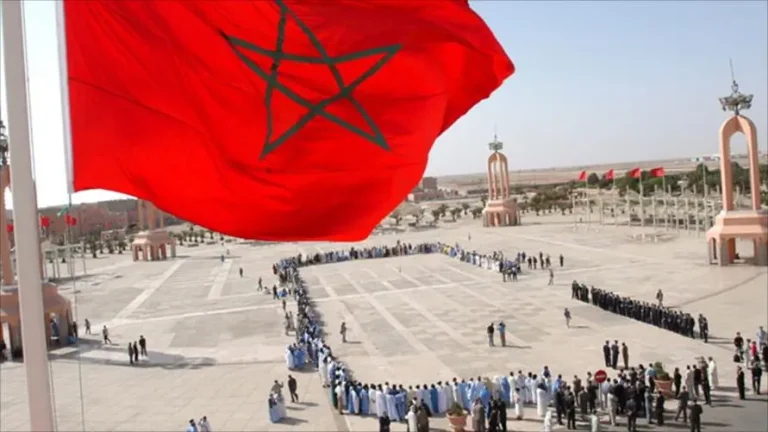
He pointed out that the fiftieth anniversary of the Green March provides an opportunity to reflect on this distinctive path, stressing that this march embodies a diplomatic philosophy that combines historical legitimacy and national unity, as well as the positive affirmation of the self without negating the other.
Based on the three fundamental pillars of the United Nations Charter, namely development, human rights, and international peace and security, Mr. Hلال called for a diplomacy of concrete and practical action, stressing that Morocco has been defending an approach based on tangible results that goes beyond mere declaration of values, and seeks to translate them into concrete initiatives, in a way that serves a more solidary and sustainable international order.
Mr. Hلال mentioned, regarding the first pillar of the United Nations Charter, i.e., development, that the Kingdom considers comprehensive growth as a driver of national stability and regional cooperation, adding that the essence of the Moroccan vision lies in the conviction that "development is not transferred, but rather created collectively."
He highlighted the role of investments in renewable energy, infrastructure modernization, human development, and economic openness as elements of a national project directed towards the future. Far from being a mere symbolic extension, Moroccan diplomacy, from this perspective, constitutes a strategic lever for this direction, through concrete partnerships, especially with African countries and developing countries.
For Mr. Hلال, the success of this approach proves that Morocco does not merely adopt the principles of the United Nations, but transforms them into sustainable and cooperative programs.
Regarding the second pillar, he affirmed that human rights form the foundation of any society that aspires to cohesion and continuity. According to him, this conviction, stipulated in the 2011 constitution, is embodied in a multi-dimensional diplomacy: humanitarian work, institutional cooperation, knowledge exchange, spiritual dialogue, and security commitment.
This consistency in choices, as a moral value for Morocco, will allow the transformation of its local experience into universal standards, especially in Africa, where the Kingdom is multiplying its educational, religious, social, and security initiatives to contribute to lasting stability.
Regarding the third pillar of the charter, Mr. Hلال stressed Morocco's comprehensive view of security challenges. Terrorism, trafficking, humanitarian crises, conflicts, and environmental degradation are not, in his opinion, isolated phenomena, but rather symptoms of deep fragility. Hence the need to reconsider security beyond its military dimension, by integrating it with food, energy, climate, and human challenges.
On this basis, Mr. Hلال highlighted that the Kingdom, proud of its experience, is running for the presidency of the Peacebuilding Commission (PBC) in the United Nations, starting next January. This responsibility would give an authentic African perspective to the United Nations operations, and reflect the continent's priorities more accurately.
This commitment is also evident in the positions taken by Morocco in the Security Council, where it expresses African concerns with what he describes as "a voice that expresses the continent's concerns with strength, lived experience, the authority of concrete commitment, and the credibility of those who do not just express their regret for crises, but act to prevent them."
He stressed the steadfastness that characterizes Moroccan diplomacy: the harmony between the declared principles and the measures taken. He believes that the fiftieth anniversary of the Green March, which was reinforced by Security Council Resolution 2797, clarifies this ability to unite ranks and be proactive.
It is worth mentioning that the fifth session of the annual forum "Moroccan Diplomacy – Sahara" organized under the high patronage of His Majesty King Mohammed VI, was inaugurated on Friday in Dakhla under the slogan "50 years of the Green March: National Unity and Continental Ambition".
(and)