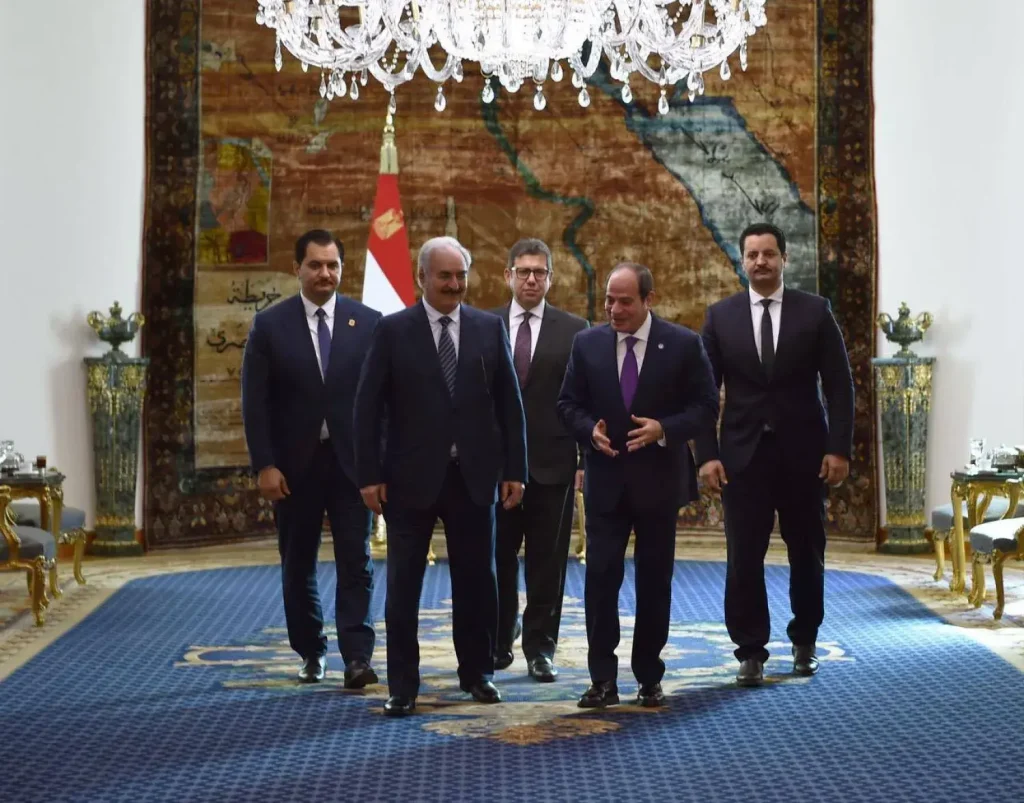
Libyan and regional developments strongly influenced the discussions between Egyptian President Abdel Fattah el-Sisi and Field Marshal Khalifa Haftar, the General Commander of the Libyan National Army, during their meeting in Cairo. The agenda was dominated by the files of the postponed elections, the presence of foreign fighters, and the demarcation of maritime borders, in addition to the deteriorating situation in Sudan. The visit came at a pivotal moment that analysts see as exceptionally significant given the specificity of the stage Libya is going through.
Egyptian Presidential Spokesman, Ambassador Mohamed El-Shenawy, confirmed that el-Sisi emphasized Egypt's full support for Libya's sovereignty and territorial integrity, and the need to address any external interference, while accelerating efforts to remove all foreign forces and mercenaries. El-Sisi also reiterated Cairo's support for initiatives aimed at holding simultaneous presidential and parliamentary elections, while maintaining support for the army and Libyan national institutions, considering them pillars of stability. The meeting included the presence of senior military leaders from both sides, led by Major General Hassan Rashad, the head of general intelligence, and Lieutenant General Saddam Haftar, and Lieutenant General Khaled Haftar, where an important part of the discussions was devoted to the file of demarcation of maritime borders between the two countries. The official spokesman clarified that there was an Egyptian-Libyan agreement on the demarcation path, which ensures common interests and respects the rules of international law, in light of the ongoing maritime disputes between Libya, Egypt, Greece, and Turkey. Haftar praised the Egyptian role in supporting Libyan stability, stressing his keenness to continue coordination with Cairo regarding internal and regional developments, especially the repercussions of the Sudanese conflict and the resulting waves of displacement that affect Libyan security. Analysts believe that Egypt is still a key partner in combating terrorism and rebuilding Libyan cities, in addition to considering Libya a direct extension of Egyptian national security. The two sides agreed on the need to intensify international efforts to find a political settlement that preserves the unity and stability of Sudan, while emphasizing that the security of Khartoum is closely linked to the security of Egypt and Libya. This comes in line with the Egyptian position calling for a Libyan-Libyan solution without external interference, and proceeding with the implementation of the UN road map, including the formation of a unified government that leads the country towards comprehensive elections as soon as possible.