HIBAPRESS
She doesn't appear much in front of the cameras and doesn't speak to the public, but her name was the first to surface with the moment of the devastating fall in Caracas.
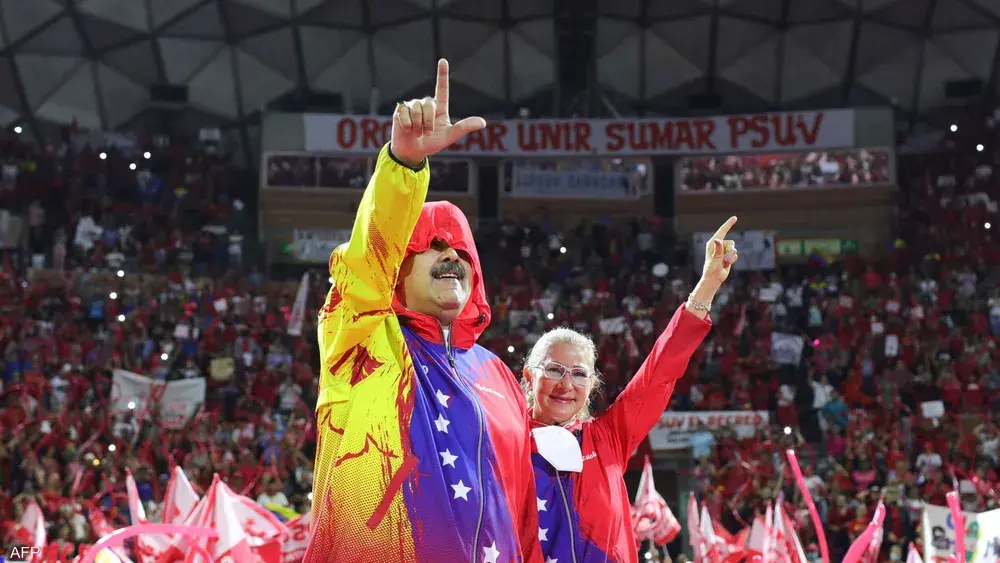
When she was taken with her husband Nicolas Maduro from their hiding place, Cilia Flores was not just a wife accompanying him, but his partner in the scene and power together.
Cilia is not the "First Lady" according to the protocols of governance, nor a passing name under a controversial president, but a figure shaped by the discourse of the "Chavist Revolution", and presented as "the first fighter".
On Saturday dawn, Maduro and his wife and first advisor, Cilia Flores, were arrested, where they were taken from their "fortress" by American forces, and were quickly transferred out of the country to appear before the American judiciary on charges related to drug trafficking.
Cilia held the position of First Lady for more than a decade, although she is called, in the official terms of the socialist movement known as "Chavismo", "the first fighter", and was Maduro's partner for more than 30 years, during which she accumulated her own political capital, and was considered one of the most powerful women in Latin America.
Cilia Flores was born in 1956 in the town of Tinaquillo in central Venezuela, and grew up in the working-class neighborhoods west of Caracas. She met Maduro, who often talks about his humble origins, during the early days of the Chavist movement. She is a lawyer specializing in labor and criminal law, and provided legal assistance to former President Hugo Chavez, whose movement bears his name, and to other military personnel who were arrested after their attempt to overthrow former President Carlos Andres Perez in 1992.
As for Maduro, he was also active in demanding the release of Chavez, and was part of the security team for the then-lieutenant.
In November 2023, Flores said, remembering that stage during the first episode of the podcast "Maduro": "During the struggle for the release of Chavez, we were involved in street activities. I always remember a meeting in Catia, and when a young man asked for the floor, he spoke, I kept staring at him. I said: How smart he is," referring to Maduro.
And since then they have remained inseparable, but Cilia has paved her own political path, as she was first elected as a member of the National Assembly in 2000, i.e. a year after Chavez was elected president, and won her seat again in 2005, and one year later she became the first woman to head the parliament, succeeding Maduro, who was appointed Minister of Foreign Affairs in Chavez's government.
During her presidency of the parliament, she prevented journalists from entering the legislative hall, and was also criticized for employing dozens of her relatives in the Congress.
In an interview with the Spanish newspaper "La Vanguardia", she replied that it was a smear campaign, but she confirmed the employment, saying: "Yes, members of my family were hired based on their own competencies. I am proud of them and will defend their work whenever necessary."
Between 2009 and 2011, she also held the position of Second Vice President of the United Socialist Party of Venezuela, which was then led by Chavez, who appointed Cilia as Attorney General in 2012.
Along with Maduro, who held the position of Vice President, she visited Chavez in Cuba, where he was receiving treatment for cancer during the last months of his life, and when she created her account on "Twitter" in 2015, she wrote in her definition "Daughter of Chavez", before changing it a few years later to "Chavista".
In July 2013, Cilia married Maduro, who met after Chavez's surrender after the failure of his coup in 1992, after two decades of relationship, and that was after Maduro's victory in the presidential elections over the then-opposition candidate Enrique Capriles.
Carmen Arteaga, who holds a doctorate in political science and is an associate professor at Simon Bolivar University, told the American news network "CNN": "She has an important political background. When she became the First Lady, she retreated to the back row. But for many she is the real power behind the throne or the senior advisor."
She added: "When they got married, she reduced her appearance significantly. She rarely makes public statements and does not seek to attract attention, but takes a step back."
According to Arteaga, Cilia's support and advice were crucial during the years that witnessed internal conflicts within the Chavismo about the succession of Chavez, as Maduro, who was endorsed by the late president, was still working to consolidate his leadership in the face of other prominent figures close to Chavez, such as Rafael Ramirez, the dismissed president of the national oil company, and former Minister of Energy and Oil.
In that circle, women rarely held high positions, and for Arteaga, there was no doubt that Cilia was the most powerful woman in the country, at least as long as Chavismo remained in power.
Political scientist Estefania Reyes told "CNN" that it is difficult to measure Cilia's influence because she practiced it "from behind the scenes" and it was not institutionalized.
She added: "If there was ever a kind of dual leadership, it was not formalized, unlike what happened in Nicaragua between President Daniel Ortega and his wife, Vice President Rosario Murillo."
Reyes also pointed out that Cilia has appeared in recent years as a supporter, as an image of a mother seeking to communicate more with the public, rather than being an election competitor, and the assistant professor at the University of Western Canada said: "Chavismo employs the role of the mother. Symbolically, she remains bound by gender constraints."
For years, the position of First Lady in Venezuela was not used, as Chavez was divorced, and when Maduro took power, he gave Cilia the title of "the first fighter", considering that the First Lady is an aristocratic concept.
In this context, Reyes pointed out that "despite the informal change in the name, the position is still related, as in other countries, to issues such as protecting childhood and leading charitable organizations."
With her appearance decreasing with the start of the Maduro government, Cilia's presence was almost limited to one of the many radio programs launched by officials in the ruling party, which was entitled "With Cilia in the Family".
But her name returned to the headlines in 2015, when two of her nephews were arrested on charges of drug trafficking by undercover agents of the US Drug Enforcement Administration in Haiti, and Flores described the incident as "kidnapping", but they were both tried and convicted in New York, and sentenced to 18 years in prison for conspiring to import cocaine into the United States, and in 2022, they were released as part of a prisoner exchange between Caracas and Washington.
The Canadian authorities also imposed sanctions on her in 2018, along with 13 other officials, one day after a report by the Organization of American States stated that the Maduro government had committed crimes against humanity.
A few months later, the US Treasury Department imposed its own sanctions, explaining in a press release that Maduro "relies on his inner circle to stay in power," and the Venezuelan president responded, saying: "If you want to attack me, attack me. Don't mess with Cilia. Don't mess with the family. Don't be cowards. Her only crime is that she is my wife."
At that time, Cilia had returned to the legislative palace after being elected in 2017 as a member of the Constituent Assembly, and then in 2021 as a deputy in the National Assembly, the position she held when she was arrested on Saturday.
(And with)