HIBAPRESS
The 2026 Global Education Monitoring Report by UNESCO, published today, Wednesday, March 25, praised the remarkable progress made by Morocco in reducing the number of out-of-school children.
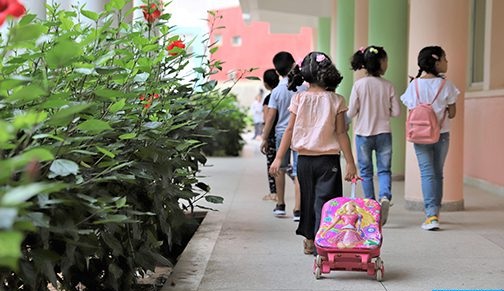
The report highlighted Morocco as one of the prominent examples, as it has been able to rapidly expand access to education in recent decades. The same source explained that since 2000, Morocco has recorded "remarkable progress, as the rate of non-enrollment has decreased by 1.6 percentage points annually, a sustainable pace for more than a quarter of a century". The percentage of adolescents not enrolled in secondary education also decreased from 42 percent to 6 percent, while the percentage of youth of secondary school age decreased from 63 percent to 23 percent, reaching levels similar to those recorded in upper-middle-income countries. The report added that Morocco, which had lower rates of non-enrollment in 2000 than the average of lower-middle-income countries, had, by 2023, reached levels approaching those recorded in upper-middle-income countries. UNESCO indicated that the total number of out-of-school youth decreased by more than 70 percent between 2000 and 2023, a development attributed, in particular, to a large program to build public schools, and to policies to reduce school dropout, including conditional cash transfers under the "Tayssir" program, which benefited 3.1 million students in 2025. Preventive measures, such as awareness campaigns, the involvement of families and social services, in addition to investment in transportation and school accommodation in rural areas, have also contributed to improving access to education and ensuring the continuity of schooling. In addition to this, a new early warning mechanism has been adopted to monitor students at risk of dropping out of school. For his part, the director of the Directorate of Remedial Education and Inclusive School at the Ministry of National Education, Preschool and Sports, Hussain Oujour, explained that the non-formal education program adopted by Morocco aims to address two main challenges, namely the professional integration of young people with certificates, and reducing school dropout. He added that within the framework of the ministry's new roadmap, about twenty programs have been launched, with the strengthening of the convergence of sectoral policies to combat school dropout, noting that this is an "unprecedented approach" within the national educational system. Mr. Oujour confirmed that a number of beneficiaries of second-chance schools have achieved distinguished paths, as they have joined higher educational institutions and held important positions, considering this "among the most prominent fruits of this commitment".