HIBAPRESS
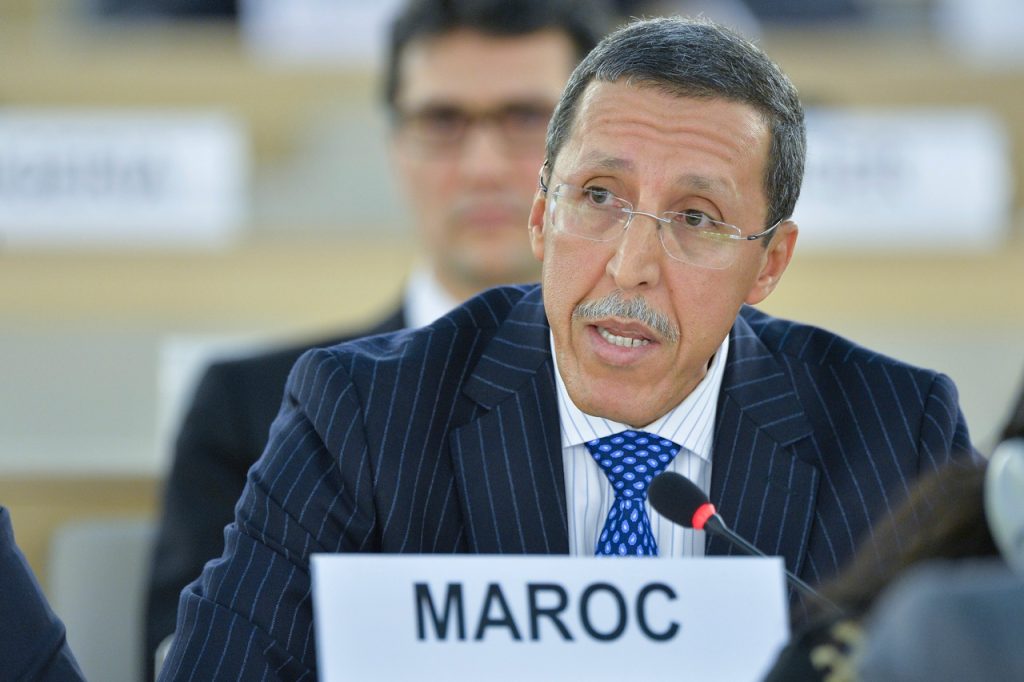
The Ambassador, Permanent Representative of Morocco to the United Nations, Omar Hilale, confirmed on Monday that Morocco condemns the use of international straits and sea lanes as a tool of pressure, during the high-level open debate dedicated to maritime security, held in New York.
In his address to the members of the Security Council, during the session chaired by the Bahraini Minister of Foreign Affairs, Abdullatif bin Rashid Al-Zayani, whose country holds the rotating presidency of the Security Council for the month of April, Hilale described the current situation as "deeply worrying", strongly condemning "the use of international straits and sea lanes as a tool of pressure and a blackmail card", as well as the veiled threats to close the Strait of Hormuz, "the global energy artery". He stressed that no country, "whatever justifications it may invoke, has the right to hold the world hostage to its sea lanes. The seas are a shared heritage of all humanity, not bargaining chips in the hands of those who have made hostility a political creed for decades." Ambassador Hilale also condemned in the strongest terms the attacks launched in the Arabian Sea, the Gulf of Aden, and the Red Sea by armed groups acting as agents for specific countries, describing them as flagrant violations of international law and the United Nations Charter. In this regard, he highlighted that the Kingdom strongly condemns these "blind attacks on commercial ships, which are not justified by any political or ideological logic." In this context, Hilale called on the international community to assume its "historic responsibility", considering that "it is not permissible to allow geography to be held hostage to ideology, and for sea lanes to be turned into weapons in the hands of countries that have made destabilization, interference in the affairs of others, and support for armed militias their regional policy for decades, ignoring their international obligations, and the appeals of the international community". The Moroccan diplomat affirmed that maritime security is no longer a secondary issue, but has become a pivotal pillar in the edifice of international peace and security, recalling that more than 90 percent of global trade passes through the seas and oceans. He added that any infringement on freedom of navigation or the security of straits constitutes a "direct attack on the economies of peoples and on their sources of livelihood". In the midst of reminding of the Kingdom's exceptional geographical location, at the crossroads of the African and European continents, and on the shores of the Strait of Gibraltar – one of the most strategic sea lanes in the world – Ambassador Hilale affirmed that freedom of navigation is not a "diplomatic option" for Morocco, but rather a "legal duty and an existential commitment dictated by geography, history, and the preservation of common prosperity." He added that the Kingdom will remain faithful to its firm adherence to the principles of international law of the sea. In this context, Hilale shed light on the Kingdom's actual contribution to safeguarding regional and international maritime security, through its involvement in maritime cooperation systems and combating smuggling along its coasts and the coasts of its partners. In the same context, he recalled the immense momentum added by His Majesty King Mohammed VI, through the Atlantic Royal Initiative, which opens a gateway to the Atlantic Ocean for the countries of the African Sahel, embodying the spirit of solidarity, economic integration, and joint development, and transforming geography from an obstacle into an opportunity in the service of the peoples of the region, in addition to the path of the African Atlantic countries, which brings together more than twenty coastal countries on the Atlantic front of the African continent. The speaker pointed out that this pioneering framework establishes maritime security as a fundamental axis for cooperation, as it enhances coordination between member states in the areas of maritime surveillance, combating cross-border crimes, and protecting common marine resources. Thus, adds Ambassador Hilale, the African Atlantic transforms from a "space of fragility into a space of solidarity and common security", carrying prospects for stability and development for Africa and the world. In conclusion, he affirmed Morocco's full and complete commitment, alongside the international community, to consolidating the security of vital sea lanes, safeguarding international freedom of navigation, and protecting international law of the sea from any violation. He called on the Security Council to adopt the clear positions required by the stage, warning that "what threatens our seas today will threaten our collective stability tomorrow".