HIBAPRESS – Muhammad Zariouh
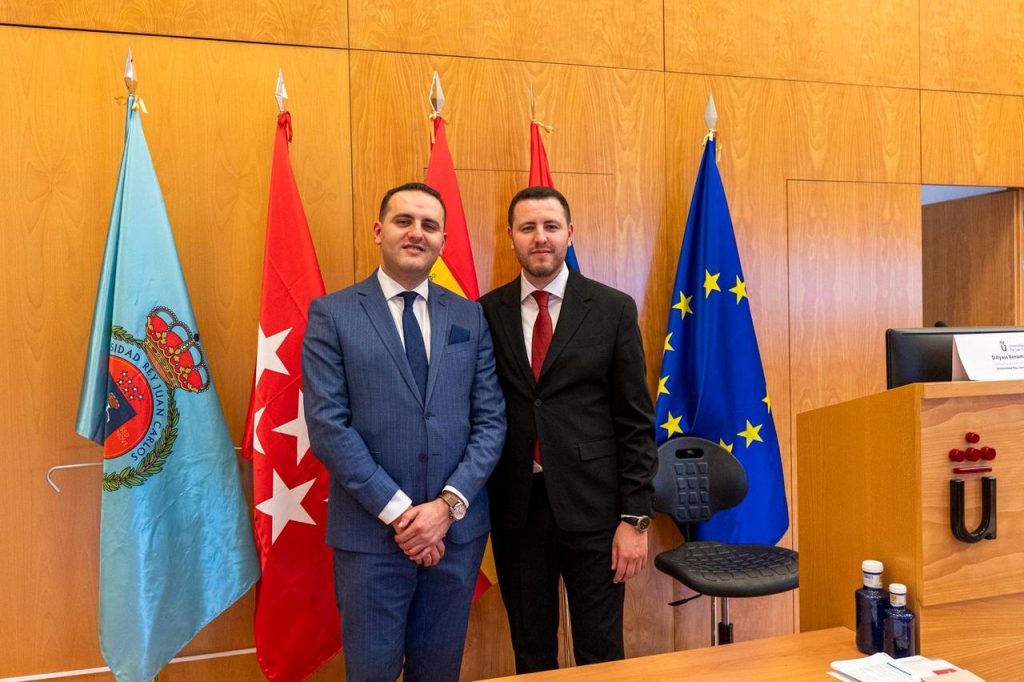
With calm steps that hide a firm certainty behind them, the researcher Elias Benamar appeared from behind the platform of the King Juan Carlos University in Madrid, in a scene overflowing with symbolism and pride. The son of the Moroccan Rif, a "singing bird" in the land of the diaspora, stood, his neck stretching towards the jury in discussion room number 151; it was a mixture of shyness, awe, and the trust of the knower who spent the night of April 27, 2026, dreaming of that historical moment, defending his thesis, which was not just an academic paper, but a dream of a lifetime that began from the Rif Mountains to blossom in the heart of the Spanish capital.
Elias was not alone in the face of strict academic protocols, as the awe of the situation dissipated with the presence of the "support" that crossed the distances. From the city of Nador, his brother, Professor Sareeh Benamar, the Deputy of the King's Attorney in Driouch, flew to be his accompanying shadow, embodying the will of their late father to stand together in good times and bad. The scene of loyalty was also completed by his lifelong friend, lawyer Dr. Muhammad Belfaqih and his son Amir, Dr. Noureddine Ashashah, and a group of comrades who witnessed how human loyalty turns into energy that supports scientific research and gives it its special sanctity.

Between the flags of Morocco, Spain, and the European Union, the researcher discussed his thesis entitled "Spanish-Moroccan Cooperation in the Cultural Field: Development and Future Prospects," under the supervision of Dr. Elena Carolina Diaz Galan. This study was not separate from its owner's conscience, but rather a life experience forged by a researcher who writes in the language of "Cervantes" with brilliance, and dedicates the fruit of his efforts to the soul of his father, whom he lost a few weeks ago; to leave for generations a good trace that immortalizes the father's name in the university and among the library shelves as a solid intellectual reference.
The research journey delved into the depths of history, extending from the end of the nineteenth century to today, where Benamar monitored the transformation of the relationship between Rabat and Madrid from a model of "cultural hegemony" during the protectorate to a "strategic partnership" based on common interests. The researcher cleverly argued that culture is not a marginal luxury, but rather a sovereign pillar and a safe bridge that crosses diplomatic crises, stressing that civil society and parallel diplomacy are the real guarantee for the sustainability of this civilizational convergence.
With a strict methodology that combined legal and historical analysis, Benamar deconstructed the roles of major institutions such as the Cervantes Institute and the Three Cultures Foundation, analyzing how the Spanish language becomes a tool for common radiation. The research, with its critical vision, did not overlook the structural obstacles and linguistic barriers, warning against the use of culture as a tool for political maneuvering, calling for a reconsideration of the concept of cultural diplomacy as a soft power capable of building bridges that are not demolished by the winds of fleeting disagreements.

In the face of this balanced presentation, the jury had no choice but to praise the scientific solidity and academic boldness that the researcher showed, especially in his ability to write in a language other than his mother tongue and at a level that meets the highest international standards. The committee crowned this path by awarding him a doctorate with the distinction "very good," with a unanimous recommendation to publish the thesis, confirming that the work represents a qualitative addition in the field of international relations, and deserves to be a road map for deepening the Euro-Mediterranean partnership.
In conclusion, Dr. Elias Benamar emerges as a model of the Moroccan intellectual who carries his identity in his heart and his knowledge in his hand to address the world in the language of the age. His obtaining a doctorate from King Juan Carlos University is not just a personal achievement, but a message that confirms that distances melt before the will, and that the bridges built with knowledge are the most durable. The "son of the Rif" has succeeded in being an excellent cultural ambassador, proving that knowledge is the wing with which innovators fly far, to remain always a source of pride for their homelands wherever they are.