HIBAPRESS – Mohamed Zeriyouh
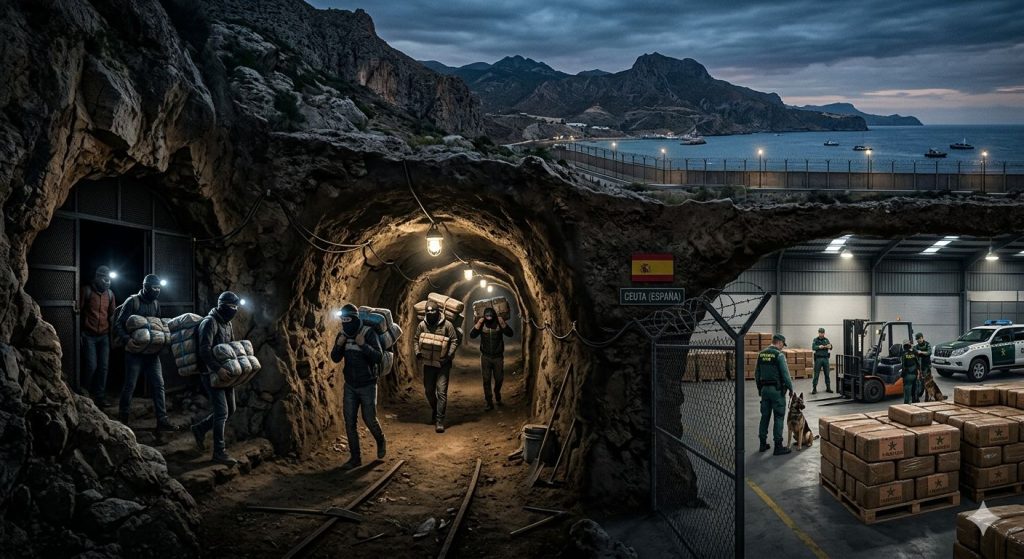
In a dramatic development resembling scenes from global thrillers, the Spanish National Court continues to unravel the threads of one of the most dangerous smuggling cases that has breached the southern borders of Europe. The investigations, led by Judge Antonio Pena, have revealed a bombshell: sophisticated secret tunnels connecting Morocco and the occupied city of Ceuta. The smuggling mafia has succeeded in building an underground infrastructure that starts from Moroccan soil and penetrates deep into the Tarajal industrial zone, allowing shipments of hashish to pass away from the eyes of radars and border surveillance cameras in a continuous and systematic manner.
Accusations are directed towards a forty-year-old businessman who uses the city of Fnideq as a cover for his activities. Judicial documents indicate that he is the primary engineer and the main suspect in managing this complex network. This 45-year-old man was not just a traditional smuggler, but he managed a precise hierarchical organization that held secret meetings in Algeciras and Ceuta to coordinate financial and logistical operations, relying on cells distributed between different regions of Spain and with possible extensions outside the continent, which made his activity go beyond mere simple smuggling to the level of cross-border organized crime.
The size of the criminal activity of this network is shown by the shocking figures revealed by the seizure reports. In June 2025, a giant shipment weighing 15 tons of hashish fell, which was hidden inside a truck coming from Nador, followed by a crushing blow in February 2026 with the confiscation of more than 600,000 euros in cash. According to official statistics, the total quantities seized exceeded 18,000 kilograms of drugs, which are figures that reflect the enormous ability of this network to flood the markets and cash in huge sums of money in record time before falling into the hands of justice.
The security earthquake did not stop at the discovery of the tunnels, but extended to shake the human structure of the organization, as the successive security operations resulted in the arrest of 12 active elements who were placed in pre-trial detention by judicial order. These detainees represent logistical cells that ensured the flow of drugs and secured warehouses inside Ceuta, which puts the security services in a direct confrontation with a new generation of smugglers who no longer rely on traditional methods, but have begun to dig their way to illicit wealth under the ground and with unprecedented engineering techniques.
These dangerous developments place the border area in front of a complex security reality, especially since the discovery of a second tunnel in a short period of time reflects the determination of criminal networks to invent new paths to overcome security alertness, which prompted the Spanish National Court to continue the investigation to track all smuggling routes and dry up the sources of funding for these networks, in light of increasing concern about the complexity of the organizations that are active on this vital axis, which requires deeper intelligence cooperation to decipher the codes of this secret passage that has long been far from surveillance.