HIBAPRESS
The Regional Director of Agriculture in the Casablanca-Settat region, Ihsaine Tahraoui, confirmed that the expected supply of sacrificial animals in the region exceeds 1.1 million head of sheep and 45,000 head of goats intended for sacrifice, ensuring that the market needs are met during the current season.
Tahraoui explained, in a statement to the Moroccan News Agency, that this supply is distributed across the various provinces of the region, with 141,000 head of sheep and 4,000 head of goats in the province of Rehamna, 320,000 head of sheep and 20,000 head of goats in the province of Settat, 120,000 head of sheep and 11,500 head of goats in the province of Benslimane, and 240,000 head of sheep and 3,000 head of goats in the province of El Jadida.
He continued that the province of Sidi Bennour has 220,000 head of sheep and 3,500 head of goats, while the number in the province of Nouaceur reaches 24,000 head of sheep and 1,000 head of goats, 20,000 head of sheep and 1,000 head of goats in the province of Mediouna, and 15,000 head of sheep and 1,000 head of goats in the province of Mohammedia.
He added that the regional herd is characterized by high quality, with the dominance of the Sardi breed, which represents about 60 percent of the total herd, especially in the provinces of Settat and Rehamna, due to the great demand for this breed nationwide.
At the health level, the regional official confirmed that the health status of the herd intended for sacrifice is "good and reassuring," thanks to the monitoring and follow-up operations carried out by the National Food Safety Office, in coordination with veterinarians in the public and private sectors and local authorities.
He pointed out that this monitoring includes monitoring the quality of drinking water, feed, and veterinary drugs, as well as monitoring breeding and fattening conditions, to ensure the safety of the herd and the quality of the sacrificial animals offered for sale.
In order to improve marketing conditions and bring the supply closer to citizens, he highlighted that a set of logistical and organizational measures have been taken, including the establishment of four model mobile markets in partnership with the National Association of Sheep and Goat Breeders, in Benslimane, El Jadida, Oulad Azzouz and Anfa in Casablanca.
Regarding prices, Tahraoui said that they vary according to breeds, weights, and marketing channels, and remain subject to the mechanisms of supply and demand, noting that the Regional Directorate of Agriculture ensures daily monitoring of the markets through field visits and the preparation of periodic reports on prices, supply and demand, and the quality of the herd, with the aim of anticipating any potential imbalances and ensuring that this period passes in the best conditions.
Tahraoui confirmed that the current agricultural season is characterized by positive indicators, thanks to the noticeable improvement in rainfall and water conditions, which has been positively reflected on pastures, fodder crops, and livestock in the region.
In a related context, the regional official highlighted that this abundance comes as an activation of the high royal directives aimed at preserving the animal stock and the sustainability of the sector, especially after the exceptional decision to cancel the Eid ritual last year (2025), noting that the government's urgent measures supporting breeders contributed to strengthening the herd in the region, which totaled about 3 million head of sheep.
He confirmed that the services of the Regional Directorate of Agriculture are mobilized, in close coordination with local authorities and professionals to ensure good and sustainable supply of markets in the best conditions, based on a comprehensive approach that relies on the national program to reshape the national herd.
For his part, Mohamed Riches, a livestock breeder in the province of El Jadida, praised the high royal attention and direct government support that accompanied the breeders during the difficult years past, which contributed effectively to the rehabilitation and building of the regional herd, expecting that the full fruits of the recent rainfall will appear on the abundance of livestock and the decline in feed prices to a greater extent during the next season.
He reviewed the strict and responsible production path that sacrificial animals are subject to, highlighting the important and regulatory role played by the National Food Safety Office (ONSSA) and the National Association of Sheep and Goat Breeders (ANOC) to technically and health-wise accompany farms and ensure the credibility and quality of the final product. He reassured citizens that prices are varied and suit everyone according to weights and the purchasing power of each family.
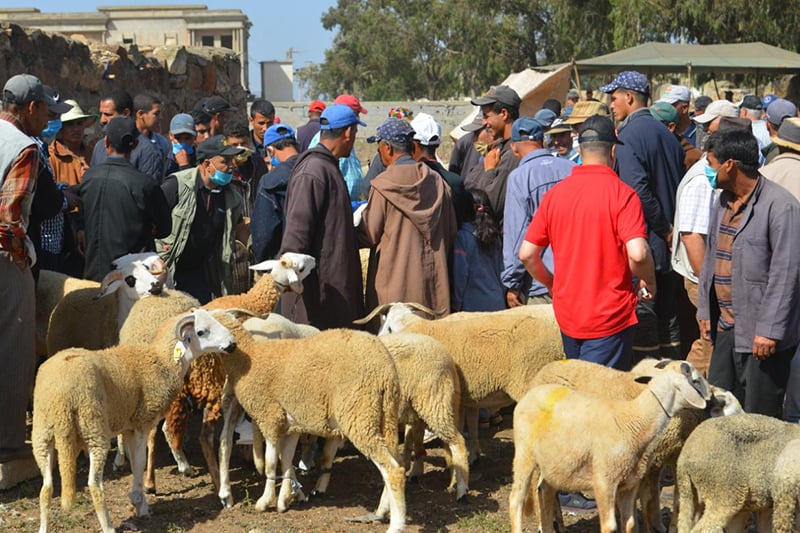
Regarding the markets of the province of Sidi Bennour, Mufakar Issa, one of the citizens arriving at the market to survey prices, said that the commercial space is witnessing a significant influx of livestock, which reflects the abundance of supply during this year, highlighting that the variety of prices allows citizens to purchase their sacrifices according to their purchasing power, in the presence of professionals and expectations of increasing demand with the approach of Eid al-Adha.
For his part, Abdelkrim Al-Hamala, a community activist and member of the livestock market association in the province of Sidi Bennour, confirmed that local professional associations are working in close coordination with the provincial, local, and security authorities to ensure the transparency of transactions and protect the rights of breeders and consumers alike, by activating the regulatory role to combat all forms of fraud and manipulation, and strict adherence to the market free of defective sacrifices.
It is worth mentioning that to facilitate the marketing process and guide consumers, a set of logistical and organizational measures have been taken, including the establishment of model mobile markets in partnership with the National Association of Sheep and Goat Breeders at the regional level, to bring the supply closer to citizens and ensure transparency and comfort in commercial transactions.