HIBAPRESS – Mohammed Zariouh
The sports scene in the Nador region is experiencing a major scandal, after revealing explosive data that exposes a group of local clubs being subjected to systematic blackmail by one of the elected councils in the region.
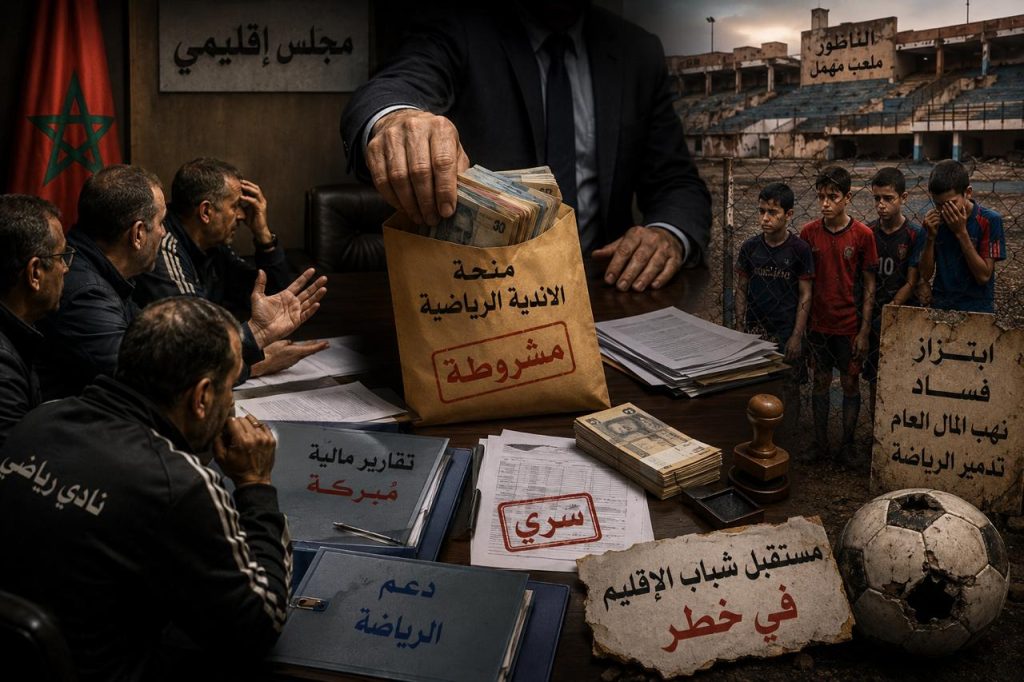
This suspicious situation has led many sports actors to seriously question the hidden parties behind these practices, which threaten the future of sports in the region and strike at the heart of integrity and transparency amidst increasing demands for accountability. These extortion operations rely on a secret and dangerous formula that has become known in management circles as "conditional grants," where an agreement is reached with the club's administration to provide a specific financial support, in exchange for a secret condition requiring the return of half or a quarter of the grant amount directly to the council president or influential parties within it. This fraudulent method aims to pass public funds with a legal semblance, before a significant part of it is embezzled and directed towards unknown pockets far from the eyes of direct monitoring. In this context, a group of managing offices of the affected clubs in the Nador region expressed their deep regret and strong condemnation of the humiliating and illegal way this council deals with the sports support file. Sources from within these offices confirmed that the continuation of these practices for many years under the table contributed to corrupting the sports environment, and turned public support, which is a legitimate right for clubs, into a means of illegal enrichment at the expense of athletes' efforts. This corrupt style in managing sports affairs caused the sports associations to be engulfed in a spiral of suspicious funding, where the managing offices find themselves forced to justify spending the full amount of the grant in their financial reports, while in reality they only benefited from a partial part of it. This manipulation not only contributes to disrupting the teams' budgets and their inability to manage their training and travel, but also puts their officials under legal and criminal liability due to the fabrication of accounts. The consistent data indicates that the council in question now puts this corrupt condition as a basic and non-negotiable rule for releasing and passing annual grants. In the event that the club administration refuses to comply with these extortions and pressures, its request is met with complete rejection, or procrastination in processing the files, or reducing support to low levels that necessarily lead to the team's bankruptcy and freezing of its activities and final withdrawal from official competitions. Faced with this clear overreach, a group of managing offices in the Nador region demanded the urgent and direct intervention of the regional and local authorities, headed by the region's governor, in addition to the judges of the Supreme Audit Council. These accelerated demands come to open a deep and comprehensive judicial investigation to determine responsibilities, and to ascertain the size of the suspicious funds that have been passed over the past years under the cover of supporting sports and encouraging youth. Those who follow local affairs believe that the biggest victims of these extortionate behaviors are the youth and children of the Nador region, who find in these clubs a unique refuge to hone their talents and stay away from deviation. Weakening the teams' budgets and depriving them of their real financial resources directly leads to reducing activities, freezing the younger categories, which frustrates the dreams of hundreds of aspiring athletes to climb the ranks and build a clean football career free from suspicions. The sports and associative circles in Nador are eagerly awaiting what the coming days will reveal in terms of official reactions, especially in light of the managing offices' insistence on breaking the wall of silence and exposing these practices. It seems that the scenario of judicial confrontation has become the closest option to purifying the sports arena in the region, and restoring the credibility of public grants as a transparent mechanism for promoting local development and not as a tool for political and financial blackmail and the looting of public money.