Mohammed Manflouti_ HIBAPRESS
The gathering dispersed, the elections concluded, and those who won, won, and those who lost and were eliminated from the "electoral" contest, were eliminated. Some people are now thinking of submitting appeals and gathering evidence and proof to overthrow their rivals.
This is the legislative election stage, full of surprises, secrets, and developments. During the campaigns that took their owners through villages, hamlets, and remote areas to gain sympathy and present electoral program pages, promises were made of the ability to solve problems, create opportunities, and defend issues of public concern, such as health, education, roads, pathways, and many other files…
On the national level, the Authenticity and Modernity Party (PAM) dominated the scene, and its leader, Fatima Al-Mansouri, was appointed Prime Minister after receiving the royal trust from His Majesty King Mohammed VI, who tasked her with forming the government.
On the local level, and for example, to bring the esteemed reader closer to the chapters of this "electoral race," let us take you to the capital of Chaouia, specifically in the province of Settat, to shed light on several aspects of the backstage of the electoral campaigns, leading up to the announcement of the results…
Following the "war of granting nominations" and the accompanying transitions to other parties in a bid to obtain the "participation" card in this national endeavor.
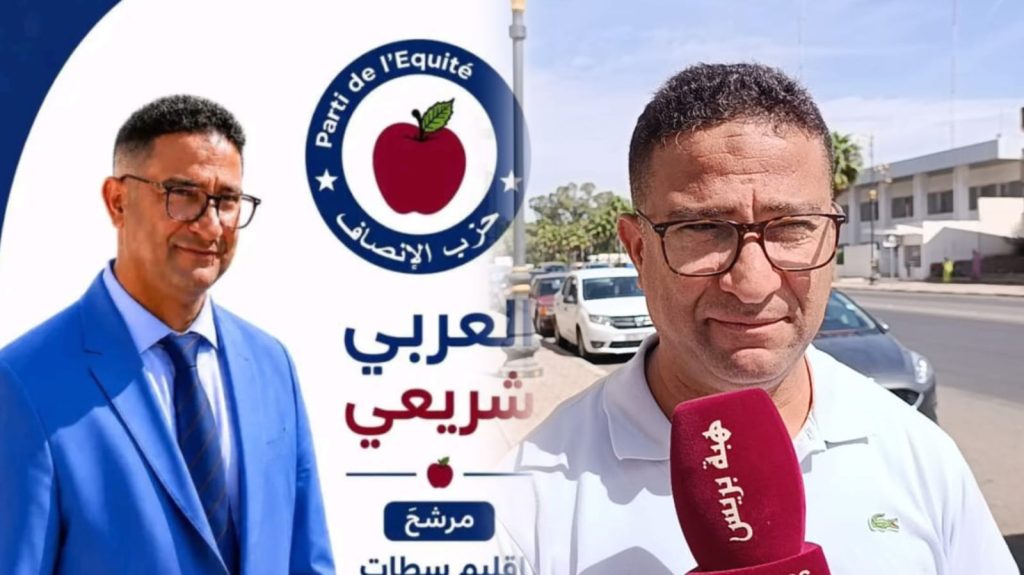
On this topic, HIBAPRESS hosted the PhD researcher and current Member of Parliament for the Al-Insaf Party, Al-Arabi Shreai, from the province of Settat, in an interesting episode that touched upon the most important political milestones the man went through before securing a seat in Parliament and uniting the tribes of Bani Meskin as one man…
As everyone knows, the province of Settat won six parliamentary seats within the official list, and two seats for women within the regional lists, meaning a total of eight seats that will be represented in the Parliament dome to defend the interests of the entire province.
From now on, there is no room or excuse… It requires genuine advocacy within the Parliament dome to present the concerns and preoccupations of the province's residents, and to work on concluding agreements, partnerships, and contributions.
After a long night of waiting at the Settat provincial headquarters, the results followed, led by the "Rasheedian tractor" to plow the land of Chaouia in the person of MP Othman Badil, followed by the Al-Insaf Party's apple, Dr. Al-Arabi Shreai, the latter having surpassed the Independence Party's scale belonging to Bouchaib Hamid Allah. Then came the palm tree of the Social Democratic Movement Party in fourth place in the person of Massoud Oussar, followed by the lamp of the Justice and Development Party belonging to Ali Fadeli, before Mohamed Ghiath's dove triumphed over Al-Zouairi's ear of wheat. The regional women's lists went to the candidates of the "Palm Tree" party and the Al-Insaf party.
No one but an ingrate would deny that the electoral campaigns were a code of honor that bound their participants. Some pledged to build roads, rehabilitate pathways, and construct hospitals, schools, and branches. Others focused their discourse on the "necessity of changing the 'old faces' who have been in power for too long without making an impact."
No one but a legal ignoramus would deny that the role of a parliamentarian (whether in the House of Representatives or the House of Councillors) is limited to representing the nation, contributing to legislation, monitoring the government's work, and evaluating public policies in accordance with the constitution. All matters related to equipment and infrastructure fall under the purview of locally, regionally, and provincially elected councils. However, despite this, some competitors present these as electoral promises, as if they are selling illusions to people.
During our interview with MP Al-Arabi Shreai, who responded without reservation and with an open face, he attempted to answer our questions without political rhetoric, emphasizing the need to move beyond the atmosphere of electoral competition and transition to a new phase characterized by collective work and joint advocacy for the province's issues. He called for putting aside party differences and working collectively to defend priority files in the province of Settat.
Shreai also called on the winning parliamentarians in the province of Settat to join hands and coordinate among themselves to form a lobbying force capable of advancing Settat's files within institutions, highlighting that unifying visions and efforts on common files would give the province greater strength in advocacy, stating that "8 parliamentarians advocating for one file will form a strong bloc to resolve it."
Regarding the question of "making electoral promises" during campaigns, Shreai said that he was clear and frank, being a man of law who knows what he is saying. His promises were all focused on changing the reality and bringing in new faces. He reiterated that each parliamentarian working individually to serve their party would not be enough to achieve the province's developmental aspirations, considering that the next phase requires moving beyond party calculations and working collectively on files that concern the residents of Settat.
Details about this interview are in the following coverage: