HIBAPRESS
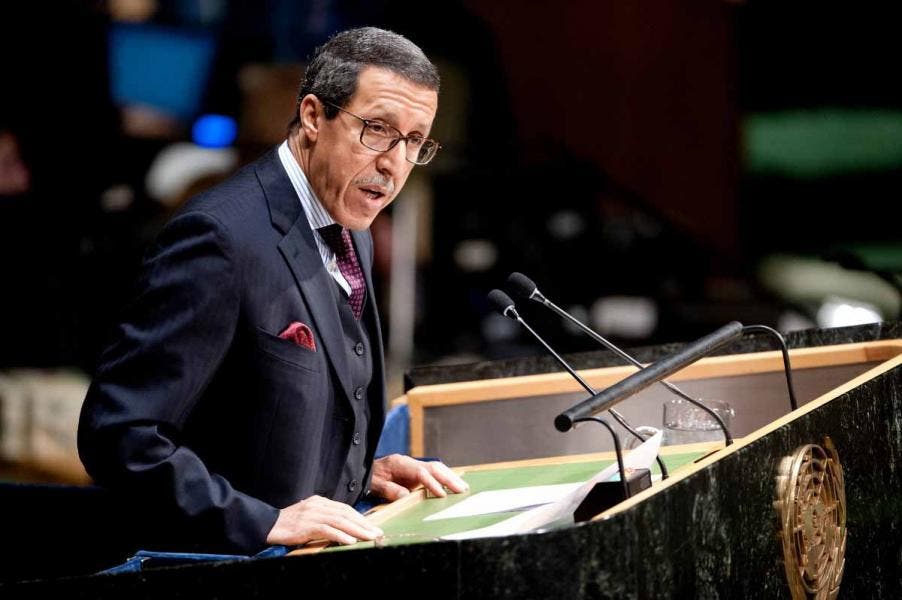
Omar Hilale, the Permanent Representative of Morocco to the United Nations, affirmed on Tuesday in New York that Security Council Resolution 2797 marked a "decisive turning point" in the UN's handling of the Moroccan Sahara issue, "by shifting from the logic of managing the issue to the logic of its settlement."
Mr. Hilale explained, in a speech before the Fourth Committee of the UN General Assembly, that this resolution, which was praised by all parties, represents "an irreversible turning point compared to all previous Security Council resolutions," noting that it "enshrined the Moroccan initiative for autonomy as the sole basis for settling this regional dispute, placing it at the heart of the political negotiation process."
He highlighted that the resolution also, for the first time, "included the status of autonomy within the framework of Moroccan sovereignty," adding that the UN document reaffirmed the responsibility of the four parties: Morocco, Algeria, Mauritania, and the "Polisario," whom the Council called upon to engage, in good faith and without preconditions, in the search for a final political solution.
Resolution 2797 also facilitated direct talks between the four parties, during three meetings held in Washington and Madrid, under the joint chairmanship of the Personal Envoy of the UN Secretary-General and the Permanent Representative of the United States to the UN, which enabled Morocco to present the advanced autonomy status, detailing the competencies, powers, and prerogatives of the executive, legislative, and judicial bodies.
Mr. Hilale stressed that this autonomy "reconciles political realism, democratic governance, and the aspirations of the population."
After noting that this "unprecedented political momentum requires each party to bear its historical responsibility in implementing this resolution," Mr. Hilale emphasized the necessity of "implementing Security Council resolutions, initiating discussions without preconditions, translating good faith into actions, respecting commitments made, and re-establishing and adhering to the ceasefire."
On another note, Ambassador Hilale pointed out that regardless of the political dimension, Resolution 2797 and the negotiation dynamics it has generated hold, above all, a humanitarian promise, affirming that "behind every decision, there are women, men, and youth waiting in the Tindouf camps."
Mr. Hilale expressed his regret that "the mere humanitarian management of this situation, which is the second-longest detained persons crisis in the world, cannot continue for another half-century," stressing that for this reason, Morocco calls for enabling the population of the Tindouf camps to have sustainable solutions as stipulated by international law, and the doctrine and practice of the UN High Commissioner for Refugees.
He explained that these sustainable solutions include voluntary return, to which His Majesty King Mohammed VI has previously issued a call in this regard, or resettlement in a third country, or integration into the host country, in accordance with the free and voluntary choice of these populations.
He asserted that "any delay or conditionality will be legally illegitimate, politically unethical, and humanely unacceptable."
Furthermore, in recalling the historical misrepresentations, legal distortions, and denial of facts that have been raised about Resolution 2797 in recent weeks, Mr. Hilale was keen to correct some claims and clarify several concepts.
Regarding the decolonization of the Sahara, the diplomat recalled that this issue "was definitively settled half a century ago, with the return of the Sahara to its motherland, the Kingdom of Morocco, thanks to the glorious Green March and the Madrid Agreement," noting that Resolution 2797 came to reinforce this integration by enshrining autonomy within the framework of Moroccan sovereignty.
Concerning the principle of self-determination, Mr. Hilale pointed out that UN doctrine in this regard is not limited to Resolution 1514 alone, explaining that the "numerous gaps and shortcomings" that marred this resolution led member states to supplement it with Resolution 1541, which enshrined the incompatibility of the principle of self-determination with any infringement of the national and territorial unity of countries, and Resolution 2625, which states that "the acquisition of any other political status freely determined by a people constitutes a means for this people to exercise its right to self-determination."
Regarding good faith, Ambassador Hilale affirmed that it is not an "empty slogan," but rather "an expression of sincerity, political commitment, and diplomatic ethics" that must be "reciprocal," stressing that Morocco's presentation in Washington of a detailed autonomy plan "constitutes the highest expression of the Kingdom's good faith."
Returning to the identification of the parties involved in the political process, Mr. Hilale affirmed that the four parties to this dispute "have been duly identified in successive Security Council resolutions." He clarified that the negotiations held in Washington and Madrid involved, by nature, "the four parties identified by the Security Council, namely Morocco, Algeria, Mauritania, and the Polisario, without any discrimination or distinction between them."
Ambassador Hilale also addressed the advisory opinion of the International Court of Justice, which was repeatedly referred to during the Fourth Committee meetings. In this regard, he recalled that the Court's opinion acknowledged two political and historical realities: 1) Morocco existed in its Sahara long before Spanish colonization. 2) There were ties of allegiance between the Moroccan sultans and the Sahrawi tribes.
Regarding the description of the Moroccan Sahara as "the last colony in Africa," Mr. Hilale noted that the use of this description when referring to the Moroccan Sahara undermines the credibility of those who promote it, affirming that "what was negotiated in Washington and Madrid is not the decolonization of the Sahara nor the issue of the last colony in Africa, but rather the status of autonomy within the framework of Moroccan sovereignty, in order to definitively settle this regional dispute."
Concerning the concept of representation, the Ambassador asserted that the armed "Polisario" group's unilateral declaration of representing the population of the Tindouf camps "is nothing but a shameful violation of their political rights and a flagrant confiscation of their democratic will."
He stated that "the true representatives of the Moroccan Sahara are those who are democratically elected, as was the case during the legislative elections held on September 23 last," recalling that the elected officials in the region have all, since 1975, been from the Sahara and its authentic tribes.
Mr. Hilale also criticized the discourse promoting the idea of a referendum, considering it "evidence of a veiled denial of Security Council resolutions." He reminded, in this regard, those he described as "forgetful" that "the Security Council definitively buried the idea of a referendum a quarter of a century ago," as did the Fourth Committee, whose resolutions, regularly adopted for twenty years, contain no reference to a referendum.
Mr. Hilale affirmed that the optimism generated by Resolution 2797 and the negotiations held in Washington and Madrid "herald a final settlement of the regional dispute over the Moroccan Sahara," noting that the true impact of this development "will be greater, as it carries an ambition to establish a new regional era."
He explained that this ambition is what His Majesty King Mohammed VI expressed in his speech on October 31 last, in which His Majesty renewed "our commitment to continue working to revive the Arab Maghreb Union, on the basis of mutual respect, cooperation, and complementarity, among its five states."
He concluded that this ambition aims to make the southern Mediterranean more open to cooperation and partnerships, the Sahel region more secure, isolated, integrated, and benefiting from exchanges, the African Atlantic space more connected and open to the world, and a more stable and united Africa, where energies are harnessed to serve development and shared prosperity.