Heba Press / Agencies
In the largest cyberattack on a communications network used by Lebanon’s Hezbollah, hundreds of party members were injured in various parts of Lebanon, including the southern suburbs of Beirut, after their communications devices were penetrated by Israel and detonated at the same time.
Lebanon’s National News Agency reported that the portable “pager” system exploded, while international agencies reported that 9 people were killed and about 3,000 members of the Lebanese Hezbollah were injured today, Tuesday, in southern Lebanon and the southern suburbs of Beirut, after the explosion of the wireless communication devices (pagers) they use, in an operation that Israel is likely behind.
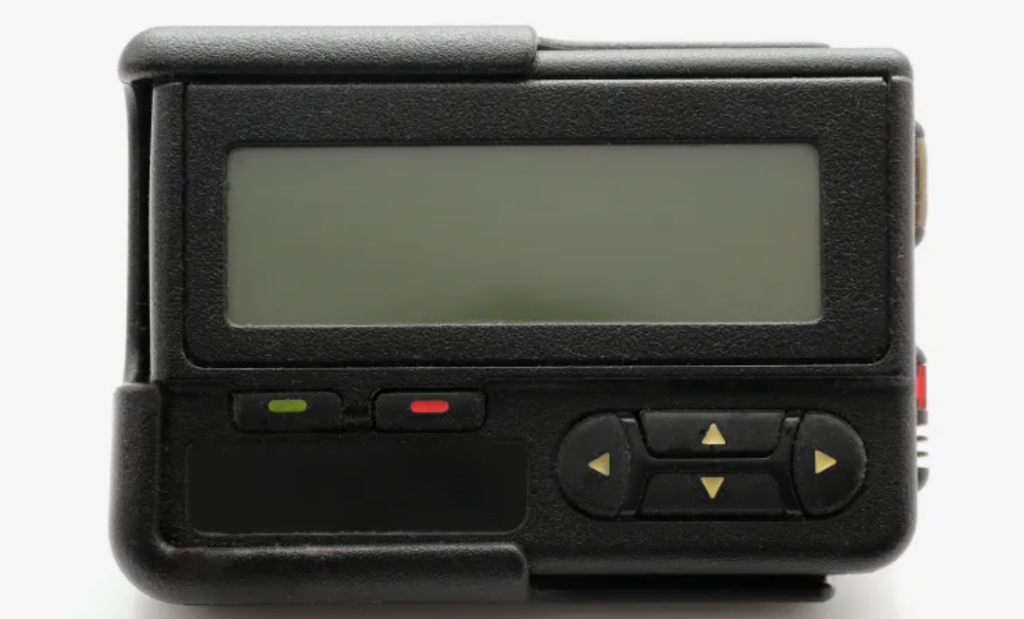
What are pagers?
The “pager” is a small, portable wireless electronic communication device invented by Canadian engineer Alfred Gross in 1949. It is also called a cordless pager. It can be used to communicate within institutions or across different groups and systems. It is powered by batteries and receives text messages, communications, and audio and light signals.
Uses of the Pager
Pagers – also called pagers – are used to communicate with customers in restaurants and cafes, or in hospitals and large shopping malls, or in any institution that wants to run a group system and communicate with them easily. They were also used to communicate between people before the advent of mobile phones.
Pagers run on lithium batteries – which can last for several days – and early versions of these devices were developed in the 1950s and 1960s and were widely used in the late 1980s and early 1990s of the same century, before the spread of mobile phones.
Originally, the pager system worked via wireless communication waves, sent from specialized antennas, and with the technological development, it began to adapt to advanced communication technologies such as smart applications, Bluetooth and Wi-Fi technologies.
Radio wave receiver
The pager device works by receiving waves and signals from a transmitter, which converts them into written or audio symbols or vibrating movements that inform the holder of the device that he or she has received a message.
The number of Pager users in the mid-1990s reached over 61 million people worldwide, and this number has fallen to around six million people by 2016.
Healthcare facilities in the United States of America were among the first users of these devices in the 1950s, and in the 1960s they were developed for use in other areas, including personal communications.
A safer device
Doctors and hospital staff use it to communicate with each other and call each other without noise and in a way that maintains the necessary calm in the patient care environment, but also to avoid the vibrations of mobile phones and their impact on patients and medical devices.
As for restaurants, they also find in pagers an effective way to organize their work, as they allow rapid communication between employees in their different work chains, and also facilitate the organization of the reception and distribution of customer requests.
One of the features of pagers – besides their cheap prices – is that they have a special communication network. They are also robust and designed to withstand harsh conditions, repeated use and long-term use.
These devices are also difficult to penetrate because they are often not connected to the Internet and operate using wireless radio wave technology on specific frequencies and with special codes. This is what explains the use by Lebanese Hezbollah to communicate between its members.
Massive bombing of Hezbollah aircraft
On September 17, 2024, Hezbollah announced that hundreds of its fighters and other Lebanese citizens had been injured to varying degrees after the pagers they were carrying exploded, and accused Israel of being behind the attacks.
These bombings took place in many areas of Lebanon, including the southern suburbs of Beirut and the cities of Bekaa, Nabatieh, Housh, Bint Jbeil, Tyre, Tripoli, Baalbek, among others.
In turn, Lebanese Health Minister Firas Al-Abyad said that 9 people were killed and about 2,750 injured by the explosion of the aforementioned communication devices, adding that more than 200 of the injured were in critical condition. He revealed that most of the injuries were in the face, hands and abdominal region.
In the same context, the American newspaper “The Wall Street Journal” reported that the “pager” devices carried by hundreds of Hezbollah members and which exploded unexpectedly came from a new delivery that the party received in recent days.
A Hezbollah official said hundreds of fighters had such devices and speculated that malware may have caused the devices to overheat and explode. He added that some people had the impression that the devices were getting hot and so were disposing of them before they exploded.
Anatolia also quoted Lebanese communications expert Hisham Jaber as saying that the process of detonating the pagers is a very high-tech process that Israel cannot carry out alone, but rather with the help of its allies.
Why do Hezbollah members wear it?
The pager is considered a relatively old technology that cannot connect to the internet and is therefore considered somewhat safe from cyber penetrations and common attempts at spying and tracking when using mobile or smart phones. It is therefore still used in the military and security fields, and this is probably the reason why Hezbollah members, God bless you for having these devices.
3- How did the devices explode?
It is still too early to know exactly how these devices exploded, as explanations for why this happened continue to emerge, the most prominent being that a chip was implanted in all the paging devices before they were imported and used by Hezbollah operatives.
This chip was activated through radio waves sent via drones launched throughout Lebanon by the Israeli occupation, so that these drones would either detonate the chip or raise the temperature of the device’s battery, leading to its explosion.
The previous theory is reinforced by what Reuters reported from Lebanese sources confirming that the communications devices that exploded were the “latest model” brought by Hezbollah in recent months. The American Wall Street Journal also cited sources close to Hezbollah as saying that the targeted devices were part of a new shipment recently received by Hezbollah.
Another explanation is that these devices were hacked with a type of virus that increases the temperature of the battery, causing it to explode.
What are the most targeted areas?
The infections were concentrated in southern Lebanon and the southern suburbs of Beirut, but in reality there are no specific targeted areas, as the infected were all people with pagers, regardless of their location.
This is evidenced by the injuries of four people in Syria following the explosion of their car in a tunnel in the capital Damascus. Syrian media suggested that the injured were Hezbollah members, as the communications devices they were carrying exploded.