Heba Press/. Rabat
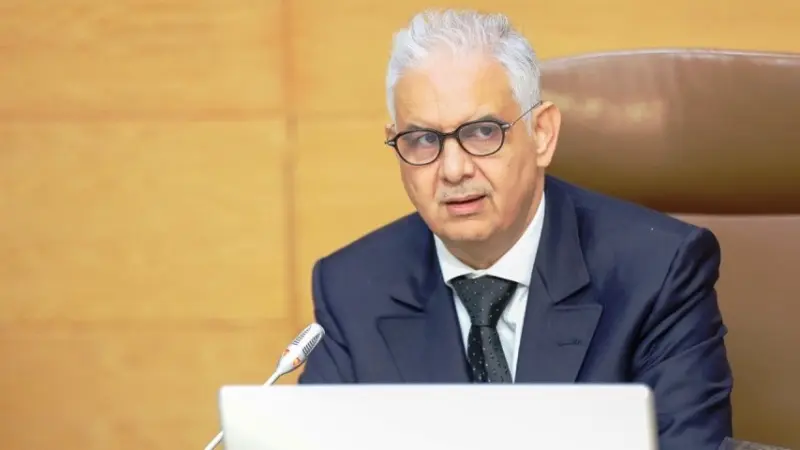
The Minister of Equipment and Water, Nizar Baraka, stressed today Thursday in Rabat that the new challenges that must be faced by Morocco underline the importance of reviewing its water policy, in order to better plan the needs of different sectors.
Mr. Baraka declared, in a speech delivered on the occasion of the opening of a study day on the theme “The assessment of water resources in the context of climate change”, that “the new challenges facing we must face confirm the importance of reviewing our water policy.” in order to better plan the needs of different sectors, in connection with the development of available water resources, in order to better take into account the realities imposed by climate change in our country.
The minister explained, during this meeting organized by the Ministry’s General Directorate of Hydraulic Engineering, that “increasingly irregular precipitation (…), rising temperatures and the worsening of extreme natural phenomena, such as floods and droughts, require a new vision.” in order to better characterize and evaluate the possibilities of water resources and the hydraulic needs of the different sectors of the national economy.
He stressed that the challenges facing a country like Morocco remain enormous, in order to increase its capacity to resist climatic disasters, noting that better water management begins first with a precise and regular assessment of water resources, whether underground or surface, in order to better plan to meet current and future water needs.
He indicated that Morocco is today going through one of the worst periods of drought in its modern history, stressing that this situation has a strong impact on water reserves and affects a set of economic sectors in the country.
This situation has led – adds the minister – to an overexploitation of groundwater tables, far exceeding the annual volume of renewable water, which has led to a significant reduction in the water level of these aquifers and, in certain cases, to a reduction in their water reserves. This overexploitation has led to a reduction in the flow of natural springs and lakes and the drying up of some of them, in addition to the deterioration of the quality of groundwater, such as coastal aquifers.
According to Mr. Baraka, if Morocco has been able to overcome the major challenges it faces in the field of water management, this is mainly due to the visionary hydro-agricultural policy launched by His Majesty the late Hassan II, and continued and developed by His Majesty King Mohammed VI has thus made it possible to provide Morocco with significant hydraulic infrastructure.
It was noted that thanks to these infrastructures and the proactive and integrated management of traditional and non-traditional water, the drinking water needs of the population were met without recording deficits in cities and large centers, while taking appropriate measures in rural areas, which also allowed for the development of irrigated agriculture.
The Minister stressed that, faced with the persistent drought characterized by the interruption of the supply of drinking water in certain regions of the Kingdom, and in application of Royal directives, the National Drinking Water Supply and Irrigation Program has was developed with the aim of accelerating investments in the water sector, improving the supply of drinking water and supporting irrigated agriculture, particularly in areas most affected by water shortages.
He concluded that Morocco was among the first countries to take into account the idea of integrated water resources management within its national laws, which enshrine the notion of social value of drinking water and the economic value of water for different users.
For their part, a number of international experts in the field of water resources management took turns, through technical presentations, to demonstrate methodologies for mitigating the water deficit and coping with the disastrous effects of drought waves, while reviewing a number of effective models in the field. exploitation of surface water and groundwater.
These experts were keen to welcome the methodology by which Morocco manages the problem of lack of water resources, as well as its future projects to meet the challenge of water supply and secure additional resources for the years to come.
This study day was an opportunity to discuss with eminent international experts from various backgrounds on the latest scientific developments in the field of water resources evaluation, to discuss the most common analysis methodologies. more important and to exchange experiences in this area with the aim of contributing to a better assessment of water resources. water resources in Morocco.