HIBAPRESS-RABAT-CI
The idea of the March was “conceived and defined in solitude and meditation” by the late HM King Hassan II, from August 19, 1975. With the exception of the restricted circle of his closest collaborators, the first to have informed of the operation were the governors of the Kingdom, one evening of the month of Ramadan, September 26, 1975, after taking a solemn oath not to reveal anything.
As soon as they returned to the prefectures and provinces, they began, under various pretexts, the inventory of available products and materials, consumer products, means of transport, buses and trucks, means of accommodation, tents and blankets.
Subsequently, seven hundred agents and auxiliaries of authority were sent by the Ministry of the Interior to Benguerir to receive accelerated training focused on civics, patriotism and the supervision of the masses, following the example of the school of executives of the Road to Unity. They themselves will only know the reason for this training during the speech on October 16 announcing the March.
From this date, volunteer registration offices are open across the country under the direct authority of governors. Throwing three hundred and fifty thousand people into the desert, 10% of whom are women, requires extremely efficient and precise organization. Even the number of volunteers is not left to chance. Hassan II explains it this way: “This is the number of individuals born in Morocco each year. I thought it was permissible for me to engage in the solemn harvest that God gives Us to bring back to the Homeland a Land that We had never forgotten. The walkers were recruited according to quotas set for each province, according to the size of the tribes, but also according to their loyalty.
According to Maâti Bouabid, former Prime Minister: “It was a real Morocco in short, where all the provinces, all social conditions, all political tendencies were represented…”. This enthusiasm must be qualified: forty-three thousand five hundred marchers are officials. Although young scouts are very present, students have been practically excluded and cities are under-represented compared to the countryside.
Units of the Royal Armed Forces (FAR) and the Royal Gendarmerie supervise the system, in coordination with the governors and assisted by four hundred and seventy doctors and medical assistants.
For twelve days, ten daily trains will transport volunteers from the North and East of Morocco to Marrakech, from where they are transported by seven thousand eight hundred and thirteen trucks to Agadir, then the bivouac centers of Tan Tan and Tarfaya, towns bordering the demarcation line between Morocco and the disputed area.
The first delegations from the various Provinces of the Kingdom arrived on October 23, 1975, from the province of Errachidia. For some who come from distant cities like Tangier, Hoceima, Oujda or Figuig, the distance to travel to reach the Atlantic city of Tarfaya exceeds 1,500 kilometers.
The Royal Gendarmerie must organize the movement of convoys and guarantee road safety so as not to paralyze ordinary passenger and goods traffic in the country. Accommodation and reception committees are responsible for organizing departures from the different regions of the country and supervising the walkers to transport them by trains, buses or trucks to the Sahara. More than five thousand civil agents, from the State and local authorities, take part, not counting the participation of elected bodies.
The same organization awaits the walkers in the camps. Each camp corresponds to a massira, that is to say the contingent of walkers from a prefecture or province. It has a leadership and management body as well as a medical structure. A national commission where all ministerial departments are represented centralizes the storage of food, medicines and other supplies.
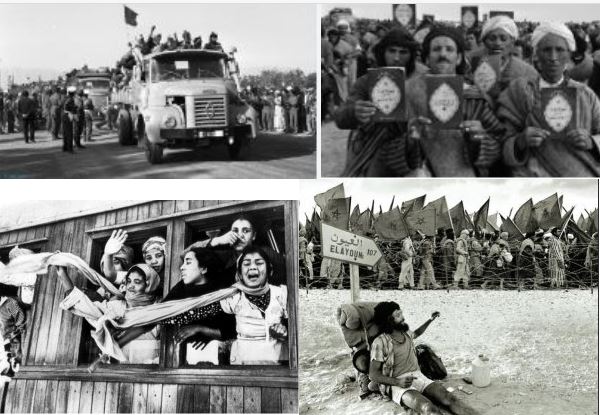
Upon their arrival, the delegations are immediately put to work, with the help of a coordination committee, to organize life on site. It’s a real little tent city that’s being built. “The camps, generally rectangular in shape, enclosed by vehicles used to transport walkers and their equipment, included an organization corresponding to the multiple administrative and socio-cultural activities of the residents’ lives. The tents are arranged by district or by douar with central places for gatherings, rehearsals or artistic, cultural or sporting events.” Logistical problems on the ground are planned down to the smallest detail, tents, health problems, food, even the airdrop of the flour necessary for making bread. Two thousand walkers were even called upon to create a landing strip, in two days, in the sands of Tarfaya, for planes transporting delegations from abroad or emergency equipment.
Life is then organized around the daily activities of camp maintenance, meal preparation, festivals and cultural events and prayer meetings and religious reflection which punctuate the walkers’ time until the evening of November 5 after the appeal launched by HM the King to his people: “Tomorrow, you will cross the border. Tomorrow you will begin the March, tomorrow you will tread a land that is yours, you will feel the sands that are yours, tomorrow you will kiss a ground that is an integral part of your dear country.