Abdel Latif El-Baz – Italy Office
Morocco’s Ambassador to the Holy See and the Independent Military Order of Malta, Raja Naji Makkawi, highlighted the role of archaeological tourism in the Kingdom, which contributes to strengthening Moroccan cultural identity by highlighting value the richness of its history and traditions.
In his speech during the twenty-sixth session of the Mediterranean Archaeological Tourism Exchange, organized in the city of Salerno (southern Italy), the Kingdom’s ambassador to the Vatican, Raja Naji Makkawi, highlighted the importance of archaeological tourism, which plays an important role in the preservation and preservation of national archaeological sites.
In this regard, the ambassador recalled the latest archaeological discoveries on Moroccan soil, including the oldest Homo sapiens in the world dating back 300,000 years, and the oldest jewelry and sewing tools in the world… in addition to the archaeological site recently discovered in Oued Baht…
She explained that these important discoveries open a new page in Moroccan prehistory, because they show the level of development reached by Moroccan societies in the Neolithic and the civilizations that succeeded one another on the territory of the Kingdom.
It was an occasion during which diplomacy showcased the richness of Moroccan architectural heritage throughout the ages, truly considered a unique blend of cultural and civilizational influences. It is a witness to the height of sophistication and prosperity, and evident architectural, cultural and artistic distinction, as each group of unique historical monuments helps identify its era. By highlighting this, the Powerpoint technique made it possible to highlight the archaeological, architectural and decorative characteristics of each era, starting with the Mauritania of Tangier (Chella), the Phoenician era (Essaouira Mogador, Luxus) and the Roman era (Vulubilis). Civilization and architecture reached their peak with the Idrissid era (Moulay Idriss mosque, Al-Qarawiyyin University and its builder, Umm Al-Bénin Fatima Al-Fihri), reaching the Almoravid and Almohad era (the dome, the katiba, the Giralda, the Kasbah of the Oudayas, the lighthouse, the Hassan Mosque and the hermitage), until the time Marinid with its numerous schools (The Bou-Inaniya school…), then the Saadians (the tombs of the Saadians), then the Alawite era, whose landmarks are innumerable (Bab Al-Mansour, the gates of Fez…). Bringing together the splendor and luxury of the architecture of this era with a dazzling model, the late Hassan II was keen to showcase his grandeur and rich and multiple arts in the Hassan II Mosque and the Sakina Mosque.
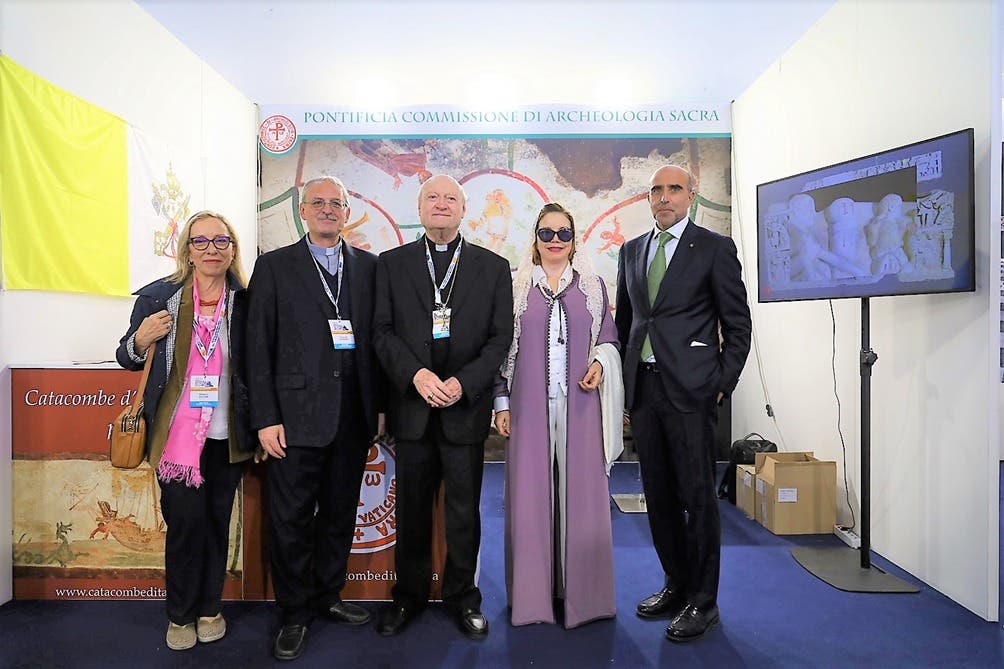
The ambassador participated in this twenty-sixth session at the invitation of Cardinal Gianfranco Ravasi, founder of the Cortili dei Gentili and head of the Pontificia Commissione di Archiologica Sacra. Who did not miss the opportunity to express their questions about the lack of participation of Morocco in the pavilions to present these riches and its desire to see its participation in the next editions of this great Mediterranean event.
It should be noted that the Mediterranean Exchange for Archaeological Tourism takes place under the auspices of the United Nations Educational, Scientific and Cultural Organization (UNESCO), the World Tourism Organization and cultural and international tourism affiliated with the United Nations. It aims to promote archaeology. tourist destinations, promote parks and museums, encourage marketing, increase economic opportunities and their impact on employment opportunities in the archaeological field.
This annual meeting is a space for exchange and discussion on fundamental subjects linked to archeology and the preservation of cultural heritage at the global level. It stood out for a rich and diverse program, which included discussion sessions, interactive workshops and exhibitions (pavilions). for each country, enriched by specialized international experts.
.