This article was automatically translated from HIBAPRESS, the Arabic version:
This article was automatically translated from Hibapress, the Arabic version:
Heba Press: Muhammad Zaruh
A survey published by the Spanish newspaper “El Bayes” revealed the unknown fate of used clothes that are given in Spain for recycling purposes, because it has shown that these clothes often do not reach the needy, but rather enter into mysterious commercial networks that extend around the world.
The report also revealed that the city of Nador has become one of the main stages of this business, after having transformed an informal alternative to smuggling, which ended with the closure of the Bani Ansar crossing in 2018.
More than a year, the newspaper took the course of 15 clothes placed in recycling containers in Spain, using electronic monitoring devices. The results have shown that these clothes cut thousands of kilometers before reaching unexpected destinations, including Morocco.
One of the cases on which the report was concentrated was a black Bolero jacket, which was made in Morocco and then donated a person in Madrid, to move to the Netherlands then in a factory in the United Kingdom , before entering the recycling circle.
The report revealed the environmental dimension of this business, because seven used clothes have traveled a total distance of 65,000 km, adding a huge environmental burden. Used clothes, known in Africa as “dead white man clothes”, constitute not only an environmental problem, but also part of the transparent economic networks, in which they are sold at a low price on non -organized markets, which threatens the local industry and contributes to environmental pollution by the spread of industrial fiber and microblisse.
After closing the crossing of Bani Ansar, many former smugglers to Nador found themselves in front of a new reality, which led some of them to enter the world of used clothing trade, which was witness to ‘A large participation rate on local markets. Among the pieces followed by “El Pais” using Artags, a red coat placed in a container in the Spanish city of Guadalajara, then moved to Morocco via Rabat and Meknes, before reaching one of the informal markets of Nador, By cutting 1600 km.
The survey also revealed that the clothing trade used in Morocco is carried out by legal importers, but a large part of it is not sold in organized channels, but rather on the black market, where trading is made without invoices or taxes, which allows the sale of clothes at very low prices.
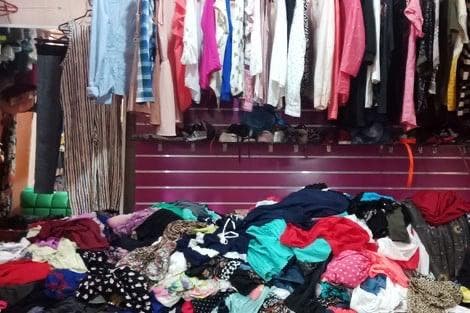
In the Nador markets, cotton treasures are sold in good condition for only 10 dirhams, while the drums are sold. Martens at 50 Dirhams and Timberland shoes at 150 dirhams, which are not compared to those of Europe, which show the size of this informal trade.
Thanks to Karama, which was established with the funding of the government as an economic alternative to people affected by the closure of the crossing of Bani Ansar, is the only part which is officially authorized to import second -hand clothes in the region of Nador. However, the survey indicated that the project, which was supposed to offer employment possibilities for 800 to 1,500 people, is not used all the affected.
In addition to the market monopoly, business workers suffer from low wages, the lack of registration in the Social Security Fund (CNSS), in addition to difficult working conditions. This reality leads to question the extent of the authorities’ ability to control this sector and ensure the achievement of its environmental and social objectives without turning into a new portal for smuggling and exploitation.