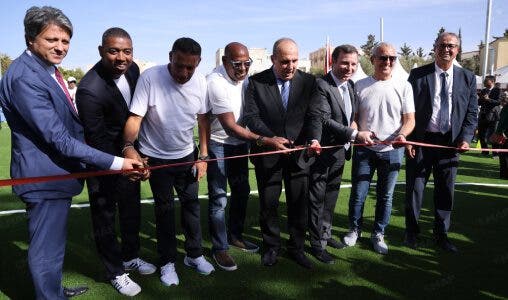
Today, Wednesday, a mini-school stadium was inaugurated at Halima Saadia School in Meknes, as part of the "FIFA Arena" project of the International Federation of Football, a global initiative aimed at creating mini-stadiums for the benefit of young people from vulnerable backgrounds around the world.
According to the data presented during the inauguration ceremony, which was attended by an important delegation from the International Federation of Football (FIFA), representatives from the Royal Moroccan Football Federation, the Ministry of National Education, Preschool and Sports, in addition to former Moroccan players, it is expected that about 2,000 male and female students distributed across four educational institutions in the Ismaili capital will benefit from this project, the first of its kind at the national level.
This modern and sustainable infrastructure provides a "safe" and "motivating" space for practicing football for the benefit of students, and also contributes to supporting the sustainable development goals adopted by the United Nations, by providing greater opportunities for children to play, especially in vulnerable urban and rural areas.
In a press statement on the occasion, the Executive President of the National Federations Division at FIFA, Elkhan Mammadov, expressed his happiness at launching a new stadium within the "FIFA Arena" program, pointing out that this project falls within the framework of implementing the commitment of the FIFA President, Gianni Infantino, during the Sustainable Sports Summit held in Paris in 2024.
Mammadov, who also praised the partnership with the Royal Moroccan Football Federation, noted that this sports facility will allow students of the concerned institutions to train and practice football in healthy and safe conditions.
He also expressed hope that these stadiums would contribute to the emergence of new stars in Moroccan football.
For his part, the Director of the Member Associations Division in Africa at the International Federation of Football (FIFA), Gelson Fernandes, praised the efforts made by Morocco to promote football among young people, adding that this initiative, which falls within the framework of the continuity of the partnership between FIFA and the Kingdom, will enable these girls and boys to practice football in favorable conditions.
He said, "Morocco is rich in many talents, and we are in the process of establishing the foundations for the future of Moroccan football."
For his part, the Vice-President of the Royal Moroccan Football Federation, Abdelsalam Belqchour, highlighted that the construction of this stadium comes within a series of projects programmed within the same initiative, noting that it was built according to FIFA's modern standards, especially with regard to the quality of artificial grass.
He explained that this initiative aims to support young people from neighborhoods that suffer from a lack of equipment, by creating appropriate sports infrastructure, highlighting that it is consistent with the United Nations Sustainable Development Goals, which include, in addition to sports infrastructure, promoting inclusion, health, and education.
For his part, Abdelsalam Mili, the Director of Promoting School Sports at the Ministry of National Education, stated that this achievement is the result of cooperation between the Royal Moroccan Football Federation, the International Federation of Football, and the Ministry of National Education, Preschool and Sports, adding that Halima Saadia School is among about 18 institutions that were selected to host this type of facility.
He explained that the selection of this school came because it won the National School Sports Championship last year, expressing hope that these facilities will contribute to highlighting a new generation of talent in football.
Four educational institutions will benefit from this infrastructure established by FIFA, namely Halima Saadia School (603 students), Hay Salam School (489 students), Salah al-Din al-Ayoubi School (181 students), and Al-Mofaddali Secondary School (816 students).
According to the project managers, the latter will have great positive effects, as it will enable this segment of young people from popular neighborhoods to practice football in ideal conditions, which enhances their social integration, stimulates their personal growth, and fuels their passion for sports.
This infrastructure consists of a small-sized stadium covered with artificial grass, equipped with fencing, nets, and sports equipment.
Morocco is the fourth African country to benefit from this project, after Niger, Liberia, and Algeria.