HIBAPRESS – Abdelatif Baraka
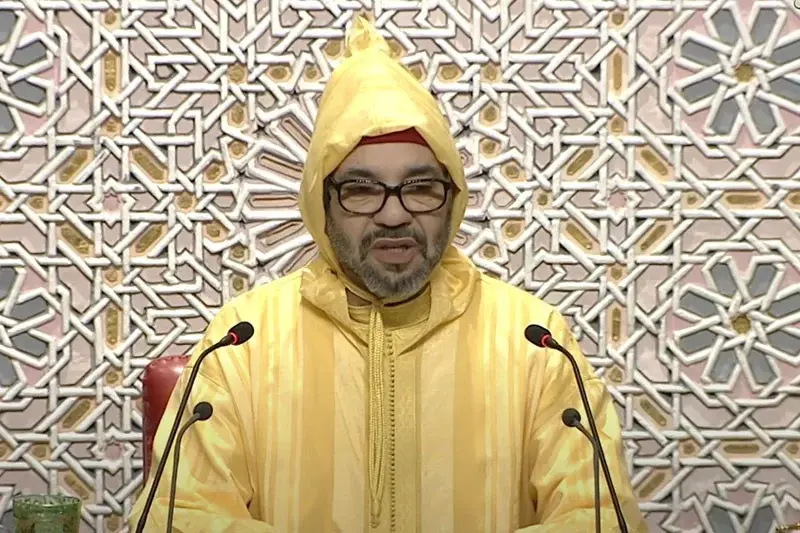
The speech of His Majesty King Mohammed VI on October 31st was a pivotal political moment in the course of managing the national issue, especially after the historic decision issued by the United Nations Security Council, which established the autonomy initiative as the realistic and only framework for resolving the fabricated conflict over the Moroccan Sahara. Various Moroccan political parties expressed their great pride in the contents of the King's speech, considering it a culmination of a long path of sound diplomatic work led by His Majesty the King, who succeeded in consolidating Moroccan sovereignty over its southern territories, and establishing the justice of the national position before the international community.
– Moroccan parties' appreciation of the King's speech
In their interaction with the King's speech, the Moroccan parties, with their various political orientations, affirmed their full support for the national position, praising the insightful vision of His Majesty the King in managing this sensitive file. The parties stressed that the King's speech was not just a political declaration, but a roadmap for the next stage, which requires renewed national mobilization to keep pace with regional and international transformations, by consolidating the new development model in the southern regions, and strengthening the advanced regional mechanisms in a way that serves the national project in its entirety.
– The situation of Moroccan parties: between the need for renewal and the demand for effectiveness
Despite this national consensus, the King's speech places the parties before new responsibilities that go beyond expressing positions to tangible field action. In recent years, Moroccan parties have been suffering from a crisis of renewing their elites, and a weakness in producing new political ideas that are in line with societal and economic transformations. The continuity of political parties has become dependent on their ability to open up to young competencies, empower them in decision-making positions, and enhance the presence of women in organizational structures. Also, the next stage requires the parties to move from the logic of populist discourse to program-based work based on competence and local management, in harmony with the spirit of the expanded regionalism that gives regional councils broad powers in planning and development.
– Parties and autonomy in the southern regions
The southern regions of the Kingdom hold special importance in the national project, and they are today an open space for the parties to embody the concept of autonomy practically by involving the population in local management and highlighting regional competencies. However, the presence of the parties in these regions is still uneven in terms of organization and effectiveness, which requires restructuring party work there to ensure balanced political representation that reflects party pluralism, and prevents the dominance of one party over the local scene. Parties must work on building trust with citizens in these regions by linking political work with actual development, and staying away from narrow electoral calculations.
– The upcoming elections and the political reform scenario
With the approach of the elections scheduled for 2026, an important question arises about the extent to which the parties are ready to contest this entitlement in light of the ongoing transformations. There is increasing discussion about the possibility of postponing the elections until the revision of the parties and elections law in line with the new dynamics launched by the King's speech, especially with regard to consolidating the principles of party governance, transparency, and linking responsibility with accountability. Revising the legal framework regulating political life may be an opportunity to rearrange the internal affairs of the parties, and renew confidence in the elected institutions, in line with the requirements of the next stage, which is based on efficiency and responsible citizenship.
– Towards a new role for the parties in the next stage
Moroccan parties are expected to turn into an effective proposing force that keeps pace with the major orientations of the state, especially with regard to strengthening Morocco's position regionally and internationally, completing the expanded regionalism workshop, and establishing autonomy as an irreversible strategic option. Also, their role in strengthening national cohesion, and mobilizing society around major issues, is more important than ever. The October 31st speech is a decisive political moment that redefines the function of parties in Morocco, from being electoral tools to being strategic partners in building the modern state. The bet today is that the Moroccan parties prove that they are able to renew their elites, develop their discourse, and engage in the new national dynamic led by His Majesty the King, for a renewed, unified, and democratic Morocco.