HIBAPRESS – Rabat
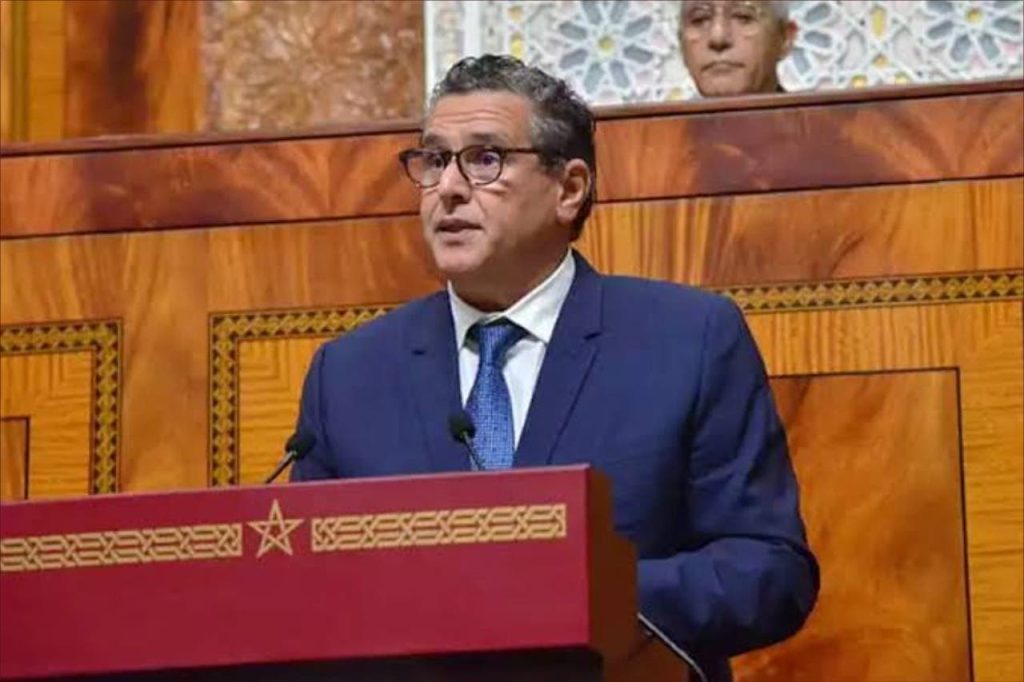
The Head of Government, Aziz Akhannouch, stated on Tuesday in the House of Councillors that the high royal directives have provided the government with a roadmap for establishing a public service rooted in the territory, based on fairness and proximity, and making advanced regionalization a lever for achieving balanced, sustainable, and inclusive development.
He highlighted during the monthly question session on the topic: "Territorial Development and the Challenges of Achieving Spatial Justice," that the stage requires a coordinated mobilization of the efforts of various actors, from the executive and legislative authorities, elected officials, public institutions, and the private sector, in order to develop an integrated territorial offer capable of transforming local qualifications into added value and more welfare for citizens, thereby consolidating spatial justice and ensuring harmonious progress that includes all areas. Akhannouch noted that implementing the royal roadmap requires adopting an integrated methodological approach that establishes a new generation of territorial interventions, based on the precise targeting of needs, the effective convergence between programs, and reliance on updated territorial data as a tool for decision-making. He continued that it has become necessary to move from temporary interventions to address deficiencies to a transformative vision aimed at creating conditions for permanent development, strengthening the capacities of fragile areas, and enabling citizens to have better opportunities for living and advancement, making spatial justice a structural path and not just a circumstantial treatment of imbalances, emphasizing that there is a need today to adopt a more accurate reading of territorial specificities, contributing to guiding public interventions according to what each area requires of appropriate solutions. The speaker stated in his speech that mountainous regions, oases, and rural areas with high fragility cannot be dealt with in the same way, but rather require approaches that are in line with their geographical nature, economic capabilities, climatic conditions, and real growth prospects. He continued by saying that the coastal area is also one of the main axes for achieving spatial justice, as called for by His Majesty the King, may God protect him, considering the developmental opportunities it abounds with and the environmental and spatial challenges it faces at the same time.