HIBAPRESS
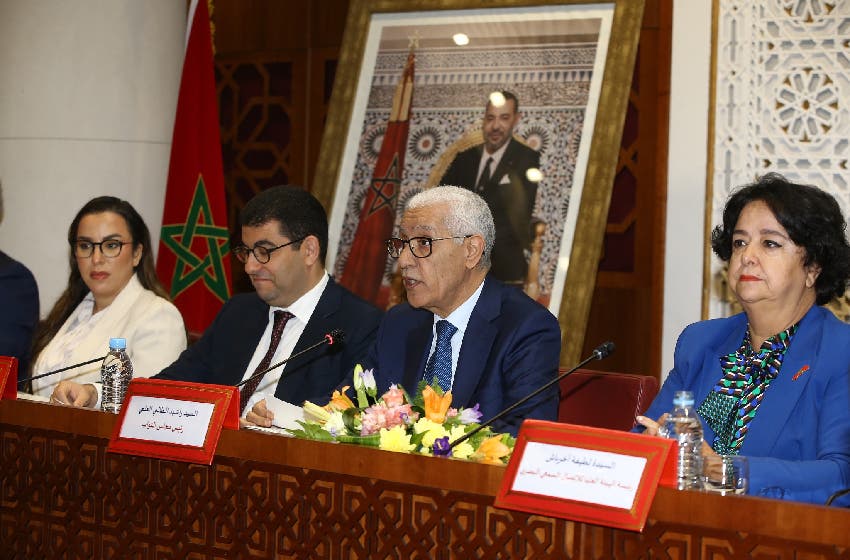
The Speaker of the House of Representatives, Rachid Talbi El Alami, said on Wednesday that the Kingdom of Morocco has achieved remarkable progress in the field of political empowerment of women and facilitating their presence in representative deliberative institutions, which embodies in a concrete way the impact of the implementation of voluntary and smart legislation adopted by Morocco.
Talbi El Alami added in a speech on the occasion of the opening of the second annual parliamentary forum for equality and parity, that “over the 26 years of the reign of His Majesty King Mohammed VI, women's issues and their rights, and their empowerment, were at the heart of the reforms adopted by the Kingdom, including the constitutional reforms that made equality between men and women in basic freedoms and rights central and convergent with what has resulted, and will result, from reforms, institutional and legislative and organizational interventions and executive decisions.”
He explained that “in just a quarter of a century, Morocco has carried out fundamental reforms in this direction, the most prominent of which are the Family Code in 2004, the advanced legislation to protect women from violence in various forms, and the legislation that enshrines positive discrimination in favor of women to enable them to access decision-making centers and representative and deliberative institutions nationally and territorially.”
The Speaker of the House of Representatives added that these achievements also include public policies and programs that put women at the heart of development, achievement and benefit, and ensuring that women occupy executive decision-making centers centrally and territorially, and voluntary policies in the field of education, in addition to the concrete valorization and incentives that enabled raising the number of women who support a family or contribute to its support from resources and institutions of the social economy to more than 270,000 women, the vast majority of whom are in the rural environment.
He added, "If what has been achieved is a cause for satisfaction, it is certainly not enough, and it challenges us all and puts us before the responsibilities of changing societal representations about the issue of equality and parity, and transforming this principle and this value into a cultural component and social behavior, which everyone possesses, and political, institutional and civil actors act on its basis in their decisions."
Talbi El Alami called in this regard to “build on the accumulation in reform, and avoid polarization in a societal issue that is of a degree of nobility, legitimacy and historical value, which requires us to agree and resort to the constitution on it, and represent the supreme royal concern for equality and equity.”
He also called for building on the gains achieved during the last two decades, where the number of women in the House of Representatives increased from two deputies in 1993 to 35 deputies in 2002, and to 96 female members in the current Council, i.e. 24.30 percent, pointing in the same context to the increase in the proportion of women's membership in the territorial units from 2.21 percent in the regional councils in 2009 to 37.61 percent in 2015, then to 38.50 percent in 2021, and in the provincial councils from 2.25 percent in 2009, then 4.18 percent in 2015 to 35.60 percent in 2021, and in the local communities from 12.33 percent in 2009 to 21.18 percent in 2015 and 26.64 percent currently.
He stressed that continuing the path to the goal of parity puts everyone before many responsibilities, including the responsibility of representing the principles of parity, equality, equity and empowerment and making them convergent in public political and civil work and consolidating this culture in society, and collective mobilization in order to value the experiences of women parliamentarians after the end of their term.
Talbi El Alami concluded that “the political empowerment of women means investing in competencies that may be disrupted, and in efforts that benefit development and progress, and launching energies that development needs, as well as the representative democracy needs”, stressing that “the matter relates to a national need and basic rights and a necessity for development that needs the intelligence of the women of Morocco and its youth and men in the context of the ongoing ascent being achieved steadily.”
(MAP)