HIBAPRESS
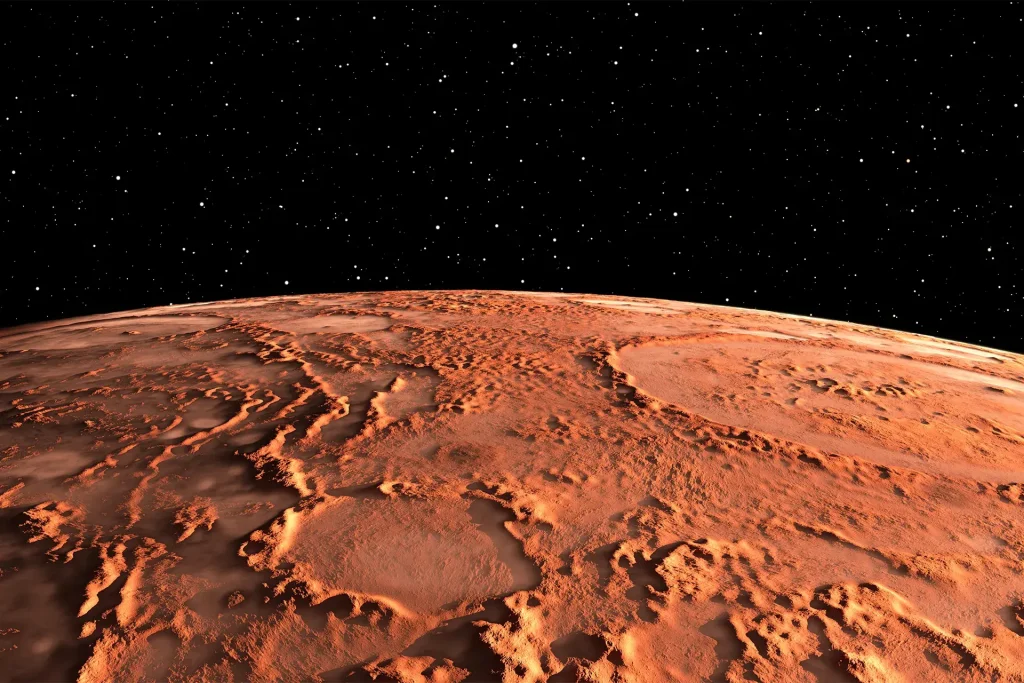
A recent scientific study has indicated that time on the surface of Mars passes at a faster rate compared to Earth, a finding reached by two researchers from the National Institute of Standards and Technology in the United States after a careful analysis of the impact of gravitational differences between the two planets on the passage of time.
The study clarified that clocks on Mars advance daily by a slight difference of a few hundred microseconds compared to Earth clocks. While this difference appears limited practically, it holds significant importance in the field of coordinating time with high precision between Earth, the Moon, and Mars, especially with the increasing space exploration projects and preparations for future human missions. The researchers based their findings on the principles of general relativity, which indicate that the passage of time slows down within stronger gravitational fields. They pointed out that the weaker gravity of Mars compared to Earth, in addition to its farther position from the sun, leads to a relative acceleration in the passage of time on its surface. The study also revealed that time synchronization on Mars presents more complexities compared to the Moon, due to the overlapping gravitational effects of the sun, Earth, the Moon, and Mars, in addition to the elliptical nature of its orbit, which results in a daily fluctuation in the time difference that extends throughout the Martian year. The same data highlighted that a year on Mars is longer than an Earth year, lasting approximately seven hundred days, while the length of a Martian day increases by about forty minutes compared to an Earth day, posing additional challenges to timekeeping and space navigation systems. The study concluded that developing accurate and applicable time frameworks outside of Earth is an essential condition to support communications, positioning, and navigation in upcoming space missions, whether on the Moon or Mars, considering that this path represents a pivotal step towards building an independent time synchronization system between the planets.