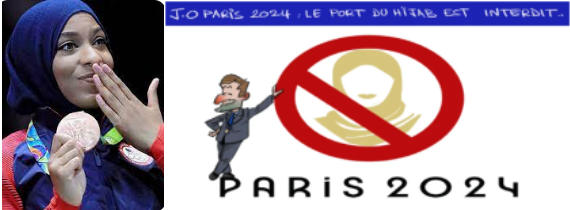
HIBAPRESS-RABAT-Amnesty
In its inadequate response to a joint letter calling for the lifting of the veil ban, the IOC has dodged the issue
The ban on French athletes wearing headscarves from competing in the Olympic Games violates international human rights law and exposes the discriminatory hypocrisy of the French authorities and the weakness and cowardice of the International Olympic Committee (IOC), Amnesty International said in a new report published ahead of the Paris Olympics.
Entitled “We can’t breathe anymore. We can’t even do sport anymore.” The human rights violations of Muslim women and girls caused by the headscarf ban in sport in France, the report presents the devastating consequences that headscarf bans have for Muslim women and girls in sport at all levels in France.
“Banning French athletes from the Olympic and Paralympic Games if they wear sports headgear undermines claims that the Paris 2024 Olympic Games are the first to achieve gender parity and exposes the racial and gender discrimination that characterises access to sport in France,” said Anna Błuś, women’s rights researcher at Amnesty International.
Discriminatory rules governing what women can wear violate the human rights of Muslim women and girls and have devastating consequences for their participation in sport, hampering efforts to make sport more inclusive and accessible.
The ban on headscarves in several sports in France has created an untenable situation in which the Olympic host country is in breach of several of its obligations under international human rights treaties to which it is a party, as well as the commitments and values set out in the IOC’s own Human Rights Strategic Framework. Despite repeated requests, the IOC has so far refused to call on the French sports authorities to reverse the ban on the participation of headscarves-wearing athletes in the Olympic Games and at all levels of sport.
In response to a letter from a coalition of organisations calling on it to take action, the IOC said France’s ban on sports headwear was not the responsibility of the Olympic Movement and said “freedom of religion is interpreted in different ways by different states”.
The IOC’s response makes no mention of other rights violated by the ban, such as freedom of expression and access to health care.
France’s ban on sports headgear is contrary to the clothing rules of other international sporting bodies such as the International Basketball Federation (FIBA), the International Football Federation (FIFA) and the International Volleyball Federation (FIVB).
Amnesty International studied sports regulations in 38 European countries and concluded that France is the only country to have adopted a ban on religious head coverings, either in national laws or in specific sports regulations.
Hélène Bâ, a basketball player, told Amnesty International that the headscarf ban at the Olympics “is a clear violation of the Olympic Charter, values and provisions, and an attack on our human rights and fundamental freedoms. I think it will be a shameful moment for France.”
“B,” another woman, told Amnesty International: “It’s unfortunate. It’s even shameful to be at this point in 2024, blocking dreams just for a piece of fabric.”
In France, the ban on Muslim women wearing any form of religious head covering extends well beyond the Olympic and Paralympic Games. Headscarf bans are in place in several sports, including football, basketball, and volleyball, at both the professional and amateur levels. As a result of these bans, imposed by sports federations, not only are many Muslim women excluded from sporting activities, but they also never receive the training and competitive opportunities needed to reach the Olympic level.
French bans, which result in exclusion, are a source of humiliation, trauma and fear and have pushed many women and girls to abandon sports they were passionate about, or to leave the country to be able to play.
The ban on Muslim women and girls from fully and freely participating in sporting activities, whether recreationally or professionally, can have serious consequences for all aspects of their lives, including their right to mental and physical health.
Hélène Bâ, who has not been allowed to play basketball since October 2023, told Amnesty International: “Mentally, it’s hard too, because you feel really excluded. Especially if you go to the bench and the referee tells you to go to the stands. Everyone sees you… It’s a walk of shame.”
Under international law, state neutrality and secularism are not legitimate grounds for imposing restrictions on the exercise of the rights to freedom of expression and/or freedom of religion. And yet, for several years, French authorities have instrumentalized these concepts to justify the adoption of laws and policies that have disproportionate consequences for Muslim women and girls. And all this in the context of a relentless campaign of harmful legislation and regulation governing the dress of Muslim women and girls in France, waged for 20 years and fueled by prejudice, racism, and gendered Islamophobia.
Founé Diawara, co-president of the football collective Les Hijabeuses, told Amnesty International: “Our fight is not political, not religious, it concerns sport and only sport.”
No politician should dictate what a woman can or cannot wear, and no woman should be forced to choose between the sport she loves and her faith, cultural identity or beliefs.