HIBAPRESS – Ahmed Al-Musaed
Under the high patronage of His Majesty King Mohammed VI, may God protect him, the local prison in Oujda opened, on Wednesday, March 25th, the activities of the fifteenth session of the "University in Prisons" program (Spring University), in the presence of Imhamed Al-Attafawi, the Wali of the Oriental Region, Lakhdar Hadouch, the Head of the Prefecture Council, Mustapha Benhamza, the President of the Regional Scientific Council, and military and civilian figures.
This year's session comes under the central slogan: "Alternative Penalties in Morocco: For Reformative Justice and Effective Integration," which is a topic of great importance in light of the legislative changes witnessed by the Moroccan criminal system, and the move towards strengthening human rights and humanizing prison institutions.
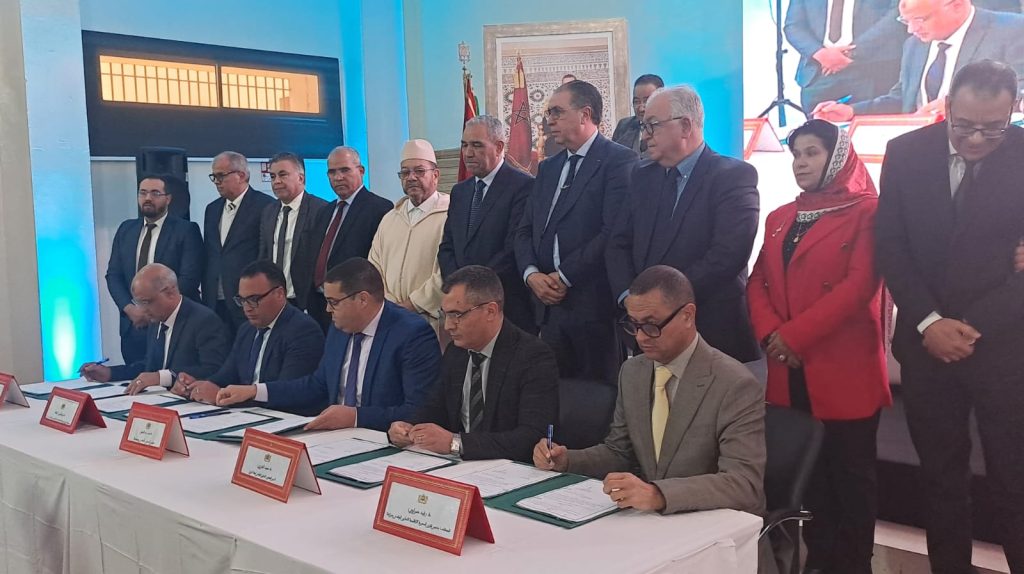
The opening session witnessed a ceremony for the signing of bilateral agreements between the prison institution in Oujda and a number of active national institutions and bodies, so that these institutions would be official spaces for the implementation and execution of the penalty of "work for public benefit" as an alternative to custodial sentences.
These agreements, which were concluded under the slogan "Morocco's Grit," reflect the involvement of vital sectors in this major reform workshop, where the list of signatory institutions included the Regional Directorate of National Cooperation for the Oriental Region, the Oriental Region's Public Prosecutor's Office for the High Commission for Former Resistance Fighters and Members of the Liberation Army in Oujda, the Jerada Regional Directorate of National Cooperation, and the Regional Directorate of Traditional Industry in Oujda.
In his opening speech, on behalf of the General Delegate for Prison Administration, Saad Abdesshfiq, the director of the local prison in Oujda, confirmed that this meeting represents a qualitative shift towards an approach based on rehabilitation and reducing the negative effects of imprisonment, praising the new partners who "will contribute to transforming the concept of punishment into an opportunity for reform and social reintegration".
For his part, and in a speech delivered on behalf of the President of Mohammed I University, Professor Zahr Eddine Tayebi considered that these agreements embody the concept of "reformative justice" in practice, stressing that the new philosophy of punishment does not aim at revenge, but rather at rationalizing public money and providing the opportunity for the convicted person to bear his responsibility without isolating him from his social environment.
The judicial interventions reinforced this argument with encouraging statistical data, as Professor Khaled Benkiran, the First President of the Court of Appeal in Oujda, revealed that the statistics up to the beginning of 2026 showed the success of the alternative penalties system, where the total of alternative penalties issued: exceeded 142 penalties, the compliance rate: recorded success as the cases of breach of obligations did not exceed 31 cases (less than 3%), and the distribution of penalties: "the penalty of work for public benefit" topped the list with a rate of about 45% to 50%, which highlights the utmost importance of the agreements that were signed in this session.
In his intervention, Professor Mustapha Yartawi, the Public Prosecutor at the Court of Appeal in Oujda, stressed that the alternative penalties law No. 43.22 represents a "distinguished legislative station," and that this tangible initial success constitutes an incentive to expand the circle of partnerships between all institutional actors, leading to a more equitable and humane criminal justice system.
The session's work was divided into two scientific sessions that focused on dismantling the legal text and anticipating the mechanisms of application:
The first session: addressed the topic of "Reformative Justice and the Legal Foundations of Alternative Penalties", where university professors addressed the philosophy of punishment in contemporary criminal policy, and a reading of Law 43.22, while highlighting legal exceptions and the protective dimension for special groups.
The second session: focused on "the stakes of effective integration" from the point of view of practitioners, which included the role of the judge in applying penalties, the Public Prosecution, and the defense, in addition to the role of the prison institution in monitoring the implementation of these penalties to ensure the achievement of their reformative goals.
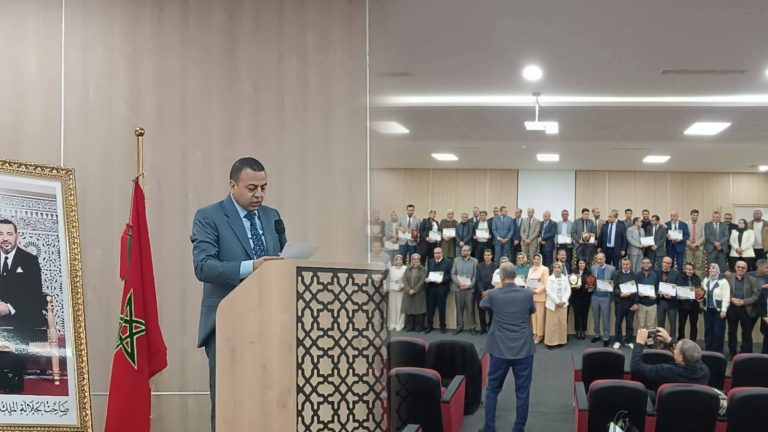
The session was not just an academic discussion, but rather a station for empowering the inmates, as the activities concluded with a speech on behalf of the participating inmates, and the distribution of participation certificates and incentive prizes to the outstanding ones among them, confirming the role of the university within prison institutions in motivating knowledge and positive change.
The meeting concluded with the recitation of the closing report of the session, and the raising of a message of loyalty and sincerity to the High Authority of God, His Majesty King Mohammed VI.