HIBAPRESS
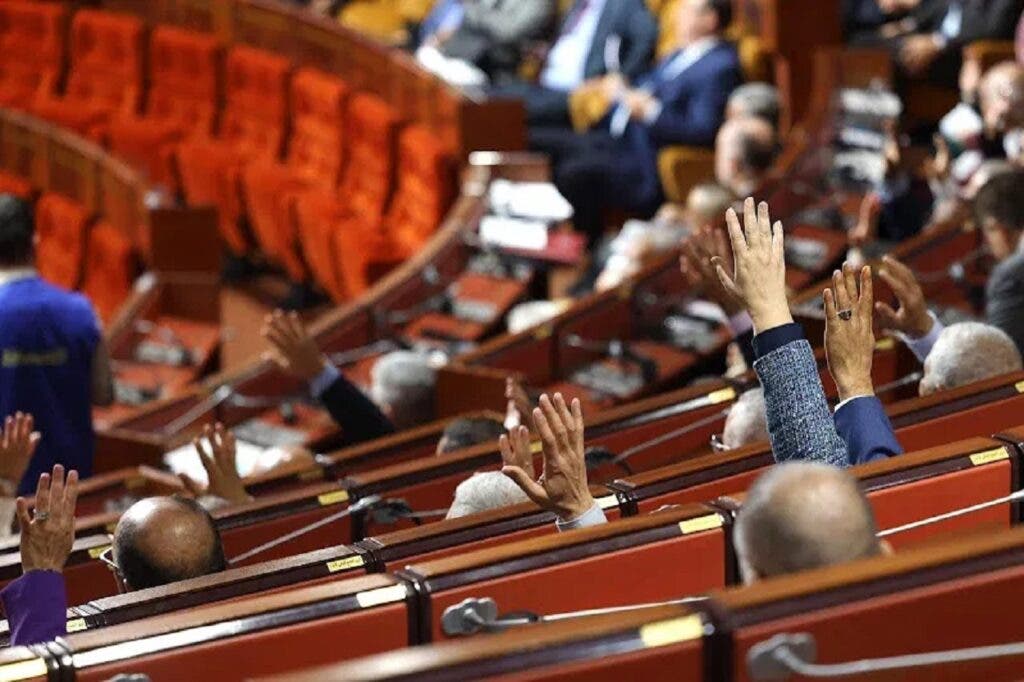
The House of Representatives, in a legislative session held today, Tuesday, approved by a majority vote draft law No. 59.24 related to higher education and scientific research, within the framework of a second reading.
The draft law was approved by 82 parliamentarians, while 33 others opposed it. In a presentation of the draft law, the Minister of Higher Education, Scientific Research and Innovation, Ezzeddine Midaoui, said that this text was prepared “with complete objectivity and away from any ideological backgrounds or considerations”, highlighting that the ultimate goal is to qualify the higher education system and create the appropriate conditions for the future university, enabling it to keep pace with various major transformations and developments. The minister noted that the amendments to the project were made within a participatory approach, pointing out that 52 amendments were accepted in the House of Representatives and 22 amendments in the House of Councillors. He also praised the contribution of the parliamentarians, majority and opposition, in enriching the legislative debate, stressing that "the disagreement regarding some unacceptable amendments is either because they are included in other articles of the project, or because of the different perspectives on some of its provisions that may affect its essence." Regarding the amendments of the House of Councillors, the minister pointed out that they were limited in their entirety to minor legal aspects, including additions and linguistic and structural corrections, as well as positive interaction with the demands of the trade union representations. It is worth noting that the developments of the same legal framework were based on the institutionalization of strategic planning, through the preparation of a master plan for higher education that enables the monitoring and foresight of the development of higher education and scientific research according to the principles of spatial justice and equity among the various regions, and the development of a national strategy for scientific, technical and innovation research that defines national priorities and enhances coordination, harmony and efficiency in the implementation of public policies. To enhance the governance of universities and sectoral institutions, a Board of Trustees was established as a new body to accompany and support the university, and to preserve the full powers and competencies of the University Council, with a review of its composition and the linking of the appointment of the university president and the heads of university and sectoral institutions to terms of reference, and the institutionalization of the "Division" as a structure to frame pedagogical and scientific activities. The draft law also provided for the establishment of a linguistic engineering that enshrines the status of the two official languages of the Kingdom with openness to foreign languages, and the institutionalization of distance education, alternating education and lifelong education, basic training within the framework of facilitated timings for workers in the public and private sectors, the refinement of the legal framework for the continuous training certificate, and the development of mechanisms for assessment and quality assurance.