HIBAPRESS – Abdellatif Baraka
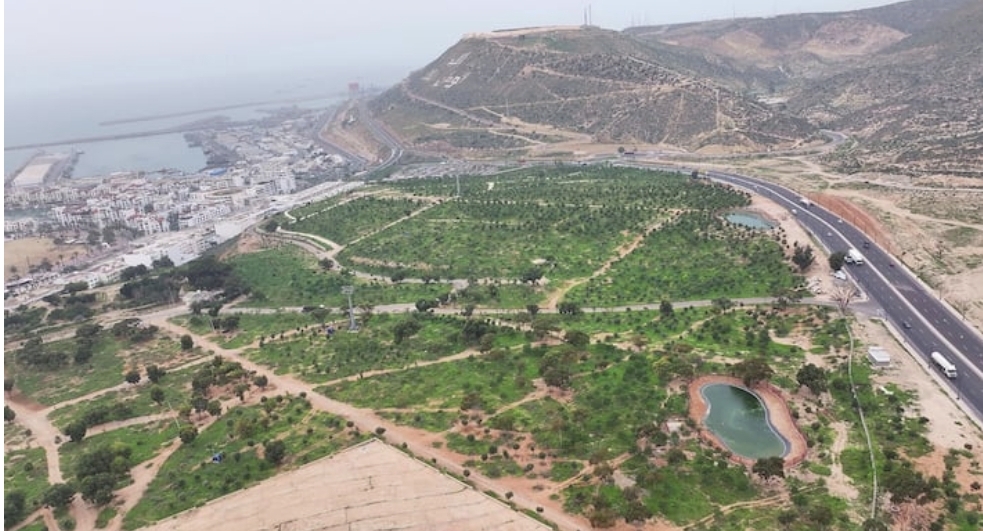
In the heart of Talborjt district, where the memory of yesterday mixes with the rhythm of the present, the "Memory Forest" in the city of Agadir has regained its spirit, after years of silence and neglect, to transform into a vibrant urban space, carrying in its roots the story of a city that resisted oblivion, and in its branches a promise of a more attractive future.
This project, which extends over an area of approximately 35 hectares, is not just an environmental rehabilitation operation, but rather a rewriting of the memory of a place that remained a witness to one of the most difficult moments in the city's history, since the 1960 Agadir earthquake that changed its features and reshaped its collective conscience. Today, this space returns to carry that memory, but in a new language that combines natural beauty and historical awareness. After work that lasted about eight months, the forest regained its balance, not only through the planting of approximately 10,000 trees of various species that suit the local climate, but also through an integrated urban vision that preserved the original spirit of the old city, as it was before the disaster. The place has become a living extension of the history of Agadir, where trees coexist with the lines of urban memory, in harmony that reflects the continuity of time instead of its interruption. The rehabilitation process did not stop at the limits of planting, but included the equipping of an advanced irrigation infrastructure, through a drip network that extends for tens of kilometers, in addition to creating an artificial lake that ensures the sustainability of water resources, in harmony with climate challenges and the requirements of maintaining environmental balance. In this sense, the “Memory Forest,” or as the Agadir people know it as "Place of the Permian," turns into more than just a natural outlet, it is a space for contemplation, and an urban laboratory that re-raises the question of the relationship between man and his field, between memory and development. The project restores the importance of Talborjt neighborhood, one of the most prominent spaces that contains the memory of the city before and after the earthquake, and gives it a new dimension that connects generations with its history without burdening them with it. In the same context, environmental activists believe that this workshop represents a qualitative step towards strengthening green spaces within the city, especially in light of climate changes and the decline of natural spaces, and it highlights the need to expand such initiatives, to provide green belts capable of improving the quality of life, and restoring balance to the urban system. Thus, Agadir writes a new chapter in its relationship with its memory, a chapter that is not based on evoking pain only, but on turning it into a force of proposal and construction, so between the tree trunks and walking paths, the story of the city of rebirth pulsates, which chose to remember… in order to move forward.