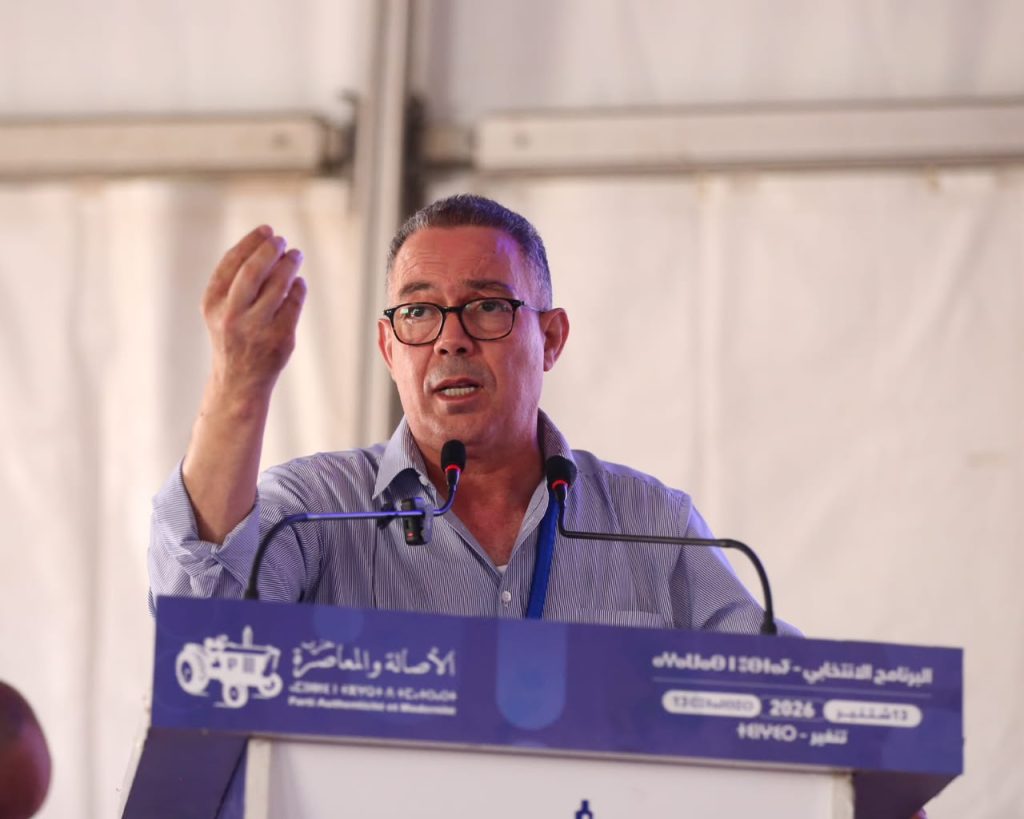
HIBAPRESS revealed that Fawzi Lahja, a member of the Authenticity and Modernity Party's Political Bureau and Minister Delegate for the Budget, on Sunday, September 13, in Tinghir Province, presented a wide range of social and economic commitments to the province's residents, including purchasing power, retirees, direct support, taxes, health, youth, water, and energy. He stressed that his party wants to transform its program into a clear contract with citizens based on serving people and improving their living conditions.
Lahja stated that he was speaking to citizens from a realistic assessment of the situation, explaining that the past five years have seen a massive financial mobilization of nearly 280 billion dirhams, directed towards a number of social programs, citizen support, income improvement, and direct aid to families.
He considered that the financial effort made was confronted by the high cost of living and prices, which limited the impact that citizens were supposed to feel in their daily lives. He explained that this situation pushed his party to place purchasing power at the forefront of its priorities.
The government official stressed the need to ensure that essential goods reach Moroccans at reasonable prices, considering that citizens must regain their ability to purchase their family's needs without suffocating financial pressure.
In his speech, he evoked the place of "al-quffa" (shopping basket) in Moroccan culture, saying that shopping and buying household necessities was associated with joy for families. He stressed that his party wants to restore this feeling through measures that protect purchasing power.
Lahja then moved on to the situation of retirees, considering that individuals who have spent many years serving the country in various sectors cannot find themselves with meager pensions upon retirement. He announced that Authenticity and Modernity proposes raising the minimum pension to 3000 dirhams per month.
He spoke about direct social support, explaining that his party proposes raising the minimum amount allocated to needy families from about 500 dirhams to at least 1000 dirhams per month, while directing assistance to those who truly deserve it according to their real income level and the family's social situation.
A member of the PAM Political Bureau criticized the method of calculating some of the indicators used to determine beneficiaries of support, questioning the usefulness of linking eligibility to owning a mobile phone, a bicycle, or a motorcycle. He considered that owning simple tools for daily use should not deprive a needy family of assistance.
He said that the criterion should be real income, adding that a citizen who needs support must receive it, while one whose financial situation improves and becomes able to work and achieve sufficient income can leave the assistance system, wishing them success and stability.
The Minister Delegate for the Budget addressed the situation of employees in both the public and private sectors, noting that income tax deducts a portion of the salary before it reaches the employee. He affirmed that the party proposes to alleviate this burden to increase the net salary received by families and enable them to cover their children's expenses and basic needs.
In the health sector, Lahja said that the reform that has begun requires increasing the pace and improving the quality of services, emphasizing that Moroccan citizens must find the required treatment in conditions that preserve their dignity when they go to the hospital.
He affirmed that health reform is not linked to structures and equipment alone, but to the citizen's ability to access treatment and receive respectful service that guarantees their right to medical care and attention.
Youth featured prominently in Lahja's speech, as he stressed that addressing their situation requires an integrated approach that begins with education and training and leads to economic integration, emphasizing that a young person with competence or talent must find someone to support them.
He added that the vision of the Authenticity and Modernity Party is based on accompanying youth in training, helping them establish their first business, and transforming them into actors within the national economy, instead of leaving their energies outside the economic cycle.
On the water axis, Lahja stressed the need to transition to a permanent strategic vision for water security, refusing to deal with the crisis by waiting for drought and then seeking emergency solutions for each city or region.
He affirmed that water security must ensure the needs of citizens and agricultural and economic activities in the long term, especially in areas that require water to ensure the continuity of production and improve development conditions.
He also addressed energy security, calling for the exploitation of Morocco's potential in wind and solar energy to produce renewable energy and make it accessible to families and the national economy at an appropriate cost.
Fawzi Lahja revealed a measure proposed by his party for poor families with limited electricity consumption, explaining that a family whose monthly bill does not exceed about 90 or 100 dirhams could have the state cover the full cost of their consumption.
He said that the idea is based on exempting vulnerable groups with limited consumption from electricity bills, thus alleviating part of the monthly expenses that burden family budgets.
The member of the Political Bureau of Authenticity and Modernity affirmed that the party tried to prepare a clear program that citizens can understand, so that every Moroccan can know the proposed commitments and understand what the party proposes on issues of their daily lives.
He stressed that the role of candidates and party officials must be to serve citizens, considering that a political official is required to work to achieve declared goals instead of being content with electoral slogans.
Lahja linked the party's program to the development initiative announced by King Mohammed VI, which aims to reduce disparities between the Kingdom's regions and end the logic of "two-speed Morocco." He pointed out that this initiative requires mobilizing huge investments exceeding 200 billion dirhams, according to the figure he mentioned in his speech.
He said that the Authenticity and Modernity Party considers this direction a priority, affirming that Tinghir and other regions must move within a unified developmental pace that ensures citizens benefit from projects, services, and opportunities in a balanced manner.
He stated that the party wants to build a new relationship with voters based on mutual trust, emphasizing that voting grants responsibility to those who gain the trust of citizens, and that the party's leadership and candidates are making their commitment to exert effort to implement the goals outlined in the program.
Lahja stated that collective mobilization, resilience, and continuous work are the way to build a new developmental path for the Kingdom, affirming that the challenge is to reach, by 2031, a Morocco that solidifies its position among emerging countries according to the ambition set by King Mohammed VI.
Fawzi Lahja stressed that the Authenticity and Modernity Party wants to transform its program into a direct commitment with citizens, based on protecting purchasing power, improving retiree pensions, doubling support for needy families, easing the tax burden on employees, developing health, accompanying youth, ensuring water and energy security, and directing development towards all regions of Morocco at a unified pace.