

HIBAPRESS
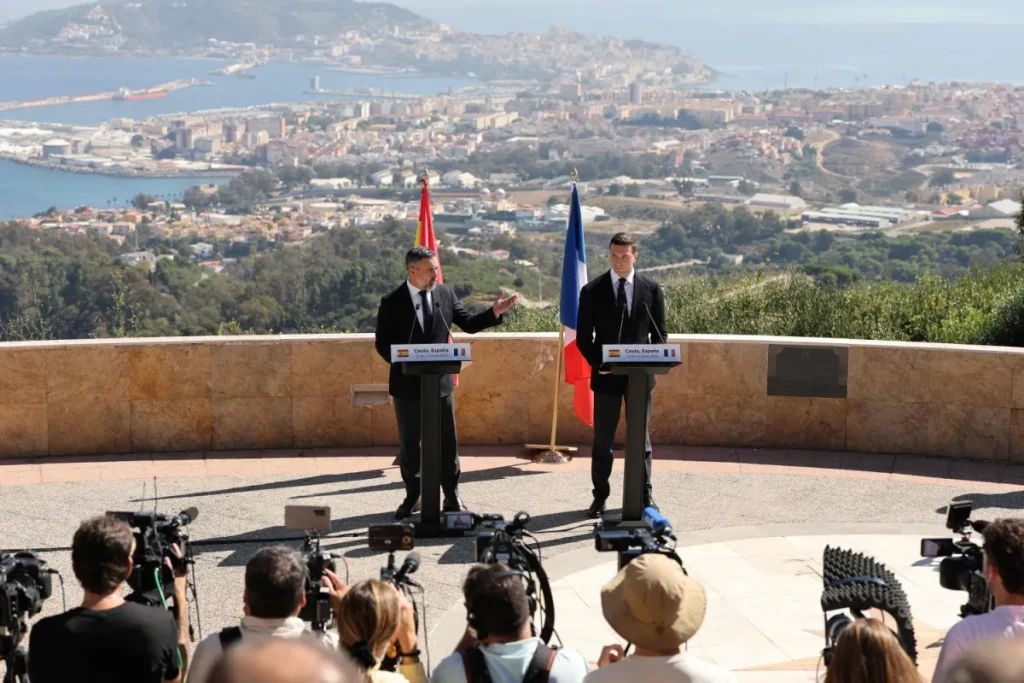
In a move with political and provocative dimensions, the leader of the Spanish "Vox" party, Santiago Abascal, and the president of the French National Rally, Jordan Bardella, arrived in the occupied city of Ceuta on Monday, October 12, 2026. During this visit, the far-right officials chose to convey hardline messages regarding immigration and identity, while implicating Morocco in accusations that were not supported by new evidence to prove their validity.
This step raises questions about the reasons for choosing the city, given the sensitive nature of the occupied Ceuta file for Morocco, and the attempt to present immigration issues as a threat requiring security and military escalation.
During the visit, Abascal described the arrival of migrants to the city as an "invasion," accused Morocco of being behind it, and held the government of Spanish Prime Minister Pedro Sánchez responsible for allowing it to happen. He also called for the deportation of those he described as "invaders" and advocated for increased border militarization.
For his part, Bardella focused on emphasizing what he considered the European belonging of occupied Ceuta, warning of what he described as a threat to European civilization. This discourse gives the visit a character that transcends the debate on immigration management, especially when unsubstantiated accusations against Morocco become a material for political mobilization, at a time when relations between Rabat and Madrid remain governed by strategic files that require responsibility and clarity in statements.
The visit included a tour of several neighborhoods in occupied Ceuta, during which Vox party officials expressed their discontent with the demographic changes that had occurred in some areas, recalling the 1970s when Spanish families had a larger presence, according to their narrative. The discussion took a turn related to the origins and religion of the residents, even though a number of people of Moroccan origin hold Spanish nationality. This discourse raises an issue related to the criteria of belonging adopted by the far-right, as questioning the identity of citizens based on their origins or religion raises questions about equality in citizenship. It also reveals the exploitation of the issue of residents of Moroccan origin in a political conflict fueled by fears related to immigration and identity.
This visit comes in the context of the escalating discourse of the European far-right, which seeks to expand its political presence by linking immigration to concepts of "invasion" and security threat, while directing accusations at Morocco without presenting decisive public evidence.
From the Moroccan perspective, the exploitation of occupied Ceuta as a platform to direct direct accusations at the Kingdom and call for border militarization represents a provocative step that would fuel tension rather than contribute to addressing the immigration issue with a logic of cooperation and shared responsibility.