A. Latif Baraka: Heba Press
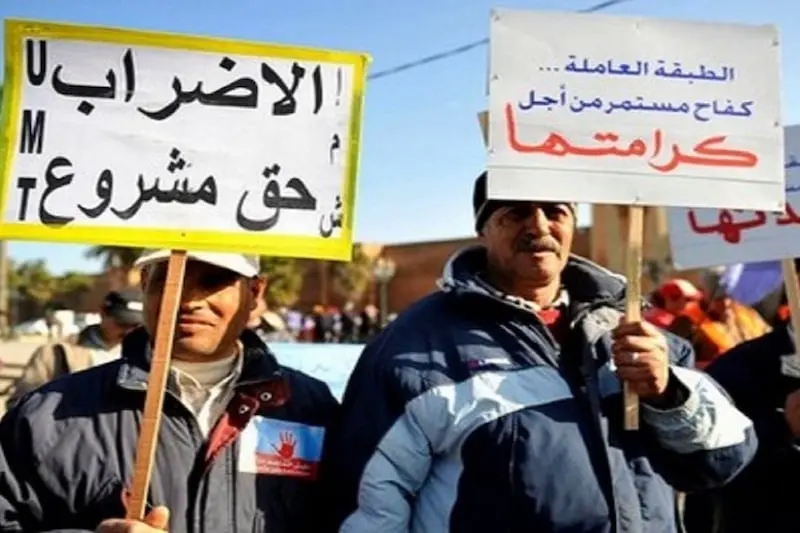
The Economic, Social and Environmental Council expressed the advisory opinion it prepared on the draft regulatory law No. 97.15 specifying the conditions and modalities for exercising the right to strike, in its latest report, consulted by the website “Heba Press”, in which it made several observations on the subject after having considered, in its conclusions, that the right to strike is unbalanced. It is dominated by the “injunctive nature”.
The injunctive dimension was favoured over a legislative framework whose primary objective was to regulate the right to strike.
The Council indicated in its report that it had noted the predominance of the injunctive dimension over a legislative framework whose primary aim is to regulate the right to strike and to surround it with the legal guarantees necessary for its exercise, since 12 articles out of 49 were attributed to this which favours a restrictive approach and creates a negative impression and apprehension with regard to the whole of the legislative initiative.
The Council pointed out that the structure of the draft regulatory law was characterized by an imbalance, since it provided for 22 articles out of 49 relating to the exercise of the right to strike in the private sector, while the draft only allocated 4 articles to the exercise of the same right in the private sector, public sector and public institutions.
Regarding the regulatory law’s definition of “strike,” the Council dwelt on what it considered to be multiple problems, including constitutional and legal ones. The report first dismantled them through its definition of the right to strike within a standard framework, based on international conventions, since Article 2 of the regulatory law defines strike as: “Any work stoppage takes place deliberately and for a specific period, with a view to defending one of the rights or the direct social or economic interests of the striking employees.”
Among the many problems raised by this definition in the draft law, the Council clarified that the exercise of the right to strike was reserved for employees and not for other social groups, while Chapter 29 of the Constitution stipulates the exercise of the right to strike (in its second paragraph) in its relations with the exercise of the freedoms of assembly, meeting and demonstration, peaceful rights, the creation of associations and trade union and political affiliation (in its first paragraph) and therefore does not separate fundamental freedoms and rights from economic and social rights.
The Council’s advisory opinion also stated that the law governing the right to strike failed to clarify what is meant by “direct social and economic interest” and failed to distinguish between the right guaranteed by law and material interest. According to the same source, Article 5 prohibits strikes for political objectives in its last paragraph without specifying or defining these objectives and distinguishing them from strikes that may be directed against certain public policy choices, in defence of the material and moral interests of the strikers.
The report also notes that “the prevention of any scheduled cessation of work is carried out alternately and successively between certain different professional categories working in the same company or institution or in one of its affiliated institutions, whether this cessation concerns one activity of the company or institution or several activities”, as stated in the report (Article 12) of the law, another problem arises related to the accuracy of the concepts and the reasons for the prohibition.
The Council indicated that Article 4 of the draft regulatory law No. 97.15 limits the right to strike to the salaried work system, that is, “persons subject to the provisions of Law No. 65.99 relating to the Labor Code” and “employees, agents and employees of the State administrations, institutions, public companies, local authorities and any other legal person.” “persons under public law”, does not reflect the spirit of the constitutional requirement and the objective of adopting a regulatory law, nor does it address the right to strike in its broad sense and general form.