Heba Press – Ahmed Al-Musaed
The eastern region is full of many different possibilities, but it suffers from problems that affect the pace of rapid urban growth, such as rural exodus and migration between cities, in addition to a set of fluctuations, among which (the closure of the Algerian-Moroccan border) border in 1994, and the definitive closure of the Jerada coal mine in 2000 due to the exhaustion of its stock, not to mention the impact of the 2008 global financial crisis on transfers and the succession of years of drought).
The speech delivered by His Majesty King Mohammed VI, may God help him, on March 18, 2003 during the official visit to Oujda, constituted an exceptional turning point in the history of the city of Oujda, since it established a new regional economy based on new engines of growth which have replaced traditional economic foundations (pastoralism and borders).
The Royal Initiative for the Development of the Eastern Region has also identified a series of large-scale structural measures to enable the establishment of an integrated, attractive, sustainable and diversified territorial offer, capable of improving the territorial attractiveness and to create real investment dynamism combining the public and private sectors in the field of investment.
It should be noted that at present the difficulty of local development in the Eastern region lies in its nature, characterized by multi-specialization and interconnection of networks, and it is not a question here only to propose solutions to problems or obstacles, but above all we must ensure the formulation of strategies, policies, programs, projects and activities. It is structured and evaluated using an approach based on the judgment approach.
To advance the city of Oujda in all areas, six priorities are targeted:
1. Promote economic development and encourage private investment:
Strengthening economic attractiveness involves taking advantage of the achievements of the modification of the Regional Investment Initiative Center (CRI), by intensifying promotional efforts to highlight the regional economic potential and by simplification of administrative and legal procedures to support new investments.
The goal is not only to strengthen the regional production system, but also to create long-term employment opportunities that will reduce widespread unemployment among workers in the region (the regional unemployment rate is 21.4 % compared to 13.6% at the national level). It is necessary to offer employment opportunities to our young graduates (88,134 students from Mohammed I University and 13,292 trainees in professional training centers).
2. Strengthening infrastructure and improving quality of life:
The eastern part is inaugurating the first phase of the port of Nador in the western Mediterranean, completing work on the Marchica Med station and completing work on the Mediterranean seaside resort of Saïdia. The region will open its projects to the rich and promising. horizons and prepare to receive a significant influx of new residents and visitors (business leaders and managers of shared service centers, tourists, etc.).
The combination of this new situation and the growing rise in citizens’ demands linked to quality of life imposes large-scale interventions on the urban landscape through the rehabilitation of existing urban infrastructures and the strengthening of structuring equipment with the aim of improve and enhance the urban environment. landscape.
In the same context, it is necessary to intensify cleaning campaigns and generalize solid waste collection and black spot elimination interventions, which are among the urgent measures to be taken to maintain the cleanliness of public places and improve the quality of life of people. residents.
3. Improve the quality of urban transport and strengthen the urban fabric:
The goal of improving urban transportation is to ensure efficient and comprehensive transportation alternatives. While awaiting the results of the review study of the urban transport master plan, two initiatives will be implemented:
First initiative: improve public transport by increasing the fleet and developing the public transport network.
· The second initiative: Improve active transportation by developing both cycle paths and safe areas for pedestrians, while improving parking infrastructure.
4. Sustainable development and environmental preservation:
Sustainable development requires a global approach harmoniously integrating the dimensions of economic, urban, social and environmental planning, in order to guarantee a suitable living environment for current generations and a healthy environment for future generations.
Based on this vision, three actions must be worked on according to an agenda:
· Manage natural resources by trying to effectively manage water stress and conserve water resources through two main actions: improving the distribution of fresh water (groundwater and surface water), unconventional mobilization water (seawater desalination and tertiary water treatment) and the use of wastewater for irrigation purposes. Watering green spaces. .
· Implement the energy conversion process through technologies that will help improve the efficiency of energy use, particularly in the area of public lighting, and encourage renewable energy (solar energy ), in addition to supporting the expansion of electric vehicle charging infrastructure,
· Develop green infrastructure by maintaining green public spaces in order to preserve the natural spaces created.
5. Organization of public space:
Strengthening security and the organization of public space constitute one of the fundamental factors in the prosperity of cities and the well-being of citizens within the framework of harmonious and sustainable urban development, which contributes to the effects that we identify in:
· Reduce the incidence of crime through video surveillance in cities (installing surveillance cameras in the main arteries of cities as a first step and distributing them to all crime centers as a complementary measure).
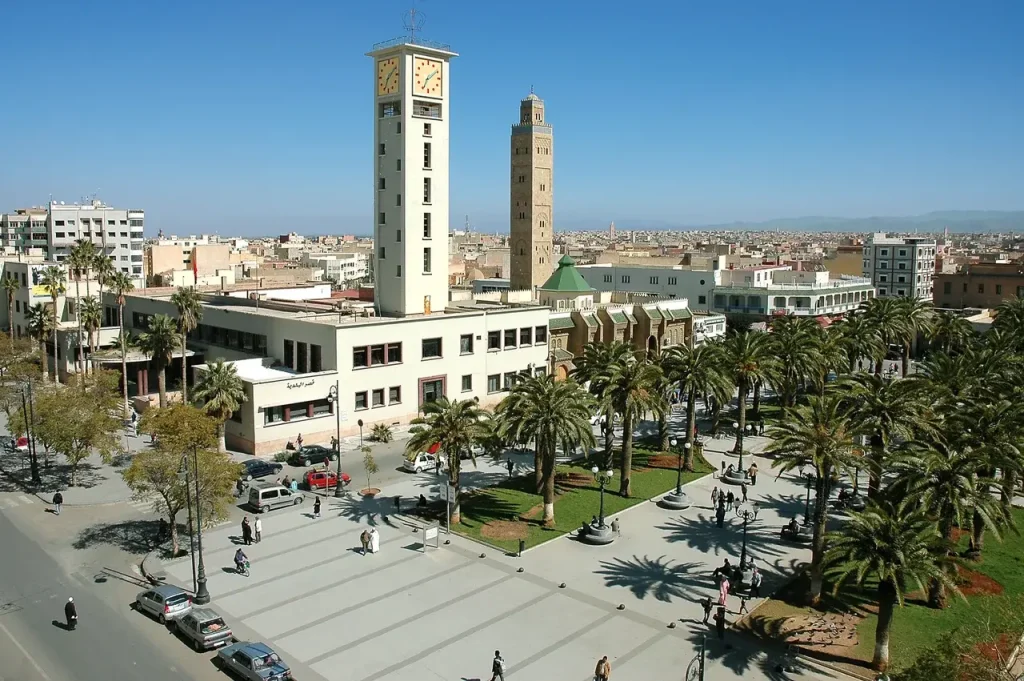
· Combat all types of imbalances, such as the illegal and chaotic occupation of the public domain (roads, sidewalks and public squares), within the framework of paying attention to the splendor of the city of Oujda and freeing it from the grip of chaos. and distortion of the general vision of the markets and centers located in the city, because the local and security authorities have launched extensive campaigns and are still working in this area with the intention of freeing Abdel Wahab Square from chance and winning the bet on the continuity and permanence of the liberation of the public domain on this square, which decades ago constituted a historical, heritage and cultural heritage for the inhabitants of Oujdia and has always been a space of vision throughout the district and a full field of commercial activity. the corners of the Jerusalem neighborhood park, crowded with snack vendors.
· Choose harmonious colors for the urban environment in order to complement the unified features of the city of Oujda by adopting the “beige” color.
· Strengthen construction control to address the problem of haphazard construction and the role of slums to avoid deterioration of the architectural quality of the built environment.
6. Strengthen territorial governance:
Strengthening territorial governance constitutes the cornerstone of the implementation of the five priorities mentioned above to improve the management of public affairs and ensure integrated, global and sustainable development and, in doing so, respond effectively to the needs of citizens. The objective here is to crystallize the plans. , programs and projects of actors contributing to regional development and facing the challenges of local public administration.
To do this, it is necessary at this stage to rely on interaction and flexibility techniques:
· Work interactively and intensify the efforts of the various local actors, whether local authorities, public establishments and decentralized state services, in order to work on reserve projects, accelerating the implementation implementing ongoing projects and including programs and projects in their work. thoughtful and publishable plans in full correspondence with local issues;
· Develop the skills of organizational flexibility, proactive management of development programs and the ability to adjust policy interventions, programs or projects according to changing priorities.