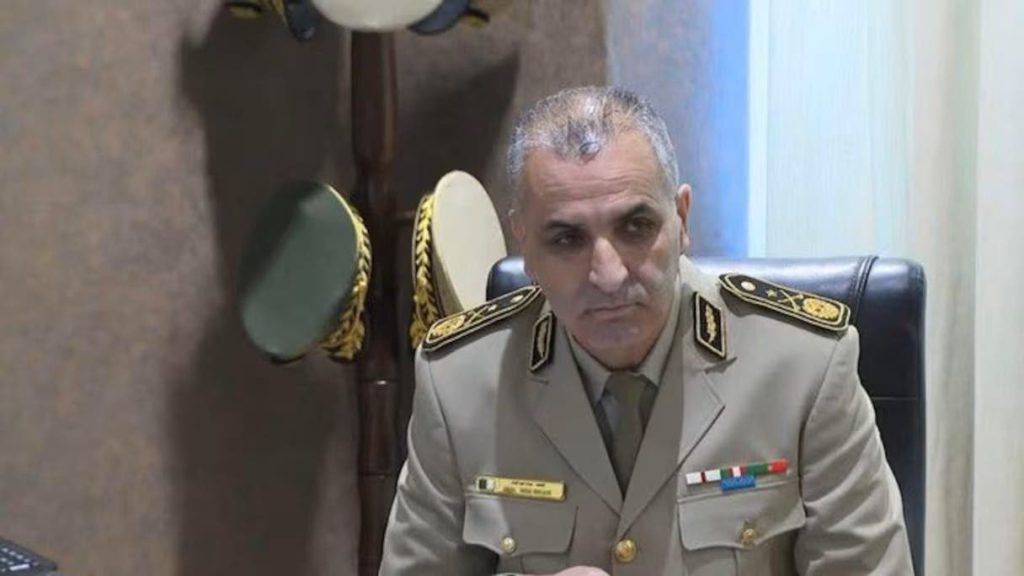
On the night of the escape of Algerian General Abdelkader Haddad—nicknamed “Nacer Djenn”—the former head of the General Directorate of Internal Security, the waters of the western Mediterranean Sea witnessed a scene rife with significant implications. On September 17, 2025, the Spanish newspaper “theobjective” revealed that a US Sikorsky MH-60R Seahawk military helicopter took off from the US destroyer USS Roosevelt (DDG-80). The helicopter was equipped for a long-range surveillance operation over the sea, conducting successive low-altitude circuits for hours near the Algerian and Spanish coasts.
The helicopter, registered in aviation databases with a specific tracking code, conducted near-continuous back-and-forth patrols along parallel routes to the coast—resembling a “race track” pattern commonly used in search, sweep, and aerial reconnaissance missions—flying at a very low altitude and relatively slow speed to support precise observation operations. These flight patterns fall perfectly within the known patterns of maritime and maritime-air surveillance operations launched from US warships in the Mediterranean. Despite the US Sixth Fleet spokesperson downplaying the incident as “routine,” the timing, location, and behavior of the helicopter raised major questions among international and regional observers, especially as the incident coincided with the escape of a central figure and a “black box” of the Algerian military regime; this raises several possibilities: potential US detention, a request for US protection by the fugitive, or at least a US intelligence role in tracking the event.
The escape itself is no less significant than the flight observed by trackers: Nacer Djenn’s escape is not merely a personal flight, but a resounding shock within the gears of the Algerian military system. This event revealed cracks within the intelligence services, the army, and the military judiciary, and the possibility of internal complicity resulting from a fierce struggle between factions within the ruling hierarchy. This prompted authorities to transform the capital into a mobile barracks, with the deployment of checkpoints, military barriers, and heightened security measures, even at neighboring border crossings, and the temporary closure of the border with Tunisia, according to press reports and informed sources.
Alarming claims circulate among witnesses regarding the mechanisms of killing and intimidation that were managed with financial payments and rewards to those who committed them, making his escape a valuable asset for intelligence blackmail and huge benefits for any foreign entity seeking to undermine internal games or exploit the file. This combination of evidence of US maritime surveillance and the escape of a “black box” has cast a long shadow over the regime’s stability: the previously influential general’s fear of “his black box falling into foreign hands”—according to circulating accounts—led him to take desperate measures, while the army’s top leadership tightened security and escalated security measures to prevent any information leaks that could shake the positions of influence of senior officers and businessmen linked to the regime.
Ultimately, Nacer Djenn’s escape does not seem to be a transient, isolated incident, but rather an indication of a structural crisis within the hierarchy of power: power struggles, institutional paralysis, and deep concern about the exposure of files that could lead to a redrawing of the map of influence in the country. The stakes now lie in what the coming days will reveal about his whereabouts—detention, protection, or actual escape?—and whether this event will represent the beginning of a new chapter of internal confrontations within the Algerian regime, or merely a passing tremor that official bodies will try to obscure.