HIBAPRESS – By: M. Mahyaoui
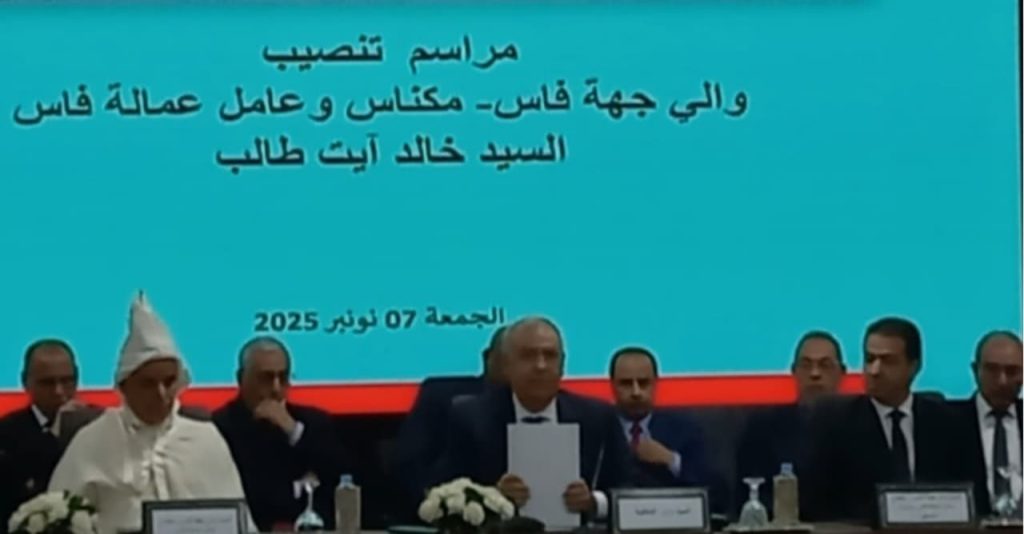
Since his appointment as the head of the Fez-Meknes region on Friday, the Wali, Khalid Ait Taleb, has found himself facing a major challenge: improving the performance of the regional administration and establishing a more effective institutional climate, capable of keeping pace with the dynamism experienced by the scientific capital and the region as a whole, especially with the acceleration of infrastructure projects and preparations for major challenges in the horizon of 2030 and purifying its environment from corruption.
Khalid Ait Taleb is one of the Moroccan administrative frameworks that has accumulated a significant experience in managing public services, where he combined professional competence and institutional commitment. He is known for his adherence to the ethics of responsibility, and his adoption of an approach that combines strictness and discipline, and listening to the pulse of the field. He stood out remarkably during his holding of the portfolio of the Ministry of Health at a critical stage in the history of the national health system, which gave him deep experience in managing complex files and crisis management, and gave him a high ability to lead change within public institutions.
The region today is not only a space for managing local affairs, but also a pivotal lever for the success of development plans that are racing against time, from qualifying infrastructure, accelerating the pace of investment, to modernizing administrative services and simplifying procedures for citizens and project owners. In this context, local actors are betting that the new phase will move more towards strengthening governance, linking responsibility to results, and adopting a citizen administration that prioritizes the logic of efficiency and return.
Field data indicate that the region is already witnessing remarkable positive transformations in a number of files, especially at the level of structuring projects and managing investment, where a group of regional competencies are praised, headed by the General Director of Fez Development, Hisham Al-Qurtasi, and the Regional Director of Investment, Mohamed Alsabri, whose services have shown high professional commitment and contributed to moving major files that were stagnant in the past. There is also an increasing interaction from economic actors with the regional administration, and a clear satisfaction among investors regarding the follow-up of their projects and the acceleration of institutional coordination mechanisms.
In the city of Fez, a new executive dynamic has emerged that has given a qualitative boost to a number of development projects, where observers indicate that some officials have shown a model in seriousness and dedication in following up on files, and practical interaction instead of media interaction, which has been positively reflected on the progress of projects according to the specified schedules, and the creation of a professional environment based on commitment and effectiveness.
The Wali of the region today is viewed as an administrative leader who seeks to go beyond the logic of traditional management towards a modern regional administration, which requires a clear strategic vision, high institutional discipline, and broad involvement of the energies capable of meeting the challenges.
However, the path of real change, as agreed by the followers, is not measured by slogans, but by its ability to:
Strengthen trust between the citizen and the administration
Accelerate the implementation of investment files without unjustified complexity
Consolidate the culture of responsibility, listening and good management
Guarantee fairness in access to public services
Strengthen the business climate to keep pace with major entitlements, and foremost among them Morocco's preparations for the 2030 World Cup
Today, Fez-Meknes stands on the threshold of a delicate administrative and developmental stage, whose main title is competence, discipline, and support for productive investment. With the succession of positive indicators in a number of sectors, the bet remains on consolidating this dynamism, and transforming it into a sustainable model of regional governance.
In the end, the success of any official is not measured only by his intentions, but by his ability to create a continuous institutional impact, and an actual management of change that is translated on the ground… Which the coming months will reveal clearly.