HIBAPRESS – Abdellatif Baraka
The frequent meetings between representatives of the Kingdom of Denmark and leaders of the Moroccan Justice and Development Party raise the interest of observers and followers of political affairs, especially in light of what appears to be a clear Danish preference for communicating with this Islamic party to the exclusion of other Moroccan political forces.
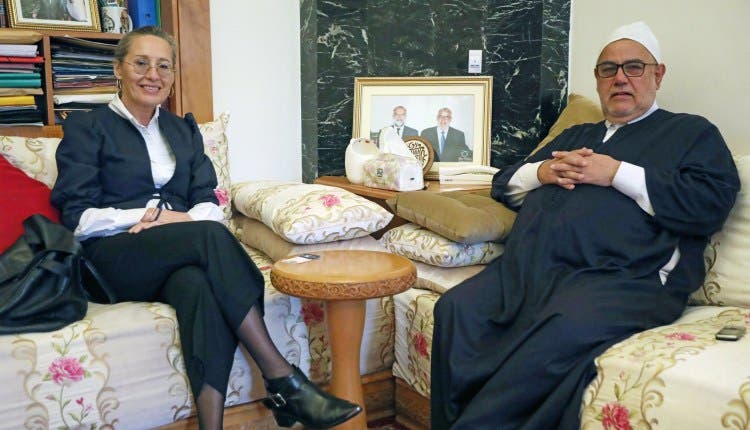
The latest of these meetings was the reception of the Secretary-General of the party, Abdelilah Benkirane, on Thursday, November 13th, by the Danish Ambassador to Rabat, in a meeting whose content was not revealed, which increased the area of interpretation and analysis of the nature of this rapprochement, and its political and diplomatic limits. Despite the fact that the two parties did not provide official clarifications about what happened during the meeting, the political chronology of the relationship between Denmark and the Justice and Development Party reveals a common thread in this rapprochement, which can be read from multiple angles, in which intellectual considerations overlap with diplomatic interests, and with sensitive files that concern Morocco and the European Union, foremost of which is the issue of the Moroccan Sahara. From the first meetings to the repeated visits. The roots of the relationship between Denmark and the Justice and Development Party go back to the mid-first decade of the third millennium, when the Danish ambassador at the time met with the party's leadership, represented by Dr. Saadeddine, to discuss the repercussions of the crisis of the cartoons offensive to the Prophet Muhammad, peace be upon him. The Danish official at the time was keen to praise what he called the "calm and balanced reactions" of the Moroccan street, which was interpreted as an indication of his country's desire to build communication channels with moderate Islamic forces in the Arab world. Since then, meetings between the two parties have been repeated on more than one occasion, whether directly through the embassy in Rabat, or through the Danish diplomatic missions in Lisbon, which administratively supervises the Danish Consulate in Casablanca. It did not escape the attention of the followers that these meetings excluded the rest of the Moroccan parties, which reinforced the belief that Copenhagen sees the Justice and Development Party as a "more representative" addressee for the moderate Islamic current in Morocco. Denmark and the European Union… and the Moroccan Sahara file. The memorandum of the Danish Ministry of Foreign Affairs dated August 20, 2025, which it issued as the rotating president of the European Union, constituted a new stage in the tension of relations between the party and the Danish side. The General Secretariat of the Justice and Development Party expressed its strong surprise at what was mentioned in the memorandum regarding the review of the trade agreement between the European Union and Morocco, on the basis of what it called "international law" and "the jurisprudence of the European Court of Justice", especially in the part related to the southern Moroccan regions. In an official statement of the party, "Misbah" reminded of its steadfast position that it expressed since the issuance of the decision of the European Court of Justice on October 4, 2024, stressing that Moroccan sovereignty over the Sahara is not subject to compromise or blackmail, and that any attempt to reopen the discussion on this file outside the framework of the United Nations affects the credibility of the partnership between Morocco and the European Union. Despite this divergence in positions, the party called for positive and constructive dealing between Morocco and Europe, on the basis of respect for the territorial integrity of the Kingdom, referring to the speech of His Majesty King Mohammed VI on August 20, 2022, which set the Sahara file as a criterion for measuring "the sincerity of friendships and the effectiveness of partnerships". Denmark between diplomatic realism and flirting with moderate political Islam. A number of observers believe that Denmark's interest in the Justice and Development Party is not isolated from a wider European policy, which is based on trying to build communication channels with moderate Islamic currents, especially after the experiences of the Arab Spring, and the rise of Islamists to power in more than one country. In the Moroccan context, Denmark considers the party a model for "the Islamic democratic experience that is reconciled with the monarchy and elected institutions", which makes it an actor that can be relied upon in understanding the internal dynamics of Moroccan society, especially in files with religious and cultural sensitivity. However, this rapprochement is not without political ambiguity; as it is viewed by some Moroccan elites as a European attempt to employ Islamic forces in regional balances, or as an indirect message to the Moroccan government regarding human rights, transparency, and the relationship with the European Union.