HIBAPRESS – Rabat
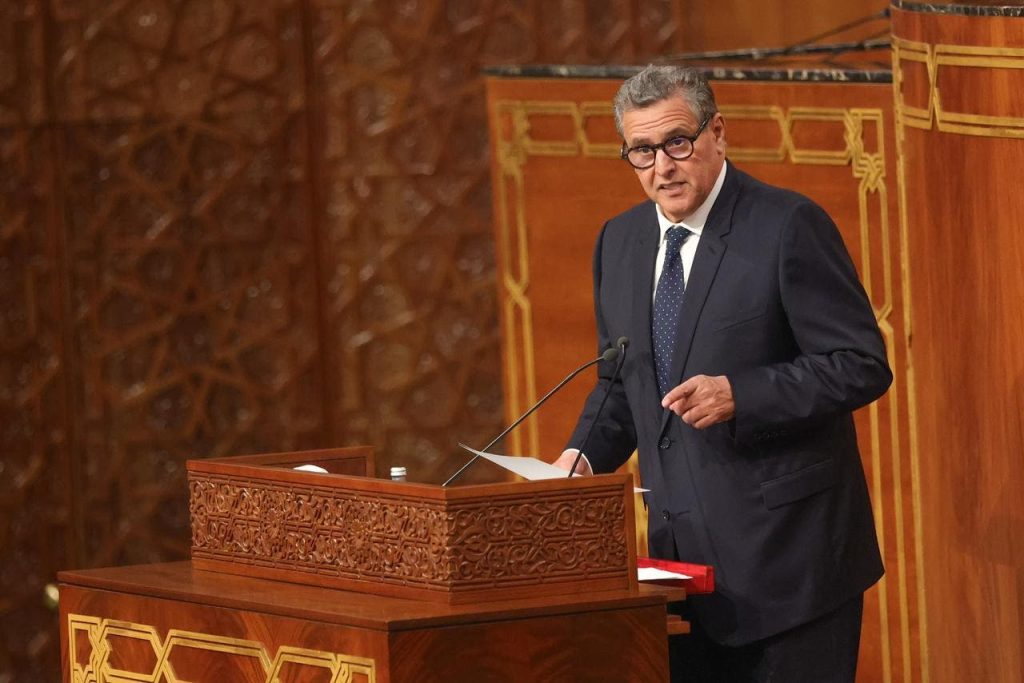
The Head of Government, Aziz Akhannouch, stated in the House of Councilors today, Monday, that King Mohammed VI has been keen, throughout the 26 years of his reign, to build the "rising Moroccan model," through programs and strategies that have achieved many of their set goals.
Akhannouch highlighted, during the monthly question session dedicated to the topic: "Territorial Development and the Challenges of Achieving Spatial Justice," that the King launched a visionary and gradual, yet deep and radical, development path, which made reducing spatial and social disparities between cities and rural areas a strategic and unavoidable goal, pointing out that this path has enabled Morocco to position itself among the leading countries in the continent in the field of balanced and comprehensive development. The government official emphasized that this royal vision made the citizen and the field the basis of the development bet, and greatly enhanced social and economic integration, especially for the population of the rural world, recalling the royal innovation of the National Initiative for Human Development, which he described as "an integrated development project and a unique model," which is based primarily on improving the economic, social, and spatial conditions of vulnerable groups in our country. Akhannouch pointed out that the creative royal vision also led to the adoption of the "Program to Reduce Spatial and Social Disparities in the Rural World," noting that it is considered the largest government investment directed towards rural development in the history of Morocco, with a budget of nearly 50 billion dirhams, targeting more than 1,200 territorial communes and 140 rural centers, encompassing more than 17 million people. He continued that this program, whose guiding principles were established by the King in the Throne Speech of 2015, formed an integrated executive tool and laid the foundations for profound transformations in territorial action, pointing to the government's work since its inauguration to complete its optimal implementation, by directing investment towards areas with the greatest territorial deficit, and ensuring the convergence of sectoral programs according to the specificities of each field, thereby overcoming the logic of fragmentation and isolated sectoral work that prevailed in the past.