HIBAPRESS
The union affiliated with the Moroccan Labor Union (UMT) recorded with satisfaction the response of the State Secretariat to a number of its demands, most notably the decision to increase the compensation granted to all categories of officials and employees of territorial directorates, with a minimum limit for these compensations set at 750 dirhams, starting from the year 2026.
This measure aims to achieve a kind of equality and fairness with the compensation adopted at the central administration level, which enhances the principle of professional justice and values the roles played by frameworks and human resources at the territorial level.
In this context, the Secretary-General of the union praised this positive attention from the State Secretariat, considering that it reflects a genuine will to interact with the union demands, especially in its part related to improving the compensation system.
He also took the opportunity to raise a number of other files that still have priority on the union's agenda, calling for the continuation of dialogue and joint work in order to find practical and fair solutions for them.
At the forefront of these demands, the union emphasized the need to take into account the vastness of the territorial areas when determining compensation, by adopting objective criteria that take into account the specificities of each region and the amount of effort exerted by human resources to implement the programs of the State Secretariat, especially those related to the national register of traditional industry, the framing of craft bodies, the control of exports, vocational training, and continuous training.
It also stressed the importance of establishing clear and transparent mechanisms for organizing the transitional movement of employees, in a way that takes into account their social conditions and professional obligations, and contributes to achieving a balance between the requirements of the administration and the expectations of employees.
Regarding working conditions, the union called for strengthening logistical support for regional and provincial directorates, as well as institutes and training centers, by allocating the necessary appropriations to cover transportation expenses, means of communication, the Internet, and mail, in addition to providing the necessary resources to cover the expenses of water, electricity, fuel, and the maintenance of official cars, while working to increase their value in proportion to the size of the programs outlined at the territorial level.
It also emphasized the need to regularize the legal status of export controllers, ensuring them legal protection while performing their duties, and enabling them to perform their roles in appropriate professional conditions.
In the same context, the union stressed the importance of providing the necessary means of work, foremost of which are official cars for the benefit of regional and provincial directorates and training institutions, which contributes to accelerating the pace of implementing sectoral projects and programs and ensuring their completion within the specified deadlines.
As part of keeping pace with the digital transformation, the union called for organizing training courses for the concerned employees, especially controllers of export operations of traditional industry products, on the use of the digital platform "Portnet", with the provision of the necessary digital equipment and ensuring continuous technical support, in addition to providing appropriate incentives for the employees supervising these operations.
The union also demanded the conclusion of a partnership agreement with the National Office of Railways, which would allow female and male employees of the sector and their family members to benefit from discounts on travel tickets, as part of strengthening the social aspects and improving their professional conditions.
On the other hand, the union praised the issuance of the ministerial circular regarding the activation of the tasks of coordination and follow-up of social and solidarity economy programs at the regional level, stressing at the same time the need to provide the necessary resources and incentives for those in charge of these tasks, with a view to restructuring the administrative organization and establishing specialized regional departments.
The union also reiterated its emphasis on the need to continue efforts to resolve the real estate status of the properties belonging to the State Secretariat, as this is important in improving governance and valuing public assets.
Regarding training centers, the union stressed the importance of raising the level of insurance coverage to include professional risks associated with working inside the workshops, while working to secure the equipment, tools, and infrastructure against various risks, in a way that ensures the safety of trainees and working frameworks alike.
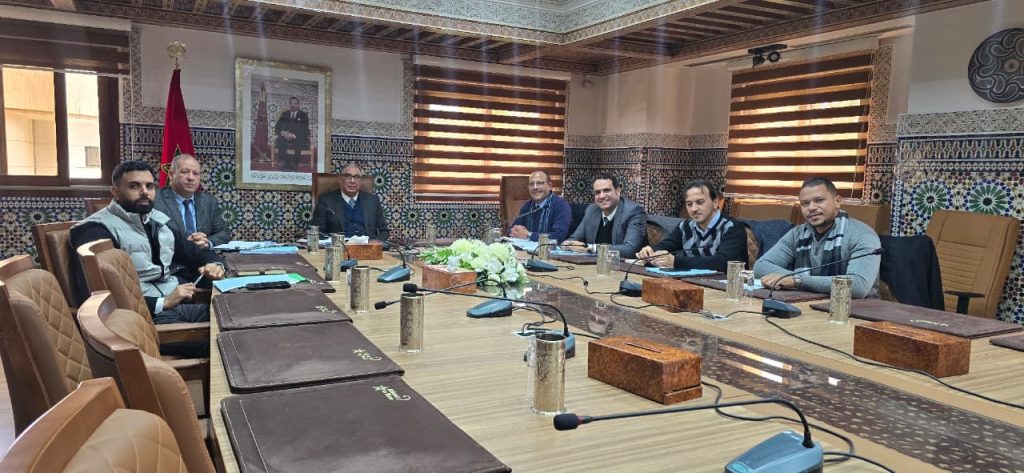
At the conclusion of this meeting, the union affirmed that the State Secretariat's response to a number of demands constitutes a positive and encouraging step, expressing its aspiration to continue the constructive and responsible dialogue in order to resolve the remaining outstanding files, in a way that contributes to improving the professional and social conditions of employees, and enhancing the effectiveness of administrative performance at the territorial level.