HIBAPRESS – Tarik Abla
Not all cities are measured by their size, nor are all bonds confined to geography. Zaiou, in the hearts of its people, represents a special case of renewed belonging, a city that expands the further they are from it, and grows in their memory with the passage of time. From this profound meaning, the Dusseldorf meeting emerged, not as a fleeting event, but as a natural extension of a collective memory that refuses to fade.
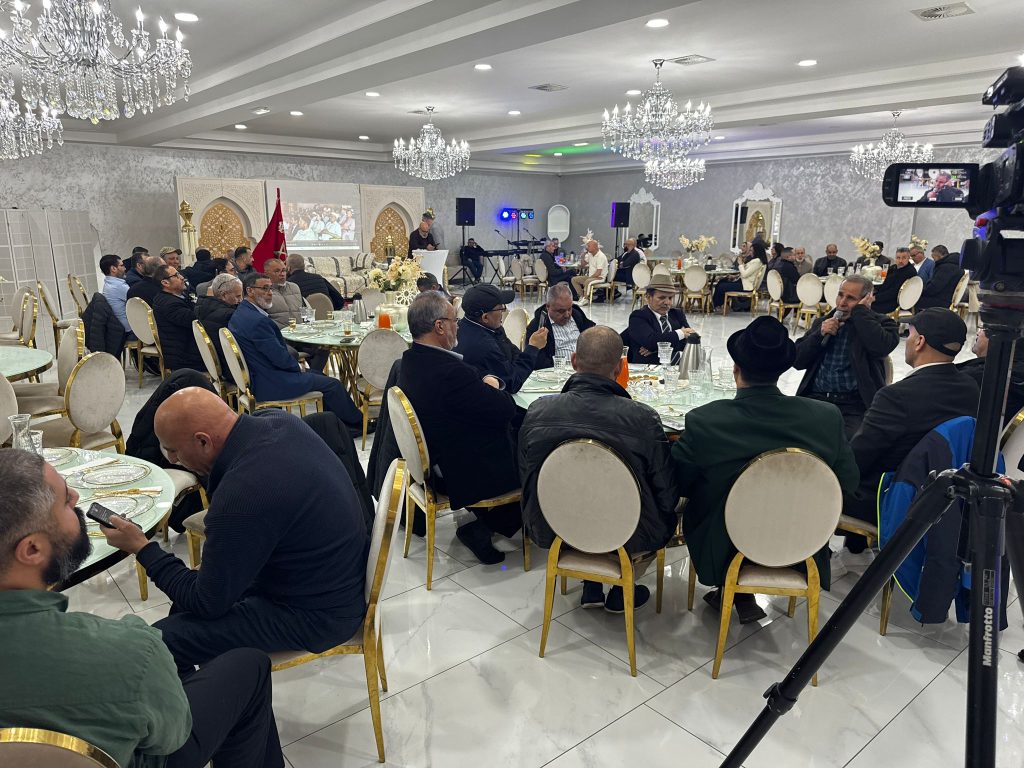
On April 5, 2026, the people of Zaiou chose to meet again, coming to Germany from the Netherlands and Belgium, and from other European locations that did not prevent them from carrying the same passion. Even Morocco was present through faces that crossed the distance to be part of this appointment, which, over the years, has become a tradition that is anticipated more than it is organized. The space that hosted the meeting was not just a hall, but transformed into a temporal mirror. Here, men sat and recalled the features of their childhood, and there, the stories of the first school embraced, with names that never left the memory. On the tables, the conversations were not ordinary, but were a rewriting of a beautiful time, in the form of nostalgia, and with a voice that was not devoid of a slight melancholy. The beginning carried a deep symbolic character, a Quranic recitation opened the door to tranquility, followed by a national anthem performed with full reverence, where standing was not just protocol, but a sincere expression of unchanging attachment. The moment of mercy for one of the group's members who had left for the afterlife, rearranged the feelings inside the hall, confirming that physical absence does not end presence in the memory of the community. Within this context, the institutional dimension was notably present, through the participation of representatives of the Banque Populaire, Abdelilah Benjelloun and Jamal Chatari, who provided precise and direct answers to the questions of those present, on issues related to money, insurance, and banking services. A presence characterized by clarity and listening, and touched the expectations of a wide segment of the community seeking trust and transparency in managing their financial affairs. The words of Farid Lemsahli, the group's president, did not go towards creation, but chose the language of numbers and facts, reviewing the path of social initiatives launched by the group, and reminding that collective work is the real capital of any project that targets the human being before anything else. Amidst this harmonious scene, the role of Arabi Al-Madghari emerged as a dynamic spirit that added special vitality to the meeting. He was not just a facilitator of the paragraphs, but was a real link between those present, touring the hall carrying the microphone, listening attentively to every intervention, and opening the field to everyone without exception. In his style close to the heart, he succeeded in transforming the discussion into an open collective moment, where opinions and suggestions overlapped in an atmosphere of respect and a sense of responsibility. His words, as well as his presence, were saturated with the values of sincere jealousy for the city, and with a deep love for its people, and with a firm belief that the future is built when every voice finds an opportunity to be heard. In another corner of the discussion, the voice of Mostafa Al-Nahari emerged, who did not suffice with the description, but presented practical concepts that could be worked on, posing precise questions to those present about how to transform good intentions into tangible programs that serve Zaiou and open new horizons for development. The female presence, in turn, was not symbolic, but carried a qualitative addition, through the intervention of Malika Al-Marid, who chose to put human dignity at the core of any solidarity initiative, presenting proposals that reflect a deep awareness of the specificity of social work, and the need to stay away from everything that affects the dignity of the beneficiaries. The rhythm of the evening was not constant, it moved between moments of reflection and discussion, and others festive, interspersed with musical performances and a dinner, creating a precise balance between seriousness and friendliness. However, the most honest images were not on the platform, but in those spontaneous embraces that condensed years of absence in a few seconds. What distinguished this meeting was not only the size of the attendance, but that collective feeling that each individual was part of its success. The well-organized organization did not come by chance, but was the result of a conscious collective involvement, which made small details an essential element in the big picture. And before the lights of the hall went out, thinking had preceded everyone to the next appointment. Multiple suggestions were put forward, not only about the place, but about how to develop this meeting to remain faithful to its original spirit, and open at the same time to wider horizons. Thus, the people of Zaiou in the diaspora continue to write a different story, a story that does not rely on nostalgia alone, but turns it into a force of suggestion, and into a collective action that believes that cities are also built from outside their borders, when their people carry them in their hearts wherever they are.