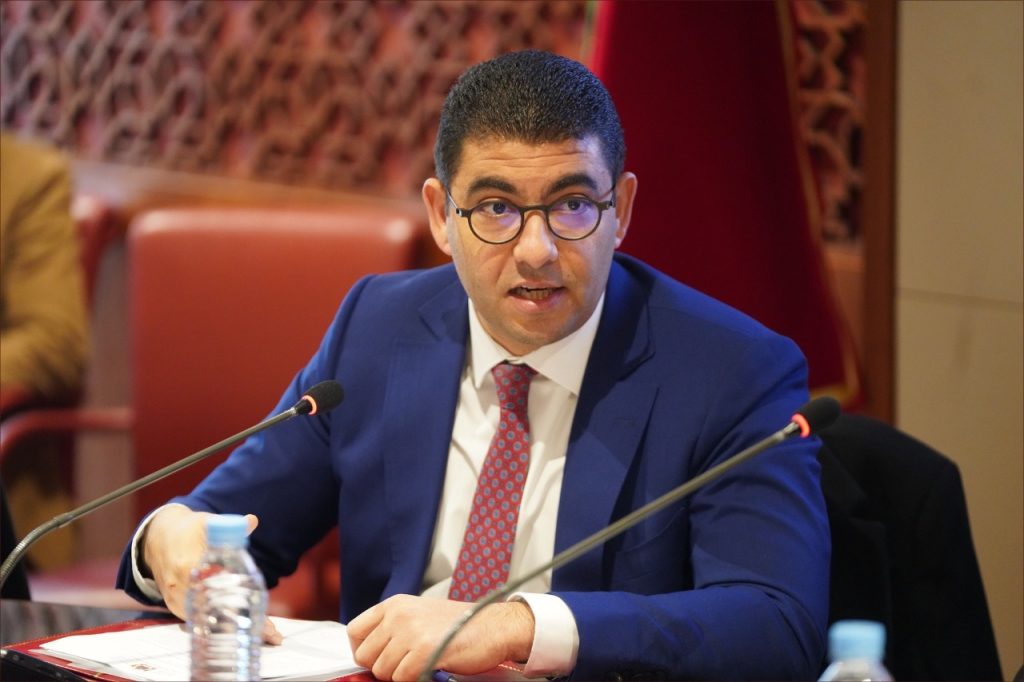
HIBAPRESS reported that the Minister of Youth, Culture and Communication, Mohamed Mehdi Bensaid, said on Tuesday in the House of Representatives that the government had positively interacted with the observations of the Constitutional Court regarding the draft law on the reorganisation of the National Press Council, considering it an "important democratic and constitutional exercise."
Bensaid explained, during a meeting of the Education, Culture and Communication Committee, which was devoted to the general and detailed discussion of the provisions of the draft law, in the context of the interaction with the Constitutional Court's decision No. 261/26 and the resulting reconsideration of a number of mechanisms for organising the profession and the composition of the Council, that this path does not pose a problem, but rather reinforces confidence in the institutions and consolidates the supremacy of the constitution. After he indicated that the previous project was prepared within the framework of a political vision based on extensive consultations that included various actors, the minister recorded that the new text was subject to amendments at two levels, one substantive and the other formal, in a way that ensures greater compatibility with constitutional provisions. He stressed that the main goal of this reform is to ensure the continuity of the work of the National Press Council and to overcome the managerial problems that characterised the previous experience, especially with regard to the management of support and addressing the imbalances related to the daily work of journalists, in addition to keeping pace with the transformations that the sector is witnessing, especially those related to the economic model of press companies. The minister also stressed the need to distinguish between the company and the journalist as a professional actor "who must be enabled to have decent living conditions", as well as correcting some imbalances in representation, especially reducing the numerical balance within the category of publishers (7 instead of 9), and assigning the task of appointment in the formation of the Supervisory Committee to the head of the government, to ensure neutrality "outside the debate of the majority and the opposition". For its part, the majority parties praised the Constitutional Court's decision and considered it an important constitutional and democratic stage in the process of consolidating the supremacy of the constitution, adding that this project comes in a context characterised by a remarkable institutional maturity, embodied in the three-dimensional cooperation between the legislative authority, the government and the constitutional judiciary. It considered that "the government and parliament's compliance with the observations of the Constitutional Court is not just a formal procedure, but rather a consecration of the state of rights and law, and a guarantee that the laws regulating the profession of journalism are consistent with the text and spirit of the constitution." The majority also positively recorded what the project brought at the level of enhancing the efficiency of the National Press Council and clarifying its roles and working mechanisms, "making it able to keep pace with the rapid transformations that the media field is witnessing, especially in light of the digital revolution", stressing that it "embodies a clear will to strengthen the principle of self-organisation of the profession and consolidate the independence of its institutions in line with the spirit of the constitution." The majority of the deputies invoked what the draft law represents in terms of a "regulatory arsenal to set clear controls for entering the profession and defining the status of the professional journalist", in a way that ensures a balance between the principles of freedom and responsibility, which is "what the Constitutional Court emphasised, which considered that granting the Council the authority to develop a code of ethics for the profession a sound constitutional mandate, provided that these ethics ensure the service of the citizen's right to free, fair and responsible information." In contrast, the opposition parties considered that the new text "still lacks provisions that actually embody the principle of free and independent self-organisation of the press and publication, as is known in best practices and experiences", despite what the Constitutional Court's decision sought, in interaction with the parliamentary referral, to consolidate a legislative trend aimed at ensuring balance within the composition of the Council and enhancing representative pluralism. It pointed out that, despite what the project has corrected from an imbalance in the balance in the numerical representation between journalists and publishers, in light of the Constitutional Court's decision, it has adopted a mechanism based on a representative threshold of 10 percent for publishers, "which would practically lead to a reduction in pluralism or the re-production of indirect hegemony of certain groups on the Council." The opposition deputies recorded that this provision contradicts "the principles of pluralism and proportional representation", considering it "a circumvention" of the spirit of the constitutional decision that "explicitly rejected any formula that leads to the monopoly of one professional organisation for all seats". The opposition also renewed its rejection of the mechanism of recruiting publishers instead of elections, considering it a choice that does not enshrine "the principle of professional legitimacy and independence". In the same context, the opposition parties raised the linking of the representation of publishers to the turnover figure, considering that this "represents a tendency towards a purely economic logic, which would threaten pluralism and open the way for the hegemony of the financially stronger actors." They stressed that the foundation for the future of self-organisation for journalists "is dependent on the work we are doing today as parliamentarians".