HIBAPRESS – Abdellatif Baraka
The transportation system in the Souss-Massa region is experiencing increasing disruptions, with taxi stations and several connection points between cities turning into long waiting spaces that burden thousands of citizens daily.
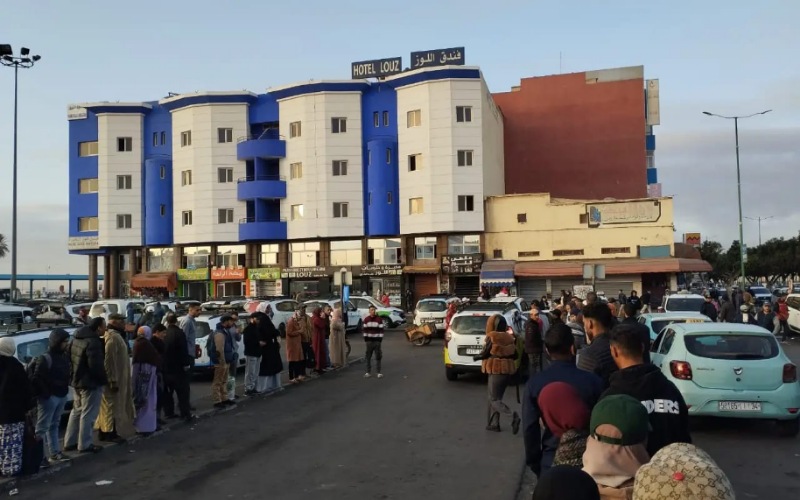
In the cities and provinces of the region, especially Agadir, Inezgane, Chtouka Ait Baha, Tiznit, and Taroudant, the sight of queues and congestion has become a daily headline for the suffering of transportation that affects students, employees, patients, and users of public administrations. With the early hours of every morning and evening, long lines form at taxi stations linking the region's cities and provinces, amid the limited supply compared to the increasing demand, which forces citizens to wait sometimes for hours, especially during peak times and at the beginning and end of the week. This situation is not limited to specific intermediate lines, but rather includes the entire transportation network within the region, in light of rapid demographic growth and urban expansion that has not been accompanied by an effective and integrated public transport policy. The complaints of citizens are not limited to transportation between cities only, as the congestion extends to urban transport within the major and medium-sized cities in the region, where users complain of the lack of buses, the irregularity of schedules, overcrowding inside vehicles, and the weak connection between the peripheral neighborhoods and vital service centers. These imbalances directly affect daily life, as students find themselves threatened with being late for school, employees are forced to leave their homes early to avoid being late for work, while patients face difficulties in keeping their medical appointments. Observers of local affairs believe that the current crisis goes beyond being a technical problem to a social dilemma that affects the right to transportation and equitable access to education, health, and administrative services. They also warn against the continuation of the logic of makeshift management that is satisfied with circumstantial measures that do not address the roots of the problem, at a time when the region needs a new and comprehensive vision for transportation between and within cities, based on integrated planning and investment in structured public transport. Among the solutions being discussed are establishing direct and regular regional bus routes connecting the various provinces with economic and administrative attraction centers, strengthening the urban transport fleet, and improving the quality of services within cities, in addition to reorganizing taxi stations and controlling their operation to ensure better flow and reduce waiting time. Civil society actors also call for launching a participatory dialogue that brings together regional and local authorities, professionals, and representatives of civil society, in order to develop sustainable solutions that keep pace with the demographic and economic transformations that the region is witnessing. In light of the current situation, the question remains pending for thousands of citizens: when will the promises be translated into practical measures that restore their right to decent and safe transportation? The wasted waiting time is not just minutes lost in queues, but rather a daily cost that burdens study, work, and treatment, and deepens the sense of marginalization among large segments of the population of the Souss-Massa region.