HIBAPRESS – Abdelatif Baraka
Relations between Madrid and Washington are heading towards a more tense phase, after the US administration under Donald Trump began rearranging the rules of its dealings with Spain within international institutions, most notably the G20, in a move that carries political dimensions beyond mere representation in economic meetings.
Spain, which has held the status of a permanent guest in the G20 since 2008, has accumulated regular presence in the group's summits and meetings over the years, despite not being an official member. However, new data reveals a clear reduction of this privilege during the current US presidency, as Washington chose to exclude Madrid from the "permanent guest" status during the upcoming Leaders' Summit, which means preventing its participation in the summit's proceedings.
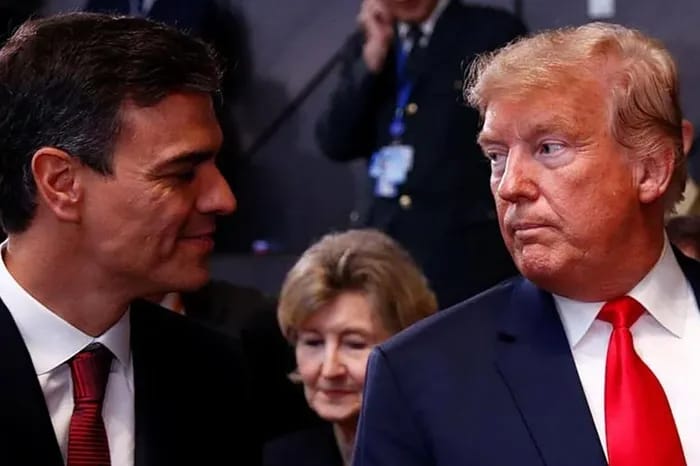
This development cannot be separated from the tense trajectory of US-Spanish relations in recent months. Trump has sharply criticized Pedro Sánchez's government, particularly regarding defense spending within NATO. The tension also reached US threats to halt trade exchanges with Spain last July, before the rhetoric later softened.
The sensitivity of the dispute is increased by the Spanish position on the war with Iran, after Madrid adopted more independent stances from Washington regarding the conflict, which put Sánchez's government in direct confrontation with the US administration's priorities in the region.
Recent developments confirm that the dispute is no longer confined to the defense file or military spending, but has begun to touch upon the nature of the political and strategic partnership between the two countries.
As for the G20 summit, the issue carries significant symbolic meaning. Washington seems determined to redefine the list of invitees and reduce the number of countries it grants participation privileges as a guest, within a new American vision for the group that is more focused on economy, energy, and technology, and less open to the traditional agenda.
Specialized analyses have confirmed that the Trump administration is moving towards adopting a "new G20" with a narrower list of guests. Therefore, treating this development as "expelling Spain from the G20" might be an exaggeration legally, but it does not negate the political dimension of the American message.
What is important is not Spain's membership, but the decline of the privilege it obtained since 2008, and the transformation of its participation from a semi-permanent status to participation subject to the decision of the host country.
Sánchez's government, on the other hand, finds itself facing a difficult equation. It is trying to maintain its decision-making autonomy on sensitive international issues, while at the same time needing to keep communication channels open with Washington, especially since the United States remains a key partner for Spain within NATO and in security, military, and economic fields.
The talk that the issue of the occupied cities of Ceuta and Melilla is directly behind the US decision requires more caution. There is no reliable evidence in the available public data to prove that Washington has taken its stance on Madrid because of the two occupied cities. Therefore, linking the two issues remains within the framework of political interpretation rather than a proven fact.
However, what is certain is that the relationship between Trump and Sánchez has entered a real test phase. The tension over defense, the dispute over Iran, the trade threats, and then the reduction of Spain's presence in some G20 meetings are all indicators that paint a picture of a relationship no longer operating according to the rules of the same traditional alliance.
The question that now arises is whether this is a fleeting disagreement between Trump and Sánchez, or the beginning of an American repositioning towards Spain.
If Washington continues to use diplomatic and economic privileges as tools of pressure, Madrid may find itself facing a new phase of relations with its American ally, a phase in which Sánchez's government will have to carefully balance its foreign decision-making autonomy with the cost of distancing itself from Washington.
In this context, what happened within the G20 may be nothing more than an early political signal that the Trump administration wants Spain to recalculate its position before the disagreements move to more sensitive files that affect the future of relations between the two countries.
It is expected that in the coming months, the issue of the occupied cities of Ceuta and Melilla will enter the agenda of the United States of America, after the administration has centrally adopted this file and placed it on Trump's table to begin discussions according to the available diplomatic agenda, which does not exclude the possibility that the file might be adopted by the International Court, as it falls within the framework of decolonization for Spain in Africa, and Madrid could lose the file internationally after the criticisms directed at it in this regard.