HIBAPRESS – Ahmed Al-Masaad
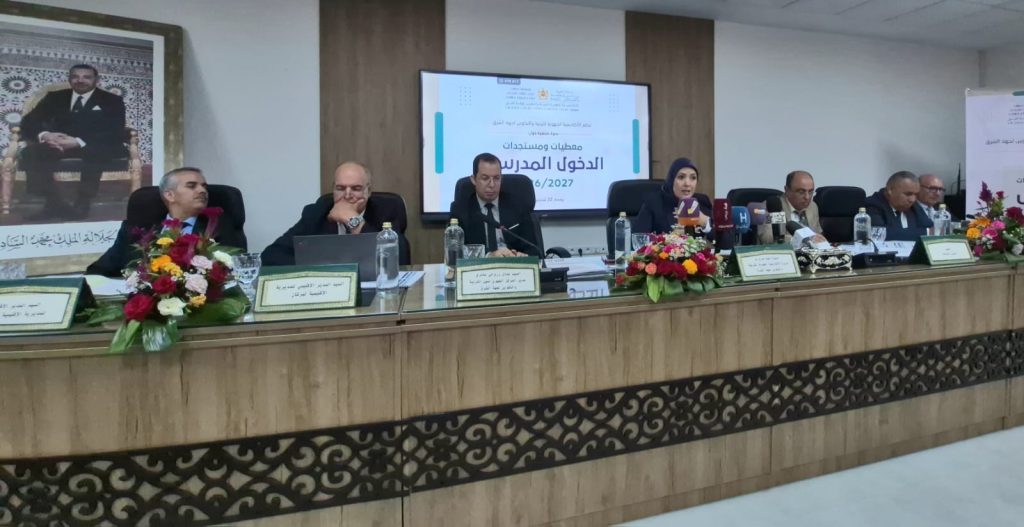
The Regional Academy of Education and Training for the Oriental Region organized a press conference on Tuesday, September 21st, chaired by Mounia Mozouri, the Academy's Director, with the participation of regional directors. The conference focused on shedding light on the data and developments recorded with the start of the new academic year 2026/2027.
The Academy Director presented a detailed presentation with statistics and updates. The actual start of studies for the academic year 2026/2027 has commenced in various educational institutions affiliated with the Regional Academy of Education and Training for the Oriental Region, in an educational atmosphere characterized by collective mobilization and responsible preparation.
Public education institutions in the region are expected to receive a total of 441,739 male and female students across different educational levels, in addition to 58,300 children in early childhood education.
This school year marks a crucial milestone in continuing the implementation of educational system reform initiatives, enhancing the quality of learning, consolidating equity and equal opportunities, reducing school dropout, and improving reception conditions and school life.
The Academy and its regional directorates, in close coordination with their partners, have worked to mobilize human and logistical resources, rehabilitate spaces and equipment, and manage various operations related to the school map, new registrations, re-registrations, class schedules, as well as placement assessments and intensive support booklets in pioneering institutions, ensuring a smooth and safe educational start.
In line with efforts to generalize early childhood education and improve its quality, considered a fundamental entry point for achieving equity and improving educational pathways from the early years, it is expected that 58,300 children will benefit from it. They will be distributed across 3,030 public classes, with 2,319 classrooms mobilized in public early childhood education, including 162 new classrooms. This is alongside the continuation of training, strengthening educational supervision, and monitoring the quality of services provided to children.
As part of the continued expansion of the pioneering institutions project in the primary cycle, the number of participating institutions has reached 617, after the program was extended to include an additional 184 institutions and 81 sub-units. This will enable 189,688 male and female students to benefit, which is equivalent to 83% of the total students in this cycle.
This model is based on strengthening the mastery of fundamental learning, developing classroom practices, enhancing support mechanisms, and providing an educational environment that encourages initiative and creativity.
At the middle school level, the number of pioneering middle schools has reached 110 institutions, after the network was expanded by 40 additional middle schools, benefiting 79,871 male and female students, representing 63% of the total students. This model, in addition to strengthening the mastery of fundamental learning and developing classroom practices, relies on a system for monitoring and supporting students at risk of dropping out, alongside extracurricular and sports activities that contribute to personal development, skill enhancement, and integration into school life.
Regarding the enhancement of the school offer and improvement of reception conditions, Mozouri confirmed that 13 new educational institutions have been established, bringing the total number of educational institutions to 1,020, including 455 in rural areas. These are distributed across the cycles as follows: 700 primary institutions, 192 middle schools, and 128 preparatory schools. Existing institutions have also been expanded by adding 159 additional classrooms, including 77 in primary, 40 in middle, and 42 in preparatory schools, contributing to expanding capacity, bringing educational services closer, and improving learning conditions.
In the area of strengthening social support programs and consolidating equity and equal opportunities, the total number of boarding facilities in the region is 129. It is expected that 26,067 beneficiaries will receive accommodation and catering services, including 11,825 beneficiaries of the full scholarship and 14,242 beneficiaries of meals, which supports consistent schooling and reduces dropout rates.
Regarding school transportation services, and thanks to the efforts of the Academy's partners in strengthening its fleet and improving its governance, approximately 47,648 male and female students are expected to benefit, including 24,682 females, through a fleet comprising 887 buses.
Concerning human resource management, the educational and administrative structures in the region have been strengthened by the appointment of 1,042 new teaching staff. The total number of human resources has reached 25,556, including 21,523 teaching staff. The Academy and regional directorates have managed human resource operations, redeployment, and needs assessment to ensure the provision of necessary staff and the stability of educational structures in various educational institutions.
To ensure the best conditions for the success of the 2026/2027 school year, the Academy Director chaired a series of coordination and communication meetings with various internal and external stakeholders of the system. These meetings were dedicated to monitoring the progress of planned measures, identifying constraints, accelerating their resolution, and assessing the readiness of educational institutions in terms of structures, equipment, human resources, and support services.
Field monitoring and vigilance mechanisms have also been strengthened, both through coordination with territorial authorities, elected councils, and various partners, and through regional and local committees to follow up on student registration and reception processes, ensuring the smooth start of the academic year and providing a safe and motivating school environment for learning and success.
At the conclusion of her presentation, the Director of the Regional Academy of Education and Training for the Oriental Region presented these preliminary data on the back-to-school period. She expressed her deep appreciation for the positive engagement of all administrative and educational staff, local authorities, security agencies, elected councils, parent associations, civil society actors, and various media representatives.
She reiterated her call for continued collective mobilization to ensure the success of the 2026/2027 academic year and achieve the desired impact on student learning and their academic pathways.